
Timing Models – Nasdaq 100 Breadth Model Carries the Day as Intermediate Uptrends Dominate

Today we will dive into long-term and short-term breadth models using the same indicators for four different indexes. These models cover the Nasdaq 100, S&P 500, S&P MidCap 400 and S&P SmallCap 600. Looking at a market of 1500 stocks, the evidence is mixed, at best. Three of the four long-term models are net bearish and all four short-term models are net bullish.

Even though the S&P 500 long-term breadth model is net bearish, the Nasdaq 100 model is bullish and NDX stocks carry a lot of weight in the S&P 500. Thus, breadth for the big boys is clearly stronger. Before looking at breadth though, I will cover the intermediate uptrends and three indicators to watch. This is the dominant force at work right now and the S&P 500 is heading for new highs as long as the intermediate evidence remains bullish.

Intermediate Term Uptrends Dominate

The intermediate uptrends are the dominant forces at work right now. These uptrends began with the surge in late March and are continuing into mid June. Perhaps they are stalling the last two weeks, but they have yet to reverse.

SPY, QQQ, and IWM are in uptrends since late March, yet all three are at different places. QQQ is leading, IWM is lagging and SPY is somewhere in the middle (cue Stealers Wheel). QQQ hit a new high, SPY managed to exceed its 200-day and IWM turned back at its 200-day.

The first chart shows SPY finding support in the 300 area, reversing during the day on Monday and surging on Tuesday. This surge is short-term bullish and holding. A move below 305 would negate the surge and a move below 295 would break short-term support.

The second chart shows QQQ surging on Tuesday and this surge is holding. A close below 238 would negate the surge, while a close below Monday’s low would break support and forge the first lower low since late February.

The next chart shows IWM with a long white candlestick on Monday and surge on Tuesday. IWM fell back more than the other two, but this surge is largely holding. In contrast to SPY and QQQ, IWM has a rising wedge working. Even though rising wedges are typical for corrective advances, I will respect the intermediate uptrend as long as the wedges rises. A close below Monday’s low would break support and reverse the intermediate uptrend.

These three ETFs capture the major food groups for the stock market. All three established short-term support with reversals and bounces the last four days. Uptrends rule as long as support holds. Breakdowns in these three would reverse the intermediate term uptrends.

Three Intermediate Term Indicators to Watch

First, the three High-Low Lines continue to drift higher. The S&P 500 and S&P MidCap 400 High-Low Lines turned up in late April and continue to work their way higher. The S&P SmallCap 600 High-Low Line turned up in late May. The rise is not very steep or strong because the total number of new highs remains relatively low. High-Low Percent has not been above +6% since February. Nevertheless, there are more new highs than new lows and this supports the intermediate term uptrend.

The next chart shows SPY with 20-day High-Low Percent turning bullish on May 18th and staying bullish during last week’s sharp decline. High-Low Percent hit -9.6% last week and did not trigger bearish, which requires a move below -10%. Even though 20-day highs have been negligible the last three days, the indicator does not turn bearish until there is a material spike in 20-day lows.

The third chart shows the Bullish Percent Indexes for the S&P 500, S&P 100 and Nasdaq 100. There is some overlap in these three, but we can reduce whipsaws by using them as a group. All three triggered bullish on March 26th and this was one of the earliest bull signals. $BPSPX dipped below 40% in mid May, but $BPOEX and $BPNDX held and did not confirm the signal. All three are well above 60% and bullish right now. A bearish signal would trigger if two of the three break below 40%.

The Bullish Percent Indexes measure the percentage of P&F breakouts. In Point & Figure lingo, a stock has either a double top breakout (higher high) or double bottom breakdown (lower low) working. The Bullish Percent Indexes capture this by quantifying the percentage of double top breakouts. Right now there are way more double top breakouts. A move below 40% in the BPIs would show a material decrease in double top breakouts, which would imply an increase in double bottom breakdowns (lower lows).

Bullish versus Bearish Run Down

Here is a bullish/bearish run down of current signals for several indicators and a few events.

Bullish Indicators

  • 26-Mar: SPX, OEX, NDX Bullish% Indexes exceed 60%
  • 9-Apr: Mid-cap short-term breadth model turns bullish
  • 9-Apr: Small-cap short-term breadth model turns bullish
  • 24-Apr: At least 2 of 3 High-Low Lines Rising (SPX, MID)
  • 29-Apr: S&P 500 short-term breadth model turns bullish
  • 29-Apr: Nasdaq 100 short-term breadth model turns bullish
  • 18-May: 20-day High-Low Percent for SPX turns bullish
  • 20-May: Nasdaq 100 long-term breadth model turns bullish
  • 29-May: S&P 500 5-day SMA moves above 200-day SMA
  • Nasdaq 100 and Technology sector leading
  • Yield Spreads back to 2019 Levels
  • Fiscal Stimulus
  • Monetary Stimulus

Bearish Indicators

  • 11-June: S&P 500 long-term breadth model turns bearish
  • 10-June: Mid-cap long-term breadth model turns bearish
  • 25-Feb: Small-cap long-term breadth model turns bearish

S&P 500 Long-term Breadth Model Remains Net Bearish

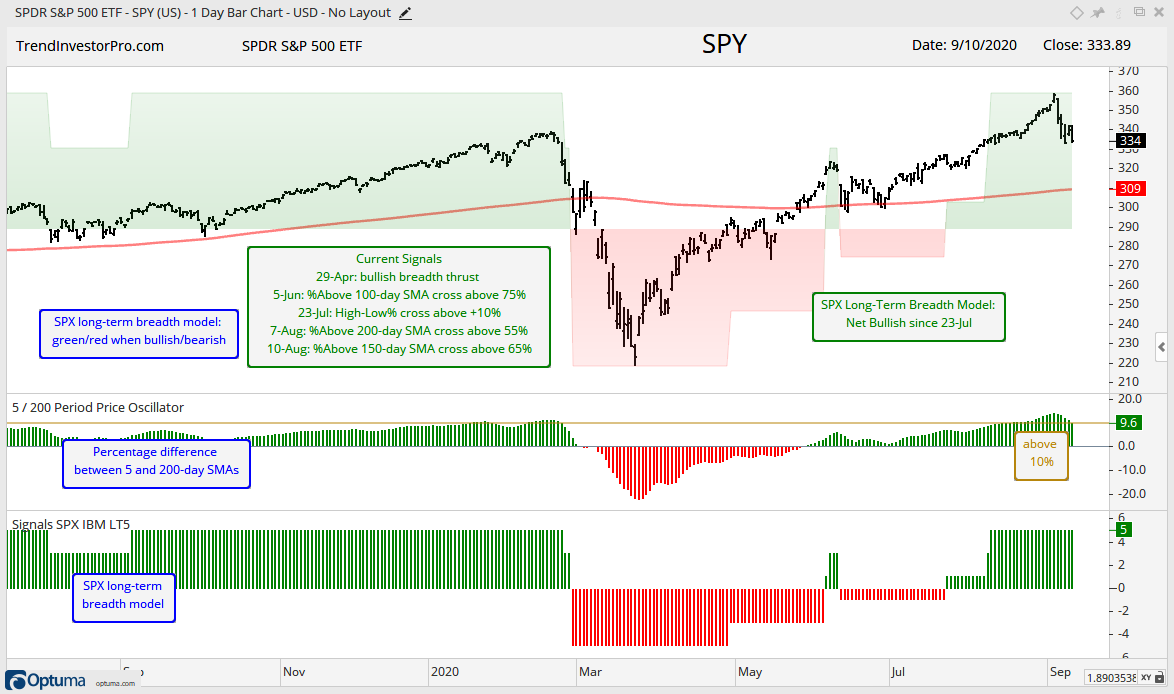
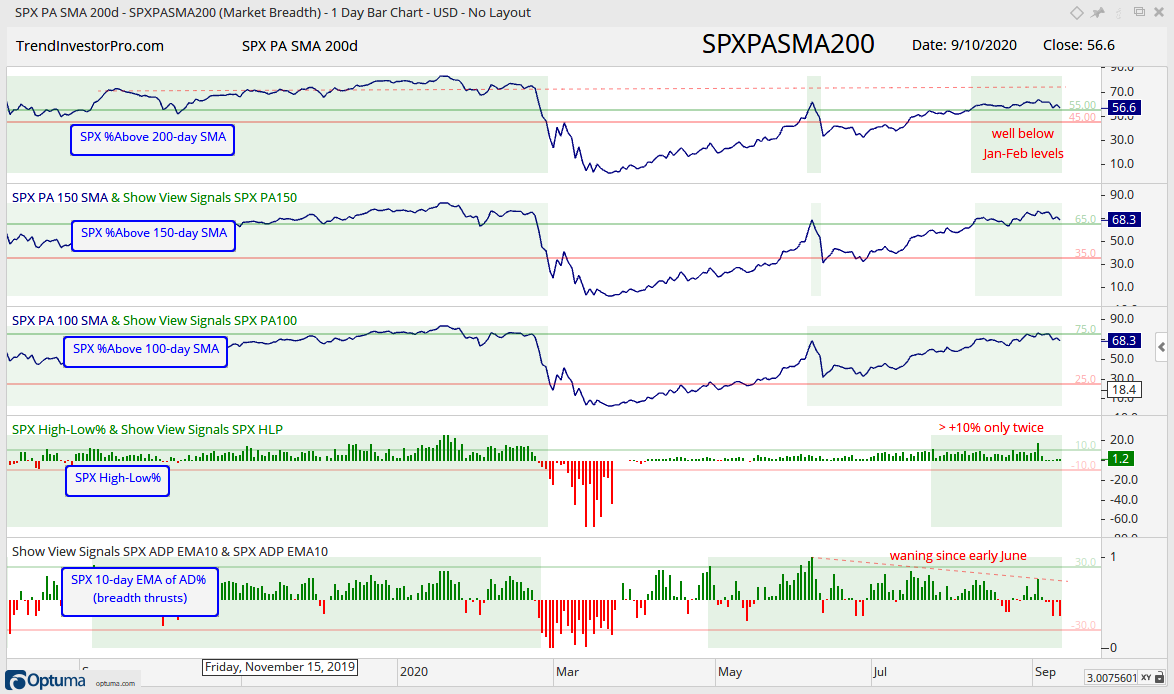
Three of the five indicators for the S&P 500 long-term breadth model are on active bearish signals. In fact, the three indicators with the longest timeframes are bearish. As the red lines on the chart show, SPX %Above 150-day SMA moved below 35% and SPX %Above 200-day SMA moved below 45% last week. High-Low Percent triggered bearish in late February with a move below -10% and has yet to recover. SPY is above its 150 and 200 day SMAs, but less then 42% of its components are above these same SMAs.

These charts are not linked, but you can find comparable charts from StockCharts at the end of this commentary with links.

The next chart shows SPY with the 5 and 200 day SMAs, the percentage difference between these SMAs, the long-term breadth model signals and the short-term breadth model signals. The long-term breadth model caught the February reversal in timely fashion, but missed the April-May advance and did not turn bullish until June 5th. This turned out to be a whipsaw as it flipped back to bearish on June 11th. It currently stands at -1 with three bearish signals and two bullish signals.

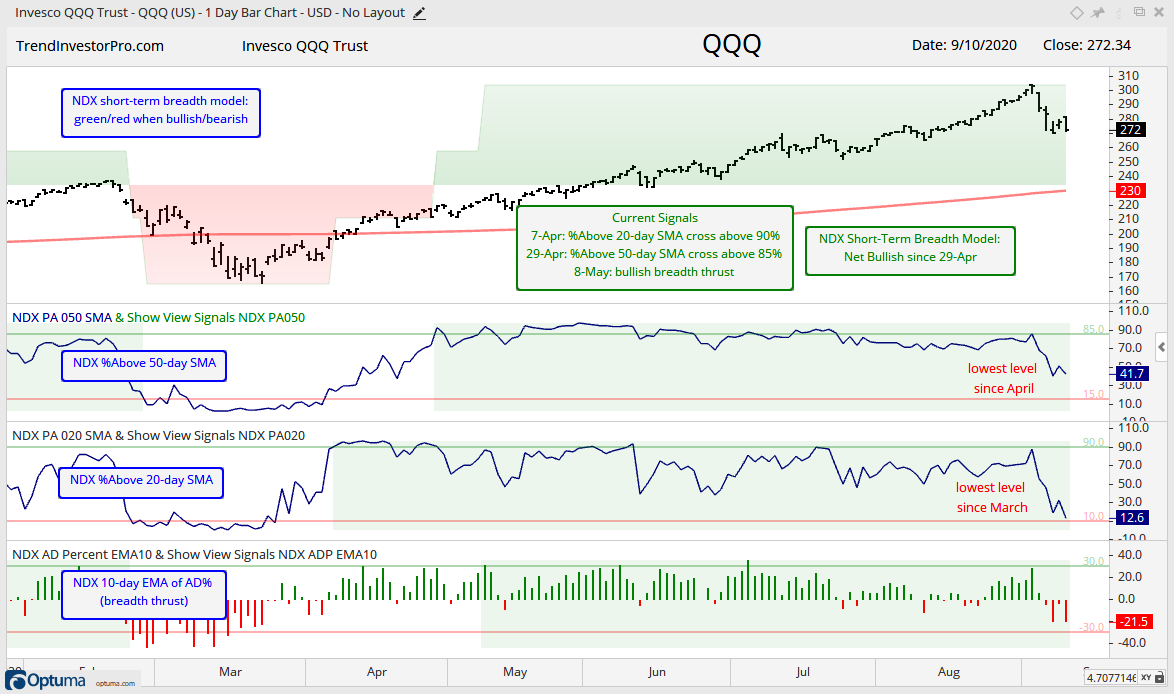
The short-term model is based on the 10-day EMA of SPX Advance-Decline Percent and two other thrust indicators. SPX %Above 20-day SMA triggers bullish with a thrust above 90% and bearish with a plunge below 10%. SPX %Above 50-day SMA triggers bullish with a thrust above 85% and bearish with a plunge below 15%. The short-term model turned net bullish at the end of April and remains bullish (+3).

About the Long-term Breadth Model

The long-term breadth model is based on data from Norgate and shown using Amibroker software. Norgate has breadth data going back to 2001 and the indicators are based on prices that are not adjusted for dividends, which is the industry standard. There is nothing wrong with StockCharts’ breadth. I just prefer using unadjusted data for breadth and need more history for testing. The list below shows the indicators with their thresholds.

  • 10-day EMA of SPX Advance-Decline Percent: Bullish breadth thrust with move above +30% and bearish thrust with move below -30%
  • %Above 100-day SMA for S&P 500 Stocks: Bullish with move above 75% and bearish with move below 25%
  • %Above 150-day SMA for S&P 500 Stocks: Bullish with move above 65% and bearish with move below 35%
  • %Above 200-day SMA for S&P 500 Stocks: Bullish with move above 55% and bearish with move below 45%
  • S&P 500 High-Low Percent: Bullish with move above +10% and bearish with move below -10%

The bullish/bearish thresholds for the middle indicators increase at the same rate (plus/minus 10) as the moving average increases by 50 days. This is a trend-following type model that turns bullish as percentage of stocks in uptrends increases, new highs increase and a breadth thrust is present. The model is bullish when at least three of the five indicators are on bullish signals and bearish when at least three of the five are on bearish signals. It is never neutral because there are an odd number of indicators.

Testing suggests that the long-term breadth model performs best when combined with a trend indicator for the S&P 500, such as the 5/200 day SMA cross. A bullish signal triggers when the breadth model is positive AND the 5-day is above the 200-day. A bearish signal triggers when the breadth model is bearish OR the 5-day SMA is below the 200-day SMA.

Nasdaq 100 Breadth Model is Bullish

Some 82 stocks in the Nasdaq 100 are also part of the S&P 500. Thus, around 16% of stocks in the S&P 500 are also in the Nasdaq 100. These 82 stocks, however, have a bigger influence when weighted by market cap. These 82 stocks account for around 40% of the S&P 500. The top four Nasdaq 100 stocks (MSFT, AAPL, GOOGL, AMZN) account for 19% of SPY and 41% of QQQ.

With Norgate and Amibroker, I was also able to build a model specific to Nasdaq 100 stocks. The model uses the same indicators applied to stocks in the Nasdaq 100. The long-term model turned bullish on May 20th and remains bullish with 5 of 5 indicators on bullish signals (green 5). The short-term model turned bullish on April 29th and remains bullish (green 3). Also notice that the 5-day SMA for QQQ crossed the 200-day SMA way back on April 14th.

Even though the S&P 500 breadth model is net bearish, the Nasdaq 100 breadth model is firmly bullish and these stocks are big drivers for the S&P 500. Thus, the S&P 500 is mixed right now with some pockets of serious strength (tech) and some pockets of relative weakness (finance).

Sector Breadth Model Remains Bullish

Norgate does not have sector breadth data so I will stick with StochCharts’ for the sector breadth table. We can also see why this table is bullish when the five S&P 500 indicators are net bearish. The three biggest sectors are bullish with all three indicators on bullish signals. These three account for over 50% of SPY. Among the other eight sectors, five are net bearish and three are net bullish. The Consumer Discretionary and Finance sectors are net bearish, but the Industrials sector is net bullish. This is why we have a mixed market.

Small and Mid Cap Models Bearish

I also built a model for the S&P MidCap 400 and S&P SmallCap 600 using the same indicator set and same bullish/bearish thresholds. The first chart shows the long-term model for MDY flipping bullish for two days and then back to bearish on June 10th. The short-term model turned bullish on April 9th as mid-caps led the April charge. On the price chart MDY is battling its 200-day SMA and the 5-day SMA is just below the 200-day.

The long-term breadth model for small-caps turned bearish in late February and has yet to turn bullish. Currently three of the five indicators are on bearish signals. The short-term breadth model turned bullish on April 9th and remains bullish. On the price chart, IJR turned back at its 200-day the last two weeks and the 5-day SMA remains below the 200-day SMA.

Yield Spreads and Fed Balance Sheet

The AAA and BBB bond spreads are back to pre-crisis levels, the 2019 highs. Both fell from mid May to mid June and this facilitated a rally in stocks.

Junk bond spreads also fell with two distinct moves: the first from mid March to mid April and the second from mid May to mid June. Stocks took their cue from improvements in the credit market and rallied during these two periods.

Overall, it is bullish (for stocks) that bond spreads are back to pre-crisis levels. Spreads will not become a negative influence on stocks unless they start to widen again.

The Fed balance sheet actually contracted this week, and by a sizable amount ($74 billion). This is the largest decrease in over a year. I would not consider a one week decrease as bearish because the Fed unleashed some $3 trillion into the system in March, April and May.

Thanks for tuning in and happy Friday!

Here are some comparable breadth indicator charts from StockCharts.

ETF Ranking and Grouping – Intermediate Uptrend Dominates the Charts – Focus on GLD and TLT

The intermediate trend is the dominant force at work for most stock-related ETFs and this trend is up. This is basically the uptrend from late March to mid June. The bears fired a shot across the bow last week with a sharp decline, but the bulls answered with a reversal day on Monday and pop on Tuesday. Most importantly, price action on Monday-Tuesday affirmed support for several ETFs and established a reaction low for others.

ETF Ranking and Grouping – Intermediate Uptrend Dominates the Charts – Focus on GLD and TLT Read More »

SPY Update and the
Preferred Moving Average Combo

This is just a short update for SPY and a decision on the preferred moving average combo for the S&P 500. After a plunge on Thursday, stocks firmed on Friday and forged an intraday reversal on Monday. This firmness is occurring near short-term support for many ETFs and the major index ETFs held their intermediate uptrends, which have been in place since late March. Small-caps, housing, biotech, gold miners and corporate bonds led the advance.

SPY Update and the
Preferred Moving Average Combo
Read More »

Weekend Video – Breadth Model Indicators, the SPY/TLT Reversals and the ChartBook

Today’s weekend video starts with the indicators that make up the breadth model and their individual signals. We then add some basic market timing and show the model signals over the last 20 years. I will also provide a preview of a short-term breadth model. Attention then turns to potential reversals in SPY and TLT, the rising wedges in RSP and IWM, the StochClose rankings and the ChartBook

Weekend Video – Breadth Model Indicators, the SPY/TLT Reversals and the ChartBook Read More »

Timing Models – Here we Go Again – Models Flip as Outsized Declines Hit Key Areas

Stocks took it on the chin Thursday with the biggest weekly decline since declines began (March). Once again, small-caps and mid-caps led the way lower with outsized declines. Even more disconcerting, we saw outsized declines in some key large-cap sectors as the Consumer Discretionary SPDR fell over 5%, the Industrials SPDR fell over 8% and the Finance SPDR fell 7%.

Timing Models – Here we Go Again – Models Flip as Outsized Declines Hit Key Areas Read More »

ETF Ranking and Grouping – Volatility and Risk Remain High as Bonds and Gold Perk Up

The broader environment for stocks is technically bullish, but risk remains well above average. The S&P 500 moved above its 200-day SMA and the 5-day SMA moved above the 200-day SMA. The %Above 50-day SMA indicators surged above 80% to trigger bullish and the Index Breadth Model based on StockCharts data triggered bullish on June 5th with five of nine indicators on bullish signals. That’s the bullish part.

ETF Ranking and Grouping – Volatility and Risk Remain High as Bonds and Gold Perk Up Read More »

Knowing When to Add Risk and When to Reduce Risk

The S&P 500 is the most widely used benchmark for the US stock market and the 200-day SMA is perhaps the most widely used moving average. These two came together again in late May as the index crossed back above on May 27th. Today we quantify the performance of prior signals and show how a little smoothing can go a long way. Furthermore, a simple market timing mechanism can tell investors when to add risk and when to seek alternatives to stocks.

Knowing When to Add Risk and When to Reduce Risk Read More »

Models and Weekend Video – Breadth Model Flips as Participation Widens and Yields Spreads Plunge

It was a big week on Wall Street as stocks surged with the biggest weekly gains since the initial lift off started (late March and early April). Small-caps and mid-caps led the way with gains exceeding 8%. Large-caps lagged as SPY gained a measly 5% and QQQ advanced a paltry 2.71%. These moves triggered

Models and Weekend Video – Breadth Model Flips as Participation Widens and Yields Spreads Plunge Read More »

Testing a Medium-term Breadth Thrust Strategy and Adding a Timing Mechanism to Soften the Blow

The market is a forward looking beast and we are seeing some pretty strong signals from short-term and medium-term breadth indicators. The long-term breadth indicators, however, are still lagging and have yet to trigger. Today I will put a medium-term breadth model to the test and show how to improve results with a simple timing mechanism.

Testing a Medium-term Breadth Thrust Strategy and Adding a Timing Mechanism to Soften the Blow Read More »

Weekend Video – Short-term Breadth Indicators to Watch, ChartBook and Yield Spreads

Today’s video will start with a 16+ year backtest of a slightly modified version of the Index Breadth Model. These results will be compared to buy-and-hold and a 5/200 cross for the S&P 500 SPDR. I will then review the current signals in the StockCharts breadth indicators. The upswing since late March dominates right now so

Weekend Video – Short-term Breadth Indicators to Watch, ChartBook and Yield Spreads Read More »

Market Timing Models – Backtesting Breadth Signals and Focusing on the Big Swings

Today we will dive into breadth indicators and test a modified version of the Index Breadth Model here at TrendInvestorPro. First, however, I will review the S&P 500 SPDR as it toys with its 200-day SMA here at month end. In particular, I am monitoring upswings in four key major index ETFs. After the breadth dissertation

Market Timing Models – Backtesting Breadth Signals and Focusing on the Big Swings Read More »

ETF Ranking and Grouping – Rotation Takes Hold as Flag Breakouts Extend

We are seeing some rotation in the market as the leaders stall and the laggards get in gear. The leaders from mid March to mid May lagged over the last two weeks, while the laggards from this period led. ETFs related to bonds, gold, healthcare and technology led the market during the rebound period and were the first to move back above their 200-day SMAs

ETF Ranking and Grouping – Rotation Takes Hold as Flag Breakouts Extend Read More »

Weekend Video – Breadth, Flags, Narrow Ranges, the QQQ Effect and the ChartBook

The S&P 500 is at a moment of truth and the direction it takes will have ramifications throughout the stock market. Today we will review the indicators in the Index Breadth Model, show that the large-cap Bullish Percent Indexes are holding up better and cover the rising High-Low Lines. I will then turn to the QQQ effect on SPY and look at recent signals in SPY

Weekend Video – Breadth, Flags, Narrow Ranges, the QQQ Effect and the ChartBook Read More »

What Drives SPY?
Hint: It has 3 Letters and Begins with Q

Stocks surged on Monday with QQQ closing at its highest level since February 21st, SPY closing at its highest level since March 6th and IWM closing at its highest level since April 29th. And there you have the pecking order. QQQ is back to late February levels, SPY is back to early March levels and IWM has yet to exceed its April high. To record a 52-week high

What Drives SPY?
Hint: It has 3 Letters and Begins with Q
Read More »

Timing S&P 500 Swings Using the Bullish Percent Index

The Bullish Percent Index is a breadth indicator that quantifies double top breakouts and double bottom breakdowns, Point & Figure style. Basically, this indicator measures higher highs (breakouts) versus lower lows (breakdowns). This makes it a great candidate to quantify underlying strength and weakness in the S&P 500. There have been three signals in the last few months and one triggered this week.

Timing S&P 500 Swings Using the Bullish Percent Index Read More »

Weekend Video – Short-term Breadth Indicators Weaken, Gold Leads, Small-caps and Banks Lag

Topics covers in today’s video: top ranked ETF by StochClose, short-term signals in two breadth indicators, small-caps and banks lead lower, Fed balance sheets expands as junk bond spreads widen, short-term support levels to watch going forward, gold breaks out, junk bonds remain weak and TLT bounces off support.

Weekend Video – Short-term Breadth Indicators Weaken, Gold Leads, Small-caps and Banks Lag Read More »

Scroll to Top