
SPY Correction, QQQ and Tech Weakness, IWM Fails, KRE Holds Breakout, TLT Fails to Bounce, Bearish Setup for Bitcoin (Premium)

Correlation Rise When Broad Market Weakens

Tech and high-growth took another beating on Monday and followed through on last week’s breakdowns. Even though other areas are still holding up, many non-tech stocks and ETFs closed lower after being up during the day. The chart below shows the Home Construction ETF (ITB), Regional Bank ETF (KRE), Aerospace & Defense ETF (ITA), Oil & Gas Equipment & Services ETF (XES), Metals & Mining SPDR (XME) and DB Base Metals ETF (DBB) closing weak after being up. A one-day reversal does not a trend make, but it reflects the broadness of selling pressure on Monday.

Correlations tend to rise when the broad market indexes weaken. While there will be groups that hold up better than others, a correction in the S&P 500 could affect three quarters of the market.  Broad market weakness at this stage would still be considered a correction within a bigger uptrend. Note that SPY advanced pretty much uninterrupted for six months and corrections are a normal part of the process. The last decent correction was September-October and lasted around two months. Today’s commentary will show some correction targets for SPY, review the seasonal patterns and highlight the breakdowns in tech. We will also cover small-caps, regional banks, bonds and bitcoin.

SPY Ripe for a Test of the 50-day SMA

The first chart shows the S&P 500 SPDR (SPY) with a 31% advance from late October to early May (~6 months) and a 13.4% advance from early March to early May (two months). These monster moves make SPY vulnerable to a corrective period. A 5% garden-variety haircut would put SPY back to the rising 50-day SMA, while a 1/3 retracement of the October-May advance would extend to the 390 area (8% decline). An 8% decline after a 31% advance is still in the two-steps forward and one step backward camp, and fits as a normal correction.

QQQ is already on its way to a correction after last week’s breakaway gap. The ETF bounced back into the gap zone on Friday and then fell below last week’s low on Monday. The long-term trend remains up, but the breakaway gap and support break are short-term bearish.

Non-Confirmations and Seasonal Weakness

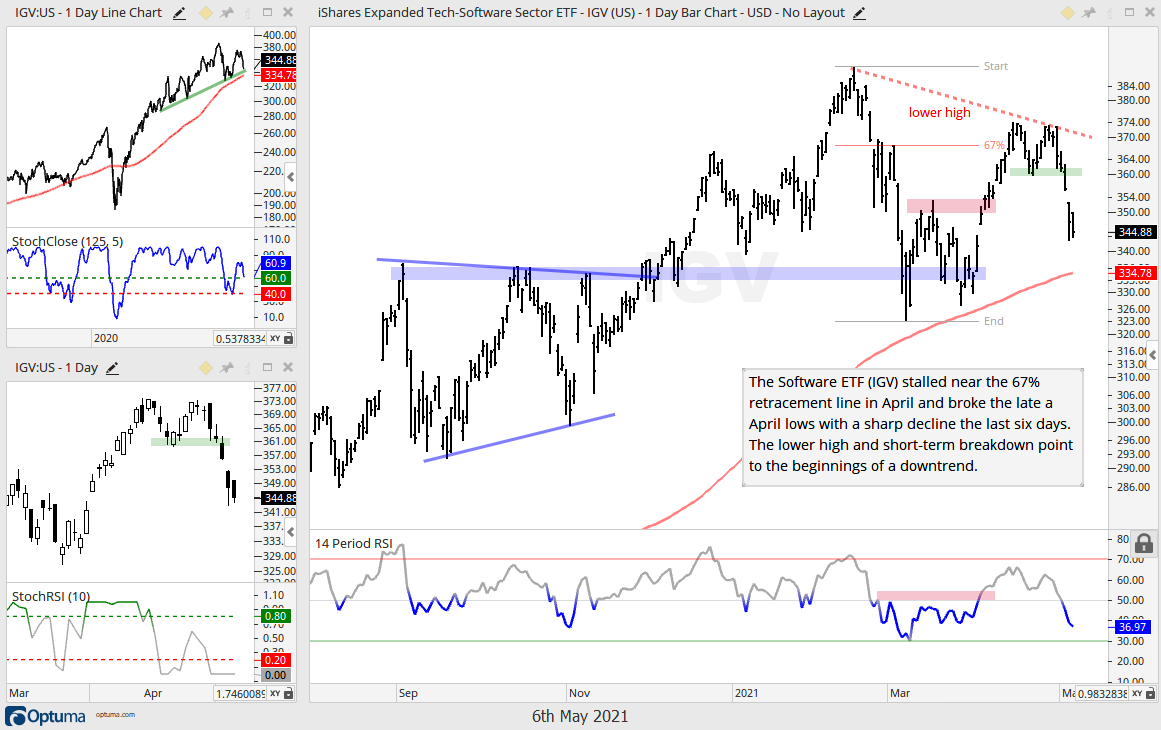
Overall, SPY was alone at the top last week because it was the only major index ETF to record a new high. The closing high for QQQ occurred on April 16th and the closing high for IWM was on March 15th. In addition, several of the tech-related ETFs peaked in mid February and formed lower highs from February to April (IGV, SMH, FDN, SKYY, CIBR, FINX). These tech ETFs also broke down last week and are heading towards their 200-day SMAs.

Even though energy, finance, industrials, materials and housing are still strong, they are also extended and ripe for corrective periods. Also keep in mind that the tech sector still accounts for 26.23% of the S&P 500 and is the biggest sector by far. Thus, weakness in tech will weigh on the S&P 500. And finally, I noted in last week’s seasonality report that May and June are not strong months for the S&P 500. In addition, the S&P 500 fell six percent or more in May 2010, May 2012 and May 2019.

IJR Looks Shaky as IWM Fails

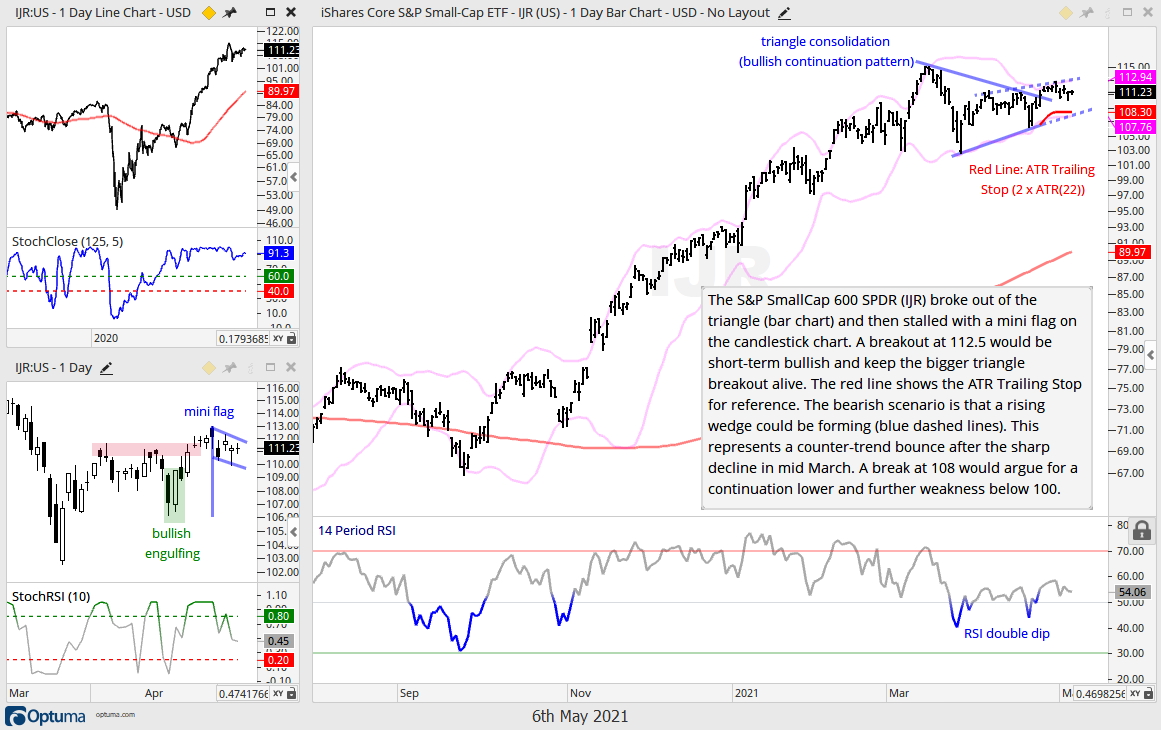
I noted the triangle breakouts in the S&P SmallCap 600 SPDR (IJR) and Russell 2000 ETF (IWM) two weeks ago and it looks like these will fail. The bar chart shows the triangle breakout in IJR and the ATR Trailing Stop at 109.20. This breakout is still holding, but I am concerned that a bearish wedge is now forming (see candlestick chart lower left). IJR fell sharply in mid March and then retraced a good portion of this decline with a rising wedge, which is a bearish continuation pattern. A break below last week’s low would confirm the pattern and argue for another leg lower. The bar chart shows that a 33% retracement of the prior advance (72%) would extend to the 99 area.

You can learn more about ATR Trailing stops in this post,
which includes a video and charting option for everyone.

The next chart shows IWM failing to hold its breakout and breaking below the ATR Trailing Stop.

KRE Still Holding Breakout

The finance sector is important to IJR and IWM because it is the SECOND largest sector in for each ETF (17-18 percent according to ishares.com). Note that ETFDB.com lumps REITs with financials and shows financial services as the largest sector (24-25 percent). The devil is certainly in the details. The Regional Bank ETF (KRE) is holding its triangle breakout and the ATR Trailing Stop is at 67.64. This level also coincides with the breakout zone on the candlestick chart (blue shading). A close below 67.64 would trigger the stop and signal a failed breakout.

TLT Did Not offer a Safe Haven

The 20+ Yr Treasury Bond ETF (TLT) tanked along with the stock market on Monday. Treasury bonds are the natural alternative to stocks and also considered a relative safe haven. However, whiffs of inflation are in the air with the DB Agriculture ETF (DBA), DB Energy ETF (DBE) and DB Base Metals ETF (DBB) hitting new highs. Bonds loathe inflation because it means the real yields are lower (yield less inflation rate). The bar chart shows TLT in a long-term downtrend and well below the falling 200-day SMA. TLT got above the 50-day SMA in late April and early May, but the 50-day SMA is better suited as a mean-reversion indicator. In other words, start leaning bearish when price moves above the 50-day and is below the falling 200-day. Also notice that RSI is turning down in the 50-60 zone, which acts as momentum resistance in a downtrend.

BitCoin Forms Bearish Pattern

I do not trade crypto or the crypto ETFs, but I follow the charts and am seeing a bearish setup in Bitcoin. The bar chart shows Bitcoin breaking the March low with a sharp decline in April. This decline pushed RSI to its lowest level (30.64) since March 2020. Thus, momentum accelerated on the decline. After breaking the low, Bitcoin bounced with a 2/3 retracement and formed a rising wedge on the candlestick chart. Both the retracement amount and pattern are typical for counter-trend bounces. Also note that RSI is stalling in the 50-60 zone, which acts as momentum resistance. As far as triggers, a StochRSI plunge below .20 would show a downward momentum thrust and a move below the early May low would break rising wedge support.

Thanks for tuning in and have a great day!

Weekend Video – Broad Strength with the S&P 500, Old Economy ETFs Lead, May-June Seasonality, Think Twice on Crypto ETFs (Premium)

It was another week and another new high for SPY and the old economy. Outside of tech and high-growth, strength in the S&P 500 is broad as the S&P 500 Equal-weight ETF also hit a new high. ETFs related to industrials, finance, materials, consumer staples, transports, healthcare, energy, housing, steel, copper, and uranium hit

Weekend Video – Broad Strength with the S&P 500, Old Economy ETFs Lead, May-June Seasonality, Think Twice on Crypto ETFs (Premium) Read More »

Timing Models – Long-term Trends for the Big Three, Composite Breadth Model, Yield Spreads, Fed Balance Sheet (Premium)

The broad market environment (market regime) remains bullish. The Composite Breadth Model is bullish and the key inputs (breadth indicators) support this bull market. Even though QQQ dipped the last two weeks and IWM stalled since mid February (blue shading), SPY hit a new high recently and all three remain well above their rising 200-day SMAs (red lines).

Timing Models – Long-term Trends for the Big Three, Composite Breadth Model, Yield Spreads, Fed Balance Sheet (Premium) Read More »

JETS Shows Short-term Relative Strength, PSCD Breaks Out, ITA forms Bullish Continuation Pattern and EPOL Extends after Breakout (Premium)

A benchmark high/low is a price peak/trough that we can use to compare performance. ETFs that break above benchmark highs, such as the mid March highs, show relative strength. ETFs that fail to exceed these highs show relative weakness. ETFs that break below benchmark lows, such as the late April lows, show relative weakness. ETFs that hold these lows show relative strength.

JETS Shows Short-term Relative Strength, PSCD Breaks Out, ITA forms Bullish Continuation Pattern and EPOL Extends after Breakout (Premium) Read More »

ETF Trends, Patterns and Setups – Old Economy ETFs Lead, Tech ETFs Lag, Clean Energy Breakdown, Gold and Silver Hold Breakouts (Premium)

Old economy ETFs continue to lead. ETFs related to industrials, materials, metals, housing and finance hit new highs. These ETFs were already in uptrends and they were simply extending on their breakouts, which occurred in March or April. Even though they are leading and in strong uptrends, many are getting quite extended and ripe for a rest. This means they are in the trend-monitoring phase.

ETF Trends, Patterns and Setups – Old Economy ETFs Lead, Tech ETFs Lag, Clean Energy Breakdown, Gold and Silver Hold Breakouts (Premium) Read More »

Weekend Video – Indecision, Whipsaws and Headfakes, Semis and Tech Lag, Old School Leads, Correction Odds (Premium)

The stock market has been churning the last few weeks with indecisive price action producing a fair number of whipsaws and head fakes. The old school ETFs associated with industrials, materials, REITs, housing, steel, metals and agriculture continue to lead. The high-beta high-flyers of 2020 continue to lag and many did not even make it back above

Weekend Video – Indecision, Whipsaws and Headfakes, Semis and Tech Lag, Old School Leads, Correction Odds (Premium) Read More »

Timing Models – QQQ Non-Confirmation, IWM Lagging, Oil Breaks Out, Bonds Reverse, Fed Balance Sheet Contracts (Premium)

The bulk of the evidence remains bullish for stocks, but we are seeing a short-term non-confirmation from QQQ and continued relative weakness in IWM. SPY remains the leader of the group with a new high this week. However, the current leg up is also getting quite extended because we have not seen a decent correction in six months. Even though the risk appetite returned to QQQ and

Timing Models – QQQ Non-Confirmation, IWM Lagging, Oil Breaks Out, Bonds Reverse, Fed Balance Sheet Contracts (Premium) Read More »

ETF Trends, Patterns and Setups – Dozens of ETFs in Trend-Monitoring Phase, Banks Break Out, XBI follows IBB and Metals Make a Move (Premium)

There are dozens of ETFs in the trend-monitoring phase because their setups evolved in February-March, they broke out at least a month ago and moved higher the last two months (or more). There is no real analysis to be done with these ETFs because they are in their post-breakout moves (trend-monitoring phase). Today’s report will show charts for these ETFs first.

ETF Trends, Patterns and Setups – Dozens of ETFs in Trend-Monitoring Phase, Banks Break Out, XBI follows IBB and Metals Make a Move (Premium) Read More »

Growth and High-Beta Start to Lead – Brazil and Emerging Markets Break Out (Subscribers)

It has been a wild ride for the Russell 2000 Growth ETF (IWO) and Nasdaq 100 Next Gen ETF (QQQJ) over the last two weeks as they went from emerging leaders to overreaction laggards and back to leading. The lagging part occurred last Tuesday when stocks fell sharply during the day. This whipsaw action is looking more like short-term noise because these two are leading again with strong recoveries.

Growth and High-Beta Start to Lead – Brazil and Emerging Markets Break Out (Subscribers) Read More »

Weekend Video – Noose Tightens for Small-caps, Growth Perks Up, Mid-week Head Fakes, Metals and China (Premium)

After getting derailed with a curve ball on Tuesday, the bulls rebounded stocks ended the week on a high note. Again, a wide array of ETFs recorded fresh 52-week highs and there are plenty of strong groups in the stock market. This week we are seeing a possible return to growth, clean energy and China

Weekend Video – Noose Tightens for Small-caps, Growth Perks Up, Mid-week Head Fakes, Metals and China (Premium) Read More »

Timing Models – Defensive Sectors Surge, SPY and QQQ Remain Extended, Bonds Bounce, New High for Fed Balance Sheet (Premium)

The bulk of the evidence remains bullish for stocks, but some yellow flags are starting to appear. Yellow flags argue for some caution and are not outright bearish. For example, defensive sectors are leading, but the offensive sectors are still holding up, even though they are lagging. Small-caps are

Timing Models – Defensive Sectors Surge, SPY and QQQ Remain Extended, Bonds Bounce, New High for Fed Balance Sheet (Premium) Read More »

Weekend Video – SPY and QQQ Lead, IWM Cup Half Full, Metals Break Out, Emerging Markets ETFs Turns (Premium)

SPY hit yet another new high, nine sector SPDRs hit new highs and the breadth indicators show broad strength within this large-cap benchmark. QQQ also hit a new high as large-cap techs extended their rebound. Small-caps and small-cap growth remain the laggards, but their cups are still half full

Weekend Video – SPY and QQQ Lead, IWM Cup Half Full, Metals Break Out, Emerging Markets ETFs Turns (Premium) Read More »

Timing Models – Large-caps Extend Lead, Small-Caps Lag, Utes and REITs Lead, IWO hits Moment of truth (Premium)

Large-caps and large-cap techs ripped higher the last five-six weeks with SPY and QQQ hitting new highs. The Technology SPDR and Consumer Discretionary SPDR are leading the charge among the sectors with 13+ percent gains. Keep in mind that Amazon accounts for 23.5% of XLY and Tesla accounts for 14.45%. These two are not exactly pure plays in the

Timing Models – Large-caps Extend Lead, Small-Caps Lag, Utes and REITs Lead, IWO hits Moment of truth (Premium) Read More »

Scroll to Top