
About the ETF Trends, Patterns and Setups Report
This report contains discretionary chart analysis based on my interpretation of the price charts. This is different from the fully systematic approach in the Trend Composite strategy series. In this ETF Trends, Patterns and Setups report, I am looking for leading uptrends and tradable setups within these uptrends. While I use indicators to help define the trend and identify oversold conditions within uptrends, the assessments are mostly based on price action and the price chart (higher highs, higher lows, patterns in play). Sometimes the chart assessment can be at odds with the indicators.
This Week's Commentary Schedule
- Tuesday – 1 November: Market-ETF Report and Signal-Rank Table Update
- Wednesday – 2 November Market-ETF Video and Market Regime Update
- Thursday – 3 November: Market-ETF Report and Signal-Rank Table Update
- Saturday – 5 November: ETF Signal and Rank Table
Composite Breadth Model Remains Bearish
The Composite Breadth Model (CBM) remains at -5, which means all five inputs are bearish. The 5-day SMA for the S&P 500 is 6.2% below the falling 200-day SMA and around 64.5% of S&P 500 stocks are below their 200-day SMAs (35.5% above). The bounce over the last few weeks brough the 5-day SMA closer to the 200-day SMA and increased the number of stocks above the 200-day SMA, but this is still considered a bear market rally. Keep in mind that the Composite Breadth Model is a trend-following indicator that will lag. In other words, it will not turn bullish until the broader market shows significant strength. The trend-following motto is basically “strength begets strength”.
You can learn more about my chart strategy in this article covering the different timeframes, chart settings, StochClose, RSI and StochRSI.
SPY Extends Counter-Trend Bounce (plus QQQ)
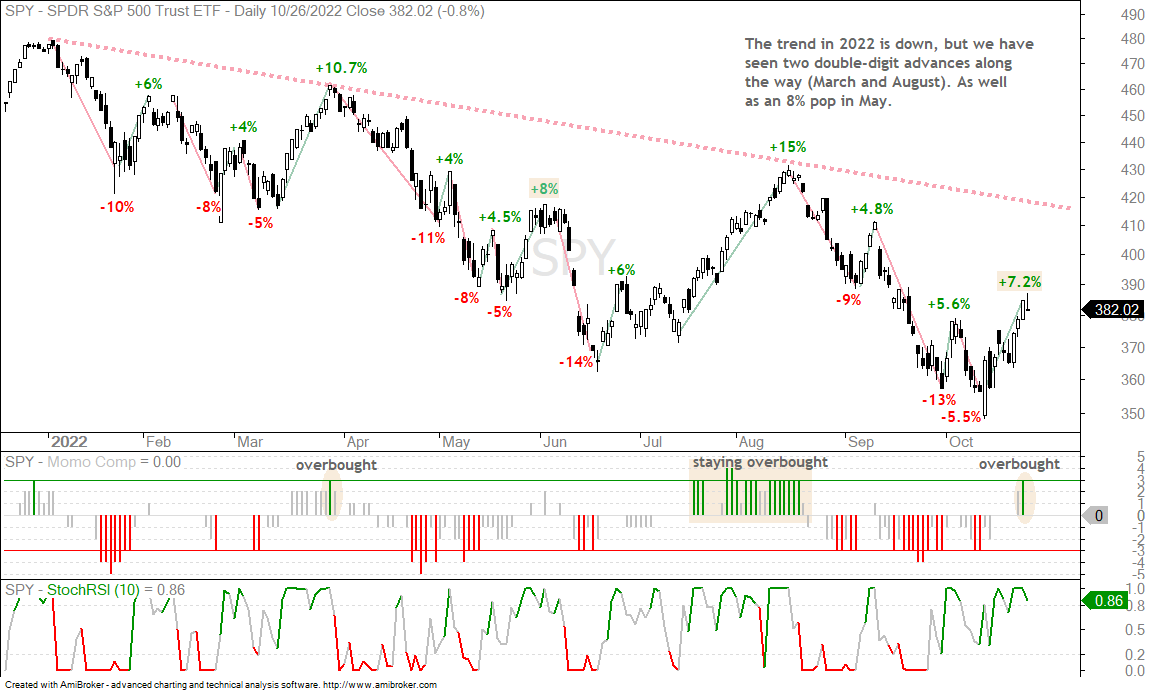
When does a counter-trend bounce become strong enough to reverse the long-term downtrend? When the Trend Composite turns net positive or we see a significant breakout (above the August high). We are not there yet. The chart below shows SPY with a 19% decline from the mid August high and 52-week lows in late September and mid October. The yellow shading in February-March, May, June and September shows when SPY exceeded its prior low and then bounced. A bounce after a lower low is pretty normal and SPY was also quite oversold after a 19% decline.
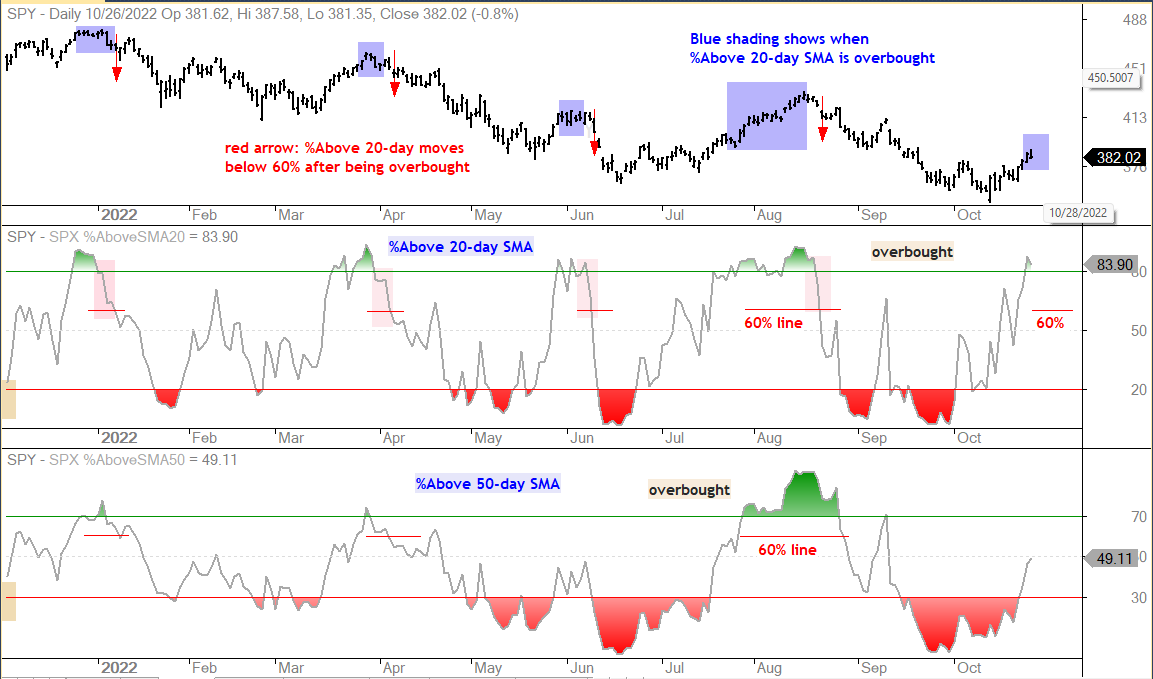
SPY is back above 380 and the current bounce has retraced around half of the prior decline. Counter-trend bounces typically retraced between half and two thirds of the prior move. The 390-400 area represents a potential reversal zone. Last Wednesday’s low marks first support (green line) and a break here would reverse the short-term uptrend. The next chart shows SPY with SPX %Above 20-day SMA becoming overbought with a move above 80% (middle window). The blue shading on the price chart shows these moves above 80% and the red arrows show when the indicator moved below 60%, which is short-term bearish. SPY is current overbought and remaining overbought, which is actually short-term bullish. Watch for a move below 60% for a short-term reversal.
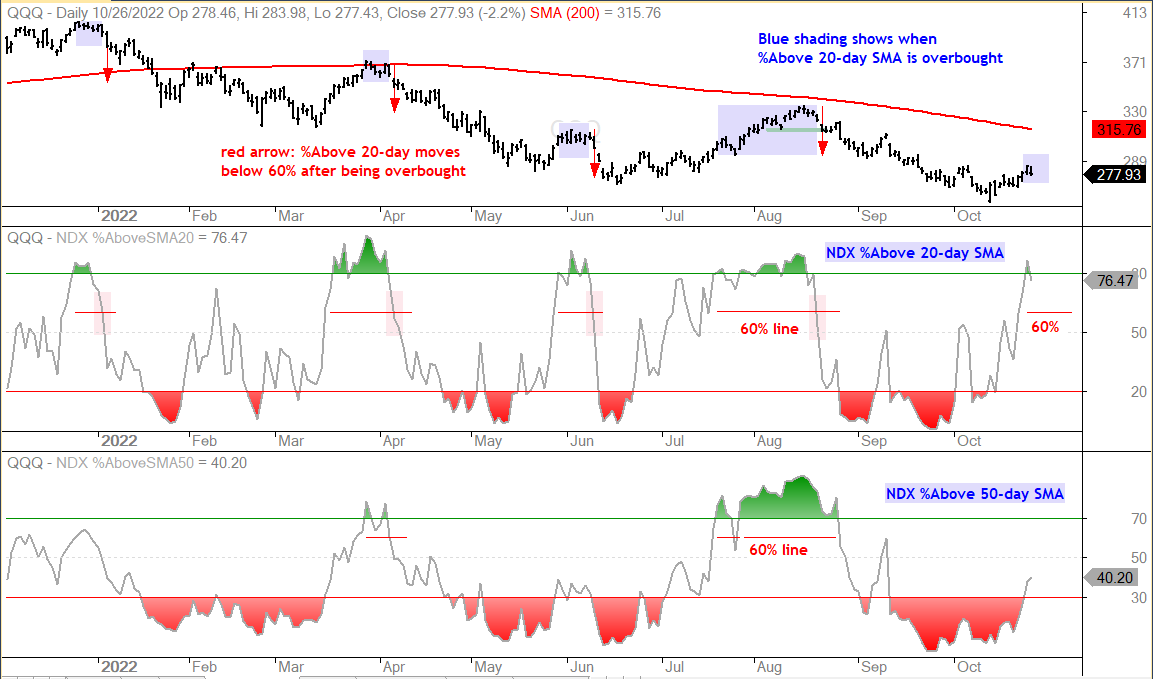
The next chart shows QQQ with NDX %Above 20-day SMA in the middle window. This indicator is also showing overbought conditions as it hovers near 80%. The oversold bounce in QQQ was not as strong as the bounce in SPY or IWM. Thus, QQQ is still lagging and weighing on the S&P 500. A short-term support break and move below 60% in NDX %Above 20-day SMA would reverse the short-term uptrend.
The Momentum Composite aggregates signals in five momentum-type indicators to identify short-term overbought and oversold conditions. This indicator is part of the TIP Indicator Edge Plugin for StockCharts ACP
More Bullish Trend Composite Signals
Even though SPY remains in a long-term downtrend and the Composite Breadth Model is bearish, there were 17 bullish Trend Composite signals over the last five trading days. And, these signals were in stock-based ETFs, as opposed to commodity, bond or currency ETFs. Six of the 17 signals were stock-based energy ETFs (PSCE, FCG, XES, XOP, AMLP, IGE – green shading)). We also saw bullish signals in ETFs related to healthcare (XLV, IBB, BBH, IHF – yellow shading) and defense (PPA, ITA – blue shading).
These three themes were highlighted in the reports and videos over the last two weeks. This was basically front running the Trend Composite signals by identifying ETFs that were showing relative strength and leading the market over the last few months. In particular, I was seeing strength in the Healthcare SPDR (XLV), Biotech ETF (IBB), Energy SPDR (XLE), Healthcare Providers ETF (IHF) and Aerospace & Defense ETF (PPA).
Healthcare SPDR Exceeds September Peak (XLV)
Chartists can use benchmark peaks and troughs to compare price performance. ETFs that held above their June troughs (lows) performed better than ETFs that broke their June lows (SPY). ETFs that broke their mid September peaks are stronger than ETFs that did not break these peaks (higher high). XLV is a case in point. The ETF is back above its 200-day and down 5.8% year-to-date. Meanwhile SPY remains well below its 200-day and is down 18.7% this year. XLV is down less, which means relative strength. On the chart below, XLV held above its June low in September-October and broke out with a surge above 128 last week. This move reversed the medium-term downswing and showed short-term leadership in XLV. The bottom window shows the XLV:SPY ratio turning up in mid August and moving to new highs in October. XLV is clearly leading SPY.
You can learn more about exit strategies in this post,
which includes a video and charting options for everyone.
Large-cap Biotechs Grab the Lead over Small-caps (IBB, XBI)
The Biotech SPDR (XBI) held up better during September, but the Biotech ETF (IBB) took the lead in October with a breakout and clear move above the 200-day. IBB is market-cap weighted with the top ten stocks accounting for some 50% of the ETF. XBI is equally weighted with the top ten stocks accounting for 12.5%. The first chart shows XBI with the Trend Composite turning positive on August 5th as the ETF advanced to the 200-day. XBI fell back from mid August to late September with a normal correction (50-67% retracement and return to broken resistance). The ETF then consolidated the last few weeks and the cup remains half full as long as the September-October lows hold. A close below 75 would be negative and likely lead to further weakness that would trigger the ATR Trailing Stop at 73.16.
The next chart shows IBB with similar chart characteristics and two differences. First, IBB exceeded the broken resistance zone (blue shading) in September and the Trend Composite turned negative. XBI held the breakout zone and IBB was lagging at this stage. The second difference is that IBB broke out of its falling channel correction with a strong move the last two weeks. The move in XBI was not nearly as strong and IBB is now leading. IBB is benefiting from big moves in five of its top ten stocks: GILD (+27%), AMGN (+20%), MRNA (+27%), IQV (+16%) and ILMN (+20%).
You can learn more about exit strategies in this post,
which includes a video and charting options for everyone.
Aerospace & Defense ETF Surges to August High (PPA)
The Aerospace & Defense ETF (PPA) rounds out the list of ETFs that were treading water when the broader market was falling. As with XLV and IHF, PPA has been gyrating above/below the 200-day SMA for a year. Even though it hit a new low in September, it was down a lot less than SPY and holding up better than the broader market. Notice how the PPA:SPY ratio (bottom window) flatlined from March to August, which means it did not underperform. The ratio turned up in September as PPA started to outperform and the ETF broke short-term resistance with a surge on October 20th.
The Trend Composite aggregates signals in five trend indicators: Bollinger Bands (125,1), Keltner Channels (125,2), 5-day Rate-of-Change of 125-day SMA, StochClose (125,5) and CCI-Close (125). The Trend Composite and ten other indicators are part of the TIP Indicator Edge Plugin for StockCharts ACP
Oil Bids to Hold Short-term Breakout
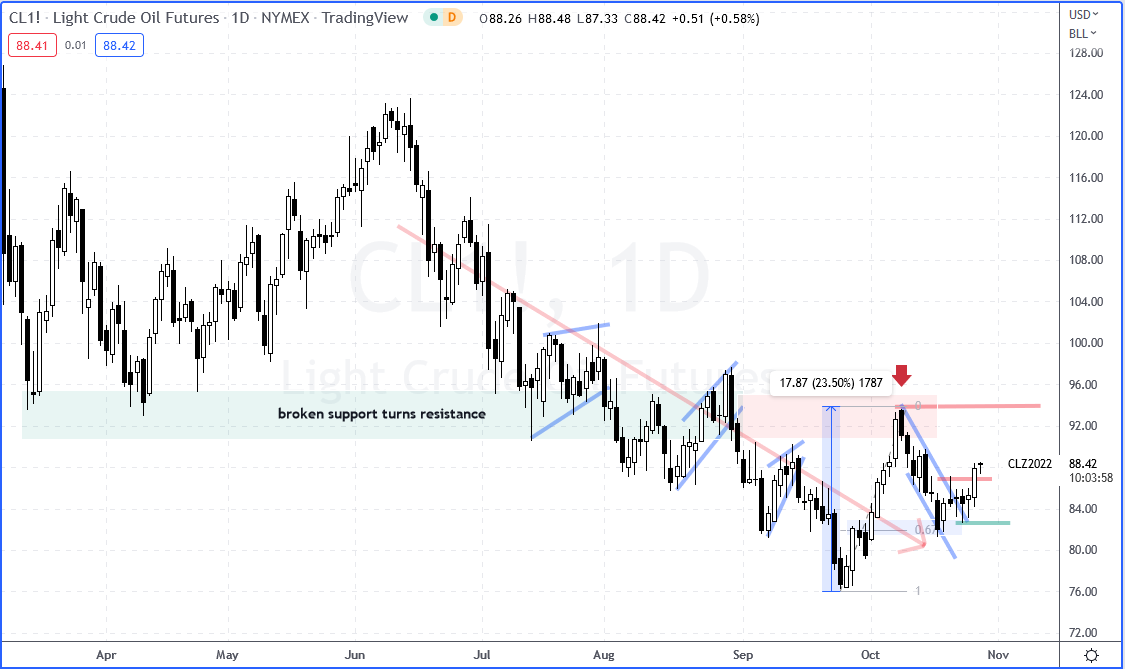
Light Crude Futures (CL1!) remains in a downtrend since summer, but managed to hold above the September low during the October pullback and broke out of a falling flag. The flag also retraced around 2/3 of the Sep-Oct surge and turned to the early October breakout zone (blue shading). This looks like a pullback and the breakout is bullish as long as it holds. Oil is currently right at the breakout level and I am marking support at the late October low (82.5). A close below this level would negate the breakout and be bearish.
Energy SPDR Nears 52-week High (XLE)
The Energy SPDR (XLE) continues to lead the 11 sector SPDRs because it is the closest to a 52-week high (~3%). XLE broke out of a large triangle and a pennant in mid October. The triangle is a long-term consolidation within an uptrend and the pennant is a short-term consolidation after the short-term surge. Both are bullish continuation patterns. The Trend Composite turned positive with these breakouts and the ATR Trailing Stop is shown for reference (74.62). The breakout zone and pennant turn first support to watch should we get a throwback (return to the breakout zone).
The other energy-related ETFs will follow XLE’s lead: Oil & Gas Exploration & Production ETF (XOP), Oil & Gas Equipment & Services ETF (XES) and Natural Gas ETF (FCG). The next chart shows XOP with the blue zone marking first support in the 140 area and the green line marking the re-evaluation level. A robust breakout should hold and a close below 136 would argue for a re-evaluation of the breakout’s validity.
Networking ETF Exceeds its August High (IGN)
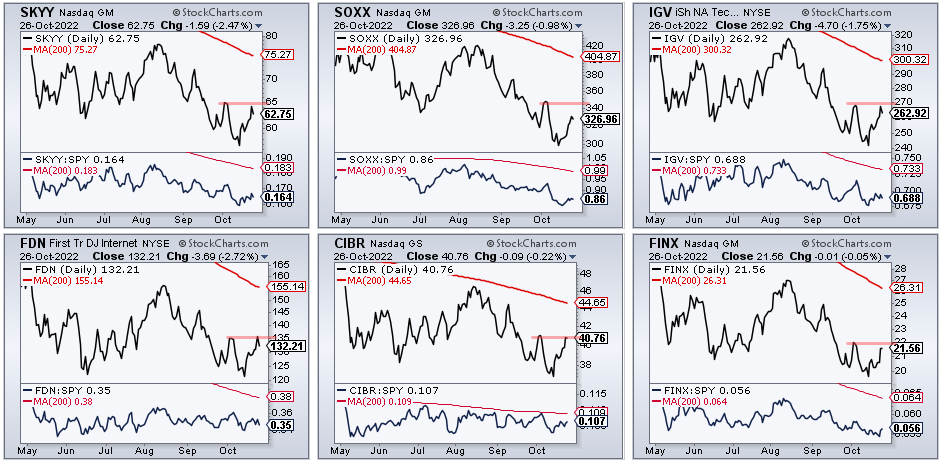
The Networking ETF (IGN) is by far the strongest tech-related ETF. The Technology SPDR (XLK), Cloud Computing ETF (SKYY), Cybersecurity ETF (CIBR), Semiconductor ETF (SOXX) and Software ETF (IGV) forged lower lows from June to October and their Trend Composites are negative. IGN held well above its June low in September and its Trend Composite has been positive since early August. On the price chart, the ETF found support near broken resistance and the 67% retracement in September, tested this area in mid October and exceeded the mid August high last week. IGN is the undisputed leader in the tech group.
Water Resources ETF Exceeds 200-day (PHO)
The Water Resources ETF (PHO) reversed its downswing with a breakout and sharp surge the last eight days. PHO makes the performance cut because it formed a higher low from June to October and has been outperforming SPY since spring. The bottom window shows the price relative (PHO:SPY ratio) rising since the second half of April and hitting a new high this week. PHO is outperforming. On the price chart, the short-term breakout is bullish and PHO is back above its 200-day SMA.
Copper and Silver Attempt to Firm (CPER, SLV)
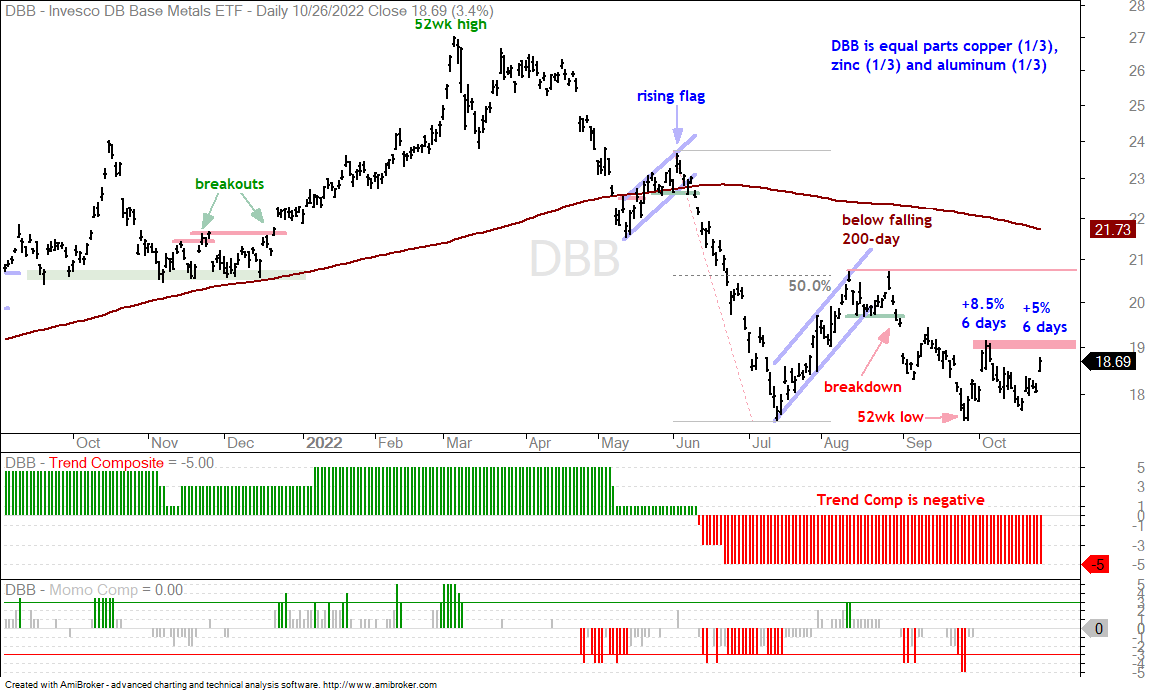
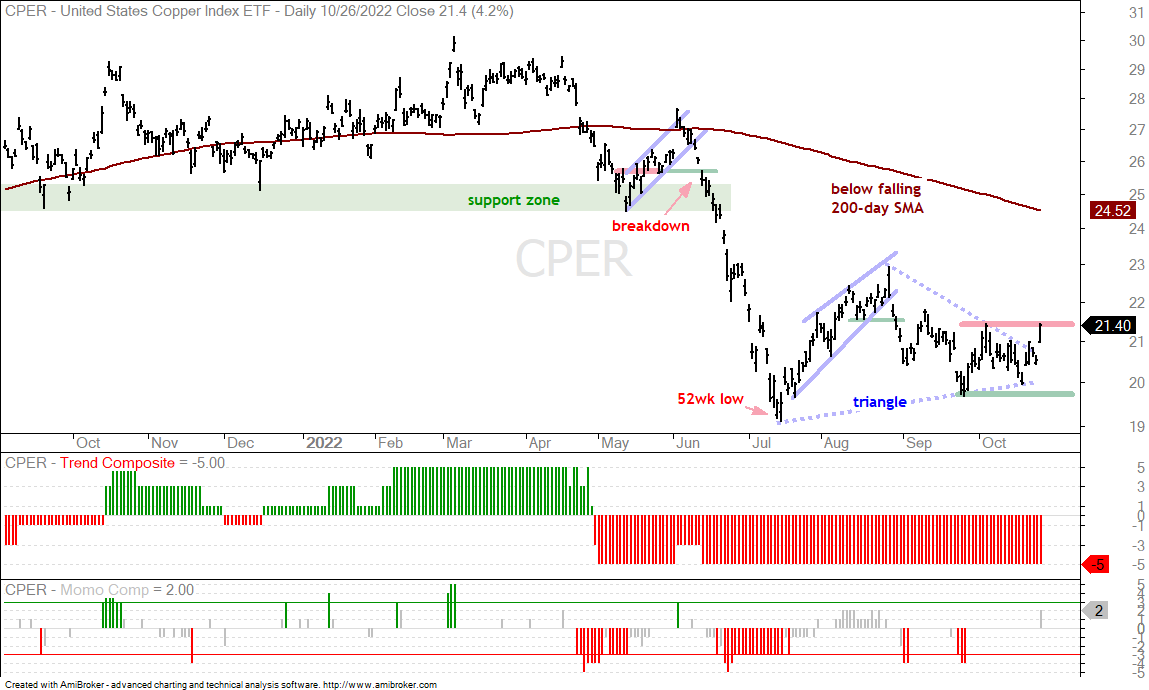
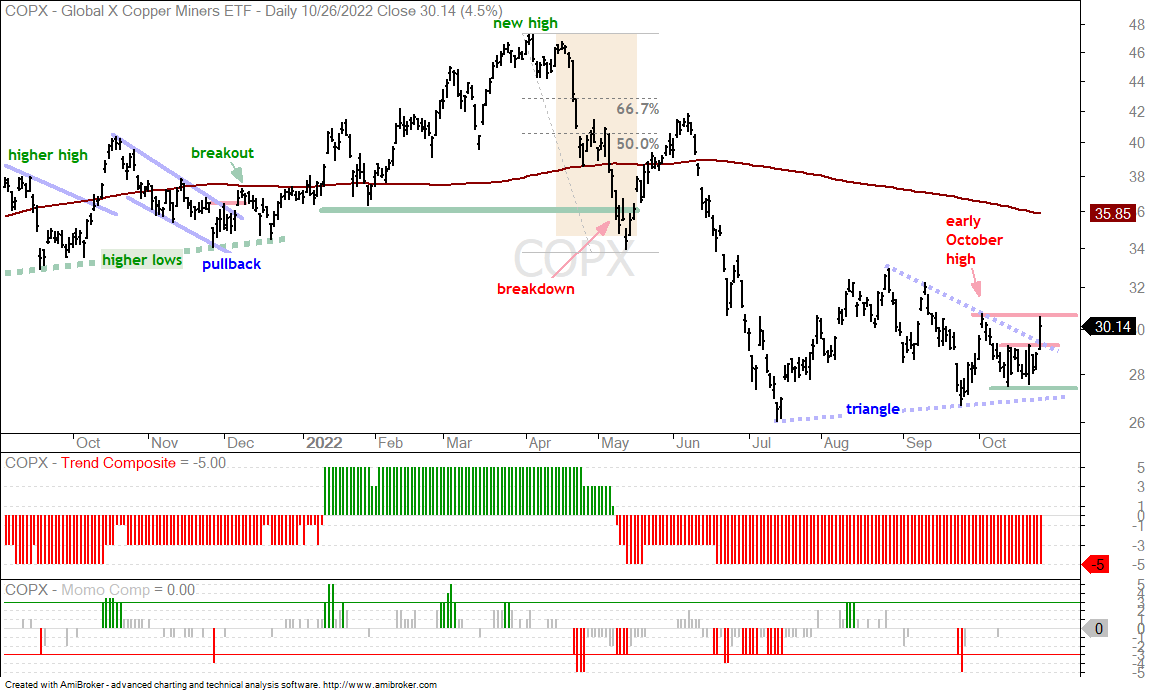
The Dollar is down in early trading on Tuesday and some industrial metals are gaining strength. Silver is up 3%, copper is up 2%, palladium is up 5%, zinc is up 1.75% and platinum is up 3%. The DB Base Metals ETF (DBB) and Gold SPDR (GLD) are near 52-week lows so I am not interested in these ETFs. The Copper ETF (CPER) held above its July low in September and the October lows are so far holding above the September lows. CPER fell sharply the last three days and this decline reinforces resistance from the October highs. A successful test of the lows around 20 and a breakout at 21.5 would be bullish for CPER.
The next chart shows the Silver ETF (SLV) bouncing in the 16-17 zone in July, early September and mid October. The overall trend is down, but SLV could be basing with some sort of a rounding bottom. Long-term, a break above the August-October highs (red zone) is need to reverse the downtrend. Short-term, a bounce is in the works over the last two weeks and a close below 17 would argue for a re-evaluation of this short-term upswing.
Palladium ETF Becomes Oversold (PALL)
The Palladium ETF (PALL) is back near its June lows after breaking channel support and triggering the ATR Trailing Stop on Friday (red line). The blue line defines the short-term downtrend and PALL is again oversold as the Momentum Composite dipped to -3. The oversold bounce attempt failed in mid October as StochRSI failed to exceed .80 on the pop (yellow oval). Watch for a break above the blue trendline and a StochRSI pop above .80 to reverse this short-term downtrend.
Previous Reports
- Thursday, October 27th (here)
- Inflation Report on Deck Friday
- Tech-related ETFs Continue to Lag (SKYY, IGV, SOXX…)
- Medium-term and Short-term Seasonal Patterns
- Channeling the April-June Decline (SPY)
- %Above 20-day SMA Indicators Overbought (SPY, QQQ)
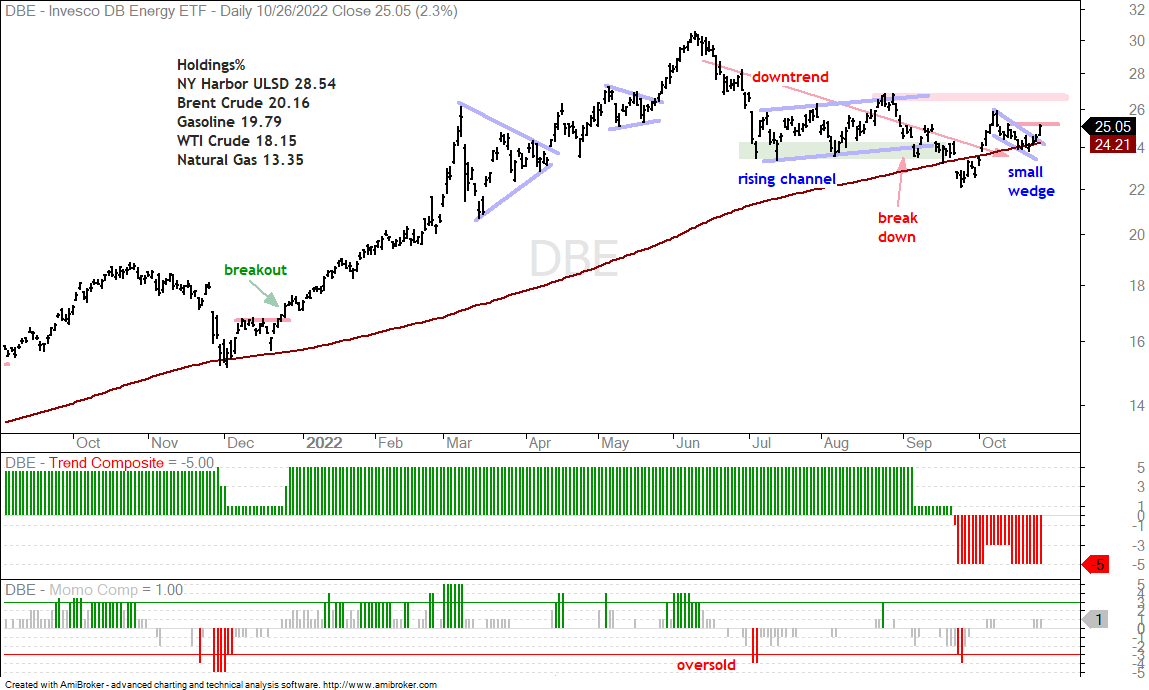
- Oil Surges for Short-term Breakout (CL1!, DBE)
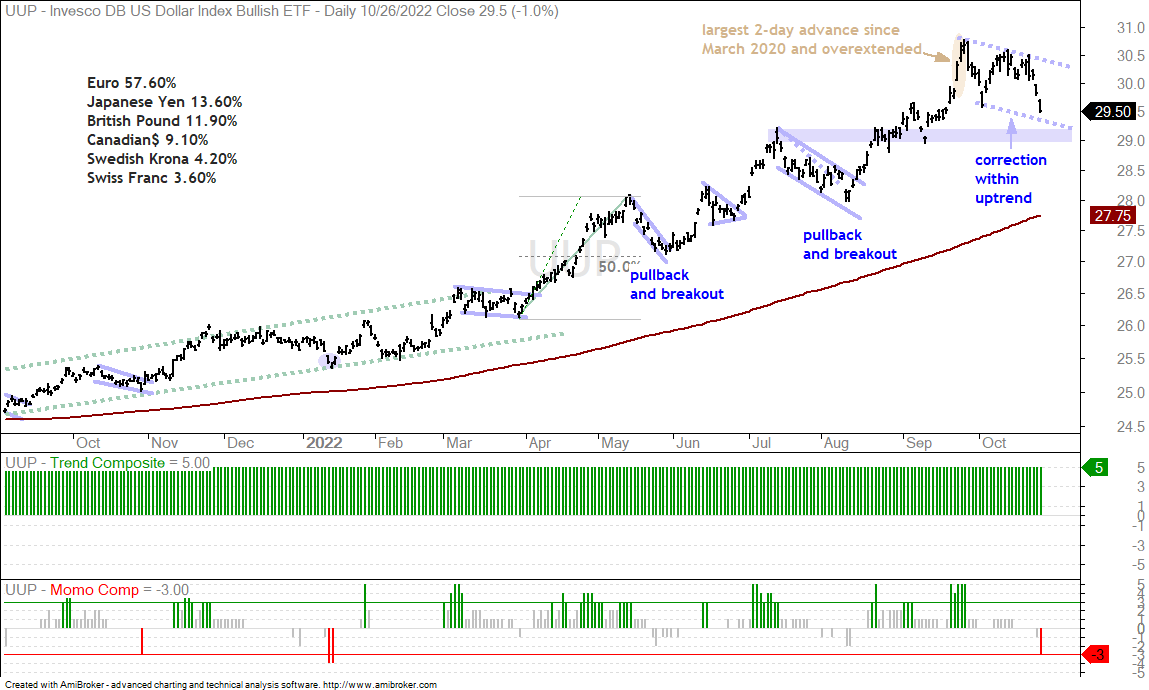
- Dollar Becomes Oversold near Support (UUP)
- DB Base Metals ETF Surges within Downtrend (DBB)
- Copper Leads the Charge (CPER, COPX)
- Previous Commentary and Video
You can learn more about my chart strategy in this article covering the different timeframes, chart settings, StochClose, RSI and StochRSI.