An Oversold Bounce is One Thing – A Bullish Breadth Thrust is Another

Use CRTL+P to Print

An Oversold Bounce is One Thing – A Bullish Breadth Thrust is Another

Use CRTL+P to Print

Panic selling and oversold extremes gave way to a rip higher last week. Stocks are poised to open strong on Monday as the market reacts positively to tariff news. Last week’s bounce is considered an oversold bounce within a bear market. Thrust signals are setting up, but strong follow through is needed to trigger actual signals. This report will first review the panic indicators and the short-term oversold condition, and then show what it would take to move from a bear market bounce to a bullish breadth thrust.

3 Standard Deviation Decline

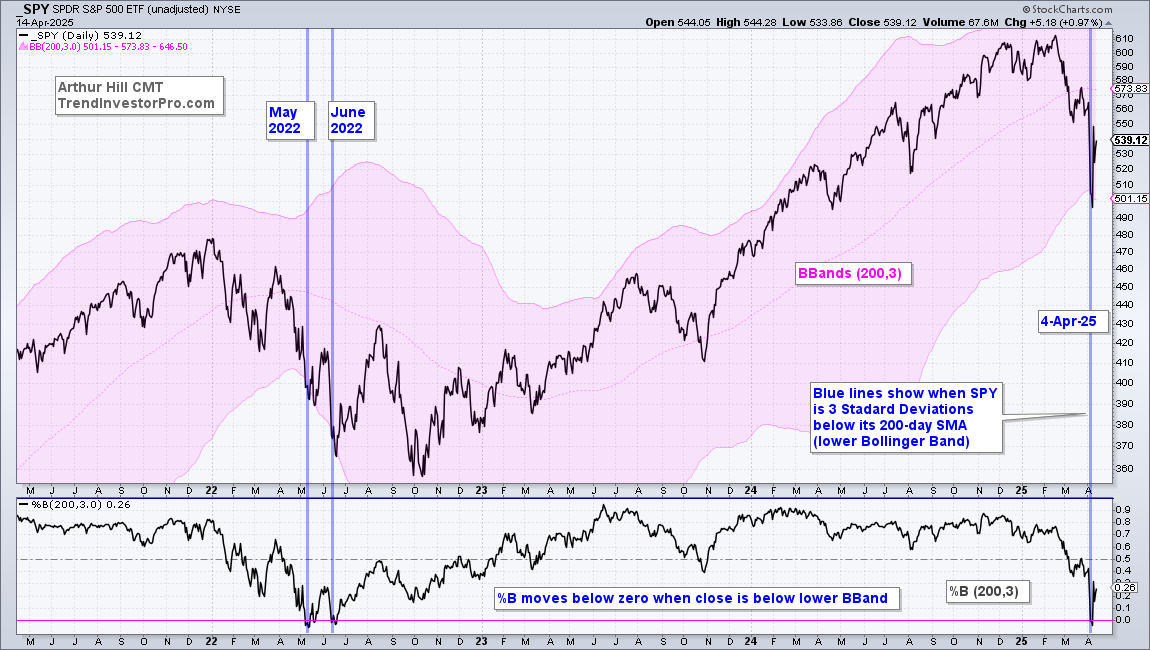
The chart below shows SPY dipping below the lower Bollinger Band (200,3) on April 4th. This means SPY was more than 3 standard deviations below its 200-day SMA, which is an extreme oversold condition. For reference, SPY has reached this extreme 27 times in the last 25 years. Such a move reflects panic selling pressure that often gives way to a bounce, which we got on Wednesday, April 9th.
Oversold Extremes for Long-term Breadth

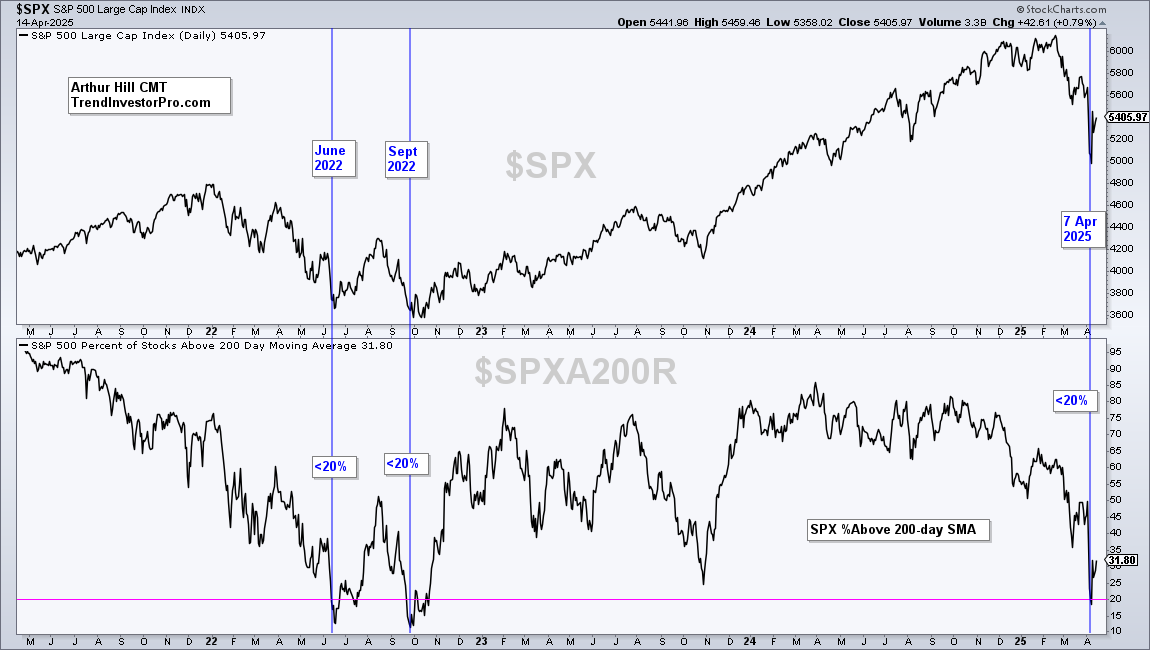
The next chart shows S&P 500 Percent Above 200-day SMA ($SPXA200R) dipping below 20% on April 7th to become extremely oversold. This means more than 80% of S&P 500 stocks were below their 200-day SMAs as traders sold pretty much everything. Extremely oversold readings in long-term breadth foreshadowed bounces June 2022, September 2022 and April 2025.
NYSE Zweig Breadth Thrust Sets Up

The NYSE Zweig Breadth Thrust is setting up as it finished below .40 on Friday. Actually, this indicator has been below .40 for four of the last five days. Readings below .40 reflect a short-term oversold condition that could give way to a bounce. The indicator first dipped below .40 on April 4th and stocks rebounded last week.
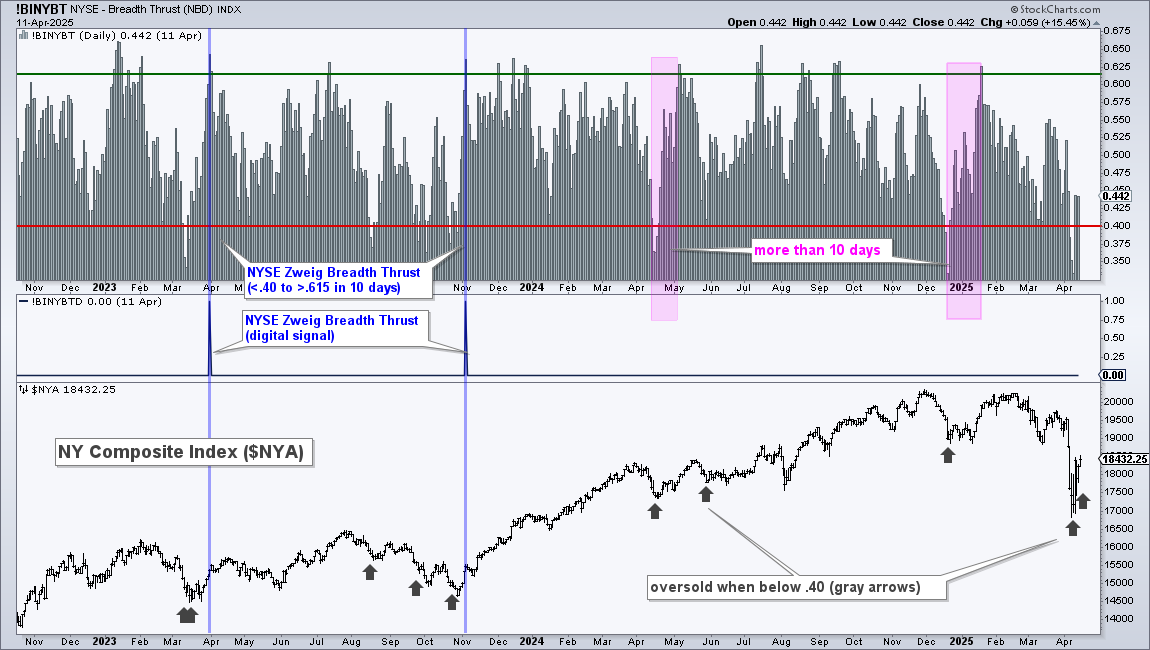
This indicator is also setting up for a possible Zweig Breadth Thrust. Currently, stocks are in the midst of an oversold bounce within a bigger downtrend. This would become a bullish Zweig Breadth Thrust should we see follow through and surge above .615 with 10 days. The countdown begins.

The Zweig Breadth Thrust indicator is the 10-day EMA of Advances/(Advances + Declines). Why did Zweig use a 10-day EMA? I believe he wanted to separate 1-5 day bear market bounces from bounces with follow through. The current bounce is just a bear market bounce and we need to see follow through within 10 days for a Zweig Breadth Thrust to trigger.

It is important to monitor more than one breadth indicator for thrust signals because you never know which one will trigger. The NYSE Zweig Breadth Thrust might miss, but the S&P 500 or S&P 1500 Zweig Breadth Thrust indicators may catch the signal, especially if Nasdaq stocks or small and mid caps lead. TrendInvestorPro monitors thrust indicators based on the percentage of stocks above their 20 and 50 day SMAs, and we have a breadth thrust index that aggregates thrust signals in over a dozen breadth indicators. This analysis continues for subscribers to TrendInvestorPro.

Recent Reports and Videos at TrendInvestorPro

  • Rate and Energy Shock Weigh – Gold Headwinds and Set Up
  • Semiconductor Equipment and Testing Stocks Set Up
  • Early August Breakouts back in Play for Tech, AI and Semis
  • ETF Master ChartList ~300 ETFs Organized in Top-Down Manner
  • Click here to take a trial and gain full access.

This content is for subscribers. (Login or Subscribe)

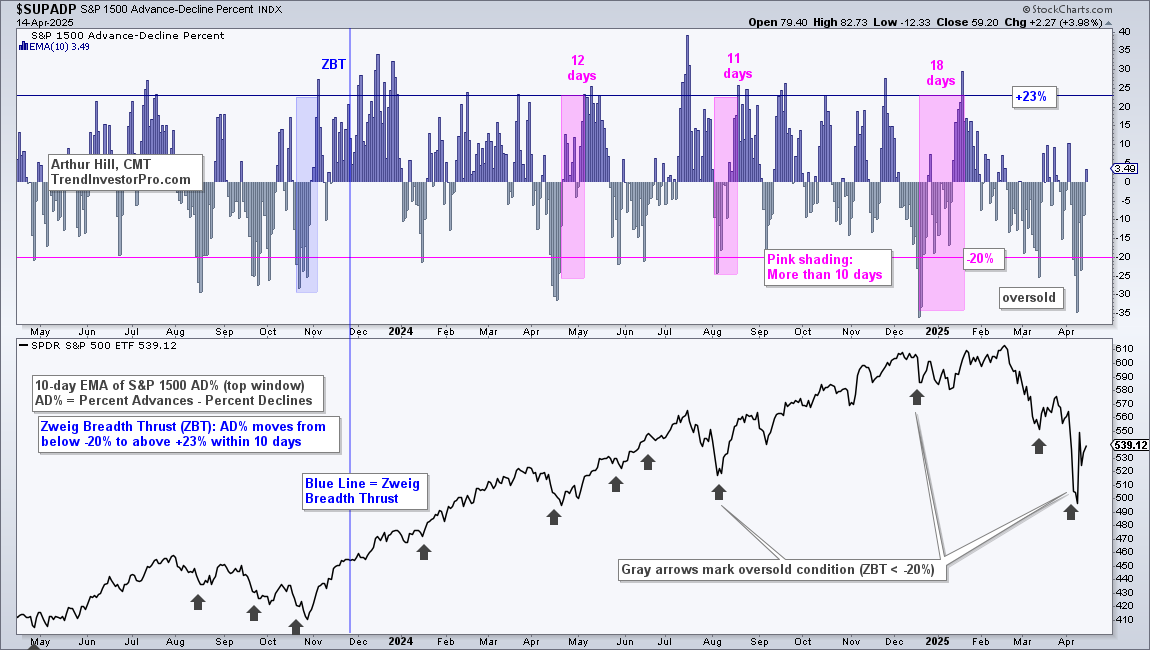
The next chart shows the S&P 1500 Zweig Breadth Thrust indicator becoming oversold on April 4th, 7th, 8th and 10th. This is a classic case of becoming oversold and remaining oversold. The extended oversold conditions reflect relative weakness in small and mid cap stocks, which dominate the S&P 1500. A move above +23% by April 25th would trigger a bullish Zweig Breadth Thrust for the S&P 1500.
Percent above 20 and 50 Day SMAs Set Up

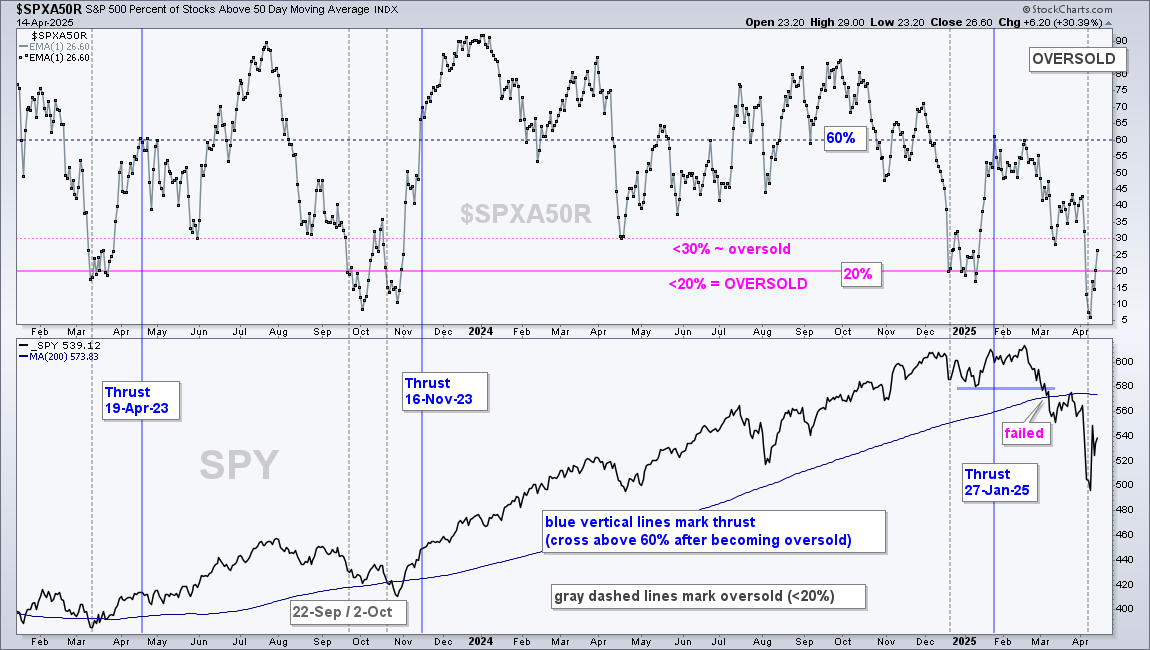
The next chart shows S&P 500 Percent Above 50-day SMA ($SPXA50R) moving below 20% to become oversold on April 4th. Oversold conditions extended as the indicator dipped to 5% on April 8th. SPY surged some 10% on April 9th and the indicator is back near 20%. Again, we are seeing an oversold bounce within a bear market, but follow through with a move above 60% is needed for a thrust signal (blue lines).
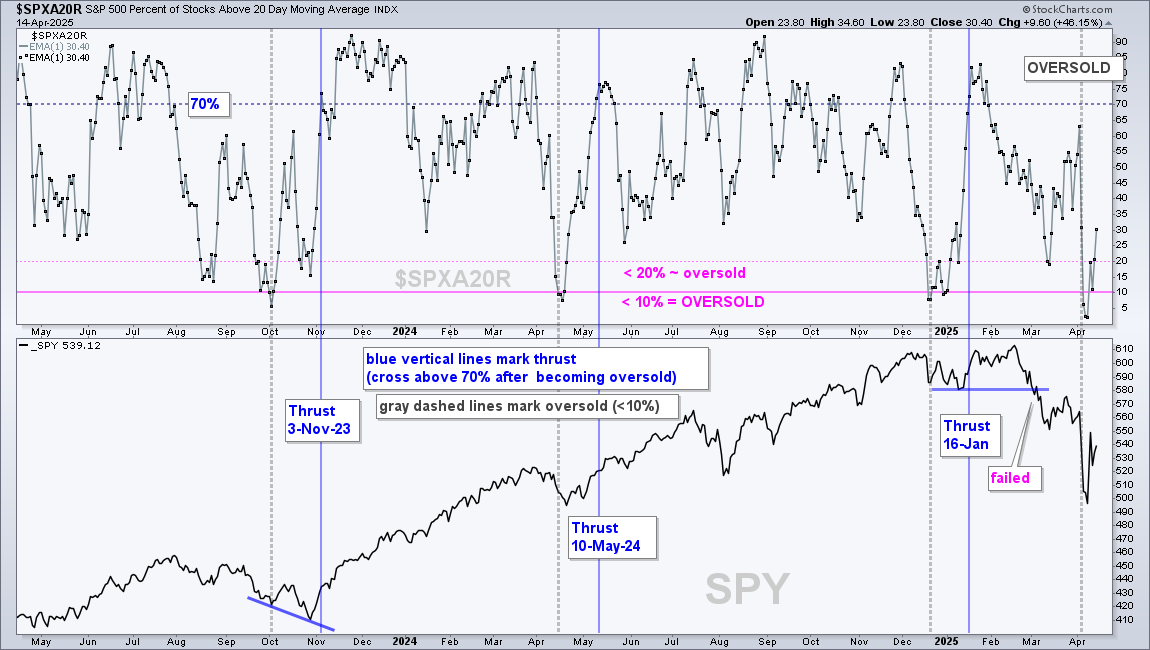
The next chart shows S&P 500 Percent Above 20-day SMA ($SPXA20R) becoming oversold with a move below 10% on April 4th and dipping to 2% on April 8th. With an oversold bounce on April 9th, the indicator move to the 20% area on Friday. This is just a bear market bounce for now. Follow through above 70% is needed to trigger a thrust signal.
Stocks moved from panic extremes to an oversold bounce this past week. Now is the real test. Bargain hunters and mean-reversion players step in at extremes and produce the initial oversold bounce. Follow through buyers are required to move from an oversold bounce to a bullish breadth thrust. Stay tuned…


Market Report – Down/Up – Evidence Unchanged – No Thrust, but Watching – SPY – QQQ

The analysis mode remains macro because the weight of the evidence is still bearish for stocks. Moreover, the markets are unhinged with stocks, commodities, currencies and Treasury bonds fluctuating wildly. Chaos makes chart analysis exceptionally difficult. Perhaps there is opportunity in the chaos, but the current market environment is for nimble traders with quick trigger fingers.

Market Report – Down/Up – Evidence Unchanged – No Thrust, but Watching – SPY – QQQ Read More »

Market Regime – Weighing the Evidence using Trends, Breadth and Yield Spreads

This market regime report weighs the evidence to determine the state of the stock market. Are we in a bull market or bear market? We start with the long-term trends for three major index ETFs (SPY,QQQ,RSP). Attention then turns to breadth indicators to measure the percentage of stocks in uptrends/downtrends and the percentage hitting

Market Regime – Weighing the Evidence using Trends, Breadth and Yield Spreads Read More »

ETF Report – Forget Support in Downtrends – 2008 Comparison – Bonds, Gold & Yen

Everything, well, almost everything, fell the last four trading days. This includes the gold and US Treasury Bonds. The Dollar was hit hard, which means other currencies gained. Stocks, industrial metals, oil, crypto and foreign stocks were all down the last four days. Within the US stock market, all sector ETFs and all but two

ETF Report – Forget Support in Downtrends – 2008 Comparison – Bonds, Gold & Yen Read More »

Long & Short Term Oversold Extremes – Bear Market Rules Apply – Zweig Indicator Sets Up

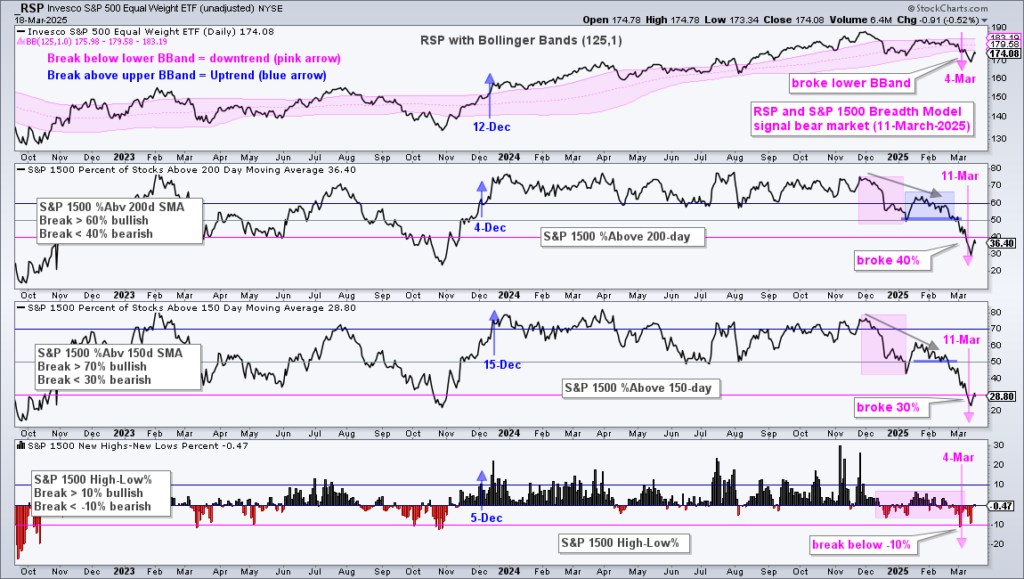
Before looking at the current extremes, keep in mind that the weight of the evidence on the Market Regime page is bearish. We are in a bear market, and bear market rules apply. Support levels are less likely to hold and Bullish Setups are less likely to work. Stocks are extremely oversold right now: long-term and short-term. These oversold conditions could lead to a bounce, but this will be considered a bear market bounce as long as the evidence remains bearish. With volatility higher in bear markets, we can expect some sharp counter-trend bounces and erratic price action.

Long & Short Term Oversold Extremes – Bear Market Rules Apply – Zweig Indicator Sets Up Read More »

Defining Oversold Extremes – Capitulation Index Sets Up, but Bearish Until Thrust Signal ($)

Price and breadth indicators are hitting panic levels as investors indiscriminately dump stocks. Several key indicators already reached extremes that could foreshadow a bounce. However, these extremes result from strong selling pressure and increasing downside momentum, which is bearish. The vast majority of stocks moved into long-term downtrends and new lows surging. Such serious technical damage is unlikely to be reversed with the first bounce.

Defining Oversold Extremes – Capitulation Index Sets Up, but Bearish Until Thrust Signal ($) Read More »

Commodity, Bond and BitCoin ETFs – Copper Turns – DBA Holds Up – IEF Goes for Breakout

Today’s report covers the commodity, bond and Bitcoin ETFs. Gold continues to lead, but looks increasingly extended. Industrial metals are under pressure as copper turns down after a parabolic move. Agriculture is holding its breakout, while bonds are poised to break out as money moves into relative safe-havens.

Commodity, Bond and BitCoin ETFs – Copper Turns – DBA Holds Up – IEF Goes for Breakout Read More »

Performance Profile Paints Different Pictures for Commodity and Equity ETFs

The performance profile for 2025 says a lot about the state of the market. Commodity-related ETFs are leading, non-cyclical equity ETFs are holding up the best and cyclical names are performing the worst. Clearly, this is not a positive picture for the stock market. This report will show how to interpret the performance profile and separate the leaders from the laggards using a ChartList.

Performance Profile Paints Different Pictures for Commodity and Equity ETFs Read More »

Commodity, Bond, Bitcoin Report – GLD in Beast Mode – CPER Parabolic – TLT Breakdown

Today’s report covers the commodity, bond and Bitcoin ETFs. Gold continues to lead the markets as it trades near all time highs. Copper is next in line as it goes parabolic and nears overbought levels. Bonds are confused with the TLT breaking down as IEF holds within a bullish consolidation. Bitcoin got an oversold bounce within a bigger downtrend and a bearish pattern is taking shape.

Commodity, Bond, Bitcoin Report – GLD in Beast Mode – CPER Parabolic – TLT Breakdown Read More »

Equity ETF Video – Defensive ETFs Lead – Two Tech ETFs Stand Out

The major index ETFs broke down in March, became oversold and got oversold bounces. Long-term trend reversals remain for SPY, QQQ and XLK. This means the recent bounces are counter-trend moves within bigger downtrends. ETFs related to housing, retail and semiconductors continue to lag and support a risk-off environment. Defensive names are holding up the best (Utilities, Insurance, MLP, Telecom). Most tech-related ETFs are in long-term downtrends, but two are holding up relatively well with short-term breakouts recently.

Equity ETF Video – Defensive ETFs Lead – Two Tech ETFs Stand Out Read More »

Equity ETF Report – Oversold Bounce – 11 Leaders – And Some Breakouts

Stocks broke down with deep declines into mid March (11-13). These deep declines led to short-term oversold conditions, which primed the pump for the current bounce. At this point, I consider this an oversold bounce, as opposed to a bullish thrust that turns the evidence bullish. We need to see strong follow through to go from oversold bounce to bullish thrust.

Equity ETF Report – Oversold Bounce – 11 Leaders – And Some Breakouts Read More »

Commodity, Bond & Bitcoin ETFs – Copper Hits New High – Miners Follow – TLT Breakout

Today’s report covers the commodity, bond and Bitcoin ETFs. Gold continues to lead the markets with strength transferring to the Gold Miners. The only concern is the overbought condition, which is fast approaching. Copper surged to a new high and Coppers Miners broke out. Bonds remain in an uptrend as TLT bids for a short-term breakout. Bitcoin bounces within downtrend.

Commodity, Bond & Bitcoin ETFs – Copper Hits New High – Miners Follow – TLT Breakout Read More »

Equity ETF Video – A Handful of Leaders – Finding ETFs with Relative Strength

Stocks are in the midst of an oversold bounce, but the weight of the evidence remains bearish for the stock market. This means the pickings are slim when it comes to equity ETFs. Today’s report focuses on equity ETFs that are still in long-term uptrends and showing relative strength. My short list is based on ETFs with year-to-date gains because they show absolute and relative strength this year. Note that SPY is down 4.3% year-to-date.

Equity ETF Video – A Handful of Leaders – Finding ETFs with Relative Strength Read More »

Market Regime – Weighing the Evidence using Trends, Breadth and Yield Spreads

This market regime report weighs the evidence to determine the state of the stock market. Are we in a bull market or bear market? We start with the long-term trends for three major index ETFs (SPY,QQQ,RSP). Attention then turns to breadth indicators to measure the percentage of stocks in uptrends/downtrends and the percentage hitting new highs/lows. These indicators measure participation within the S&P 500, Nasdaq 100 and S&P 1500. Finally, we analyze yield spreads to see if the credit market show confidence or stress.

Market Regime – Weighing the Evidence using Trends, Breadth and Yield Spreads Read More »

Scroll to Top