There is not much change in the overall picture since Tuesday’s report. The weight of the evidence remains bullish, but stocks were destabilized with sharp declines and weakening breadth in mid December. At this point, I view the December declines as pullbacks within bigger uptrends. SPY and QQQ are holding strong, but mid-caps and small-caps have yet to rebound.
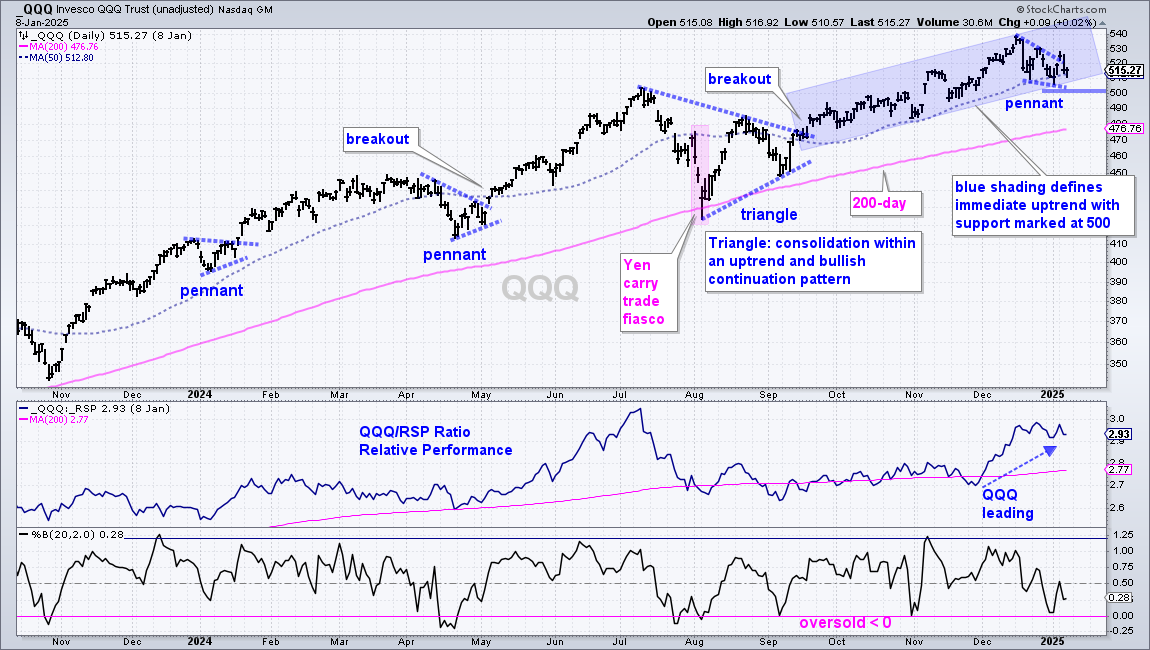
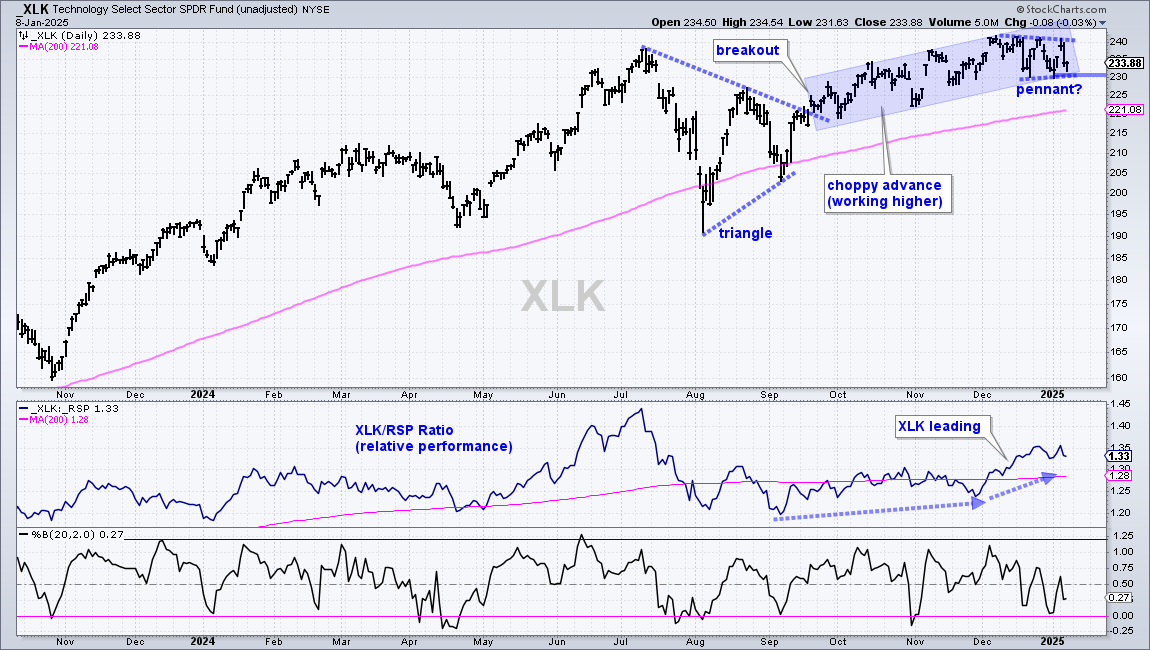
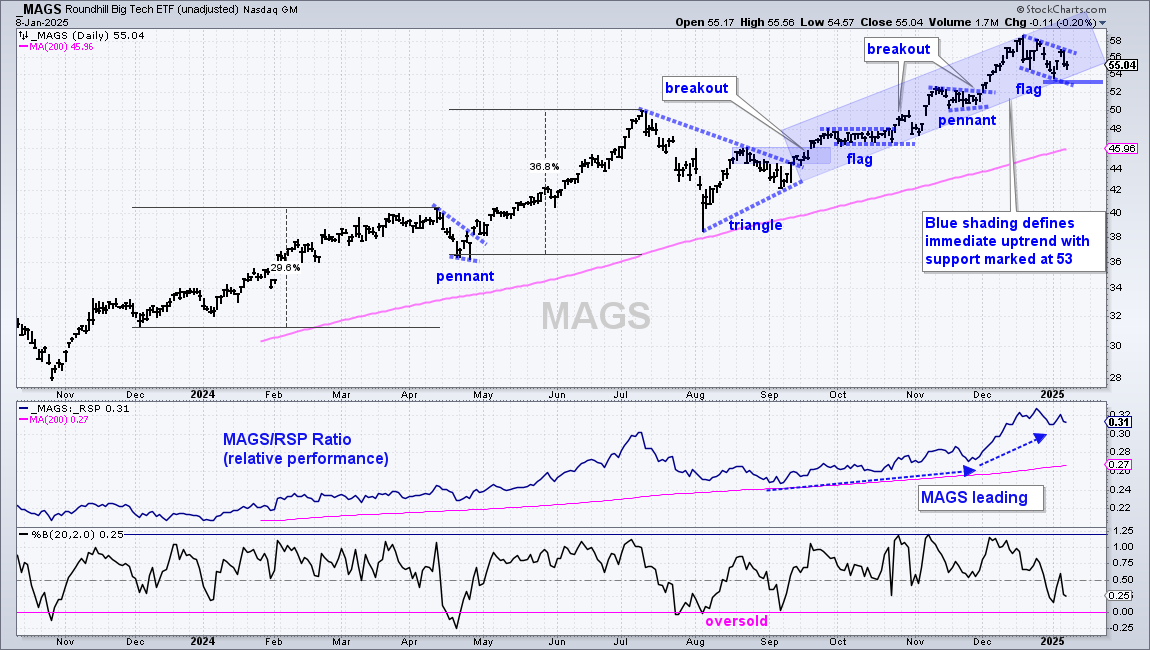
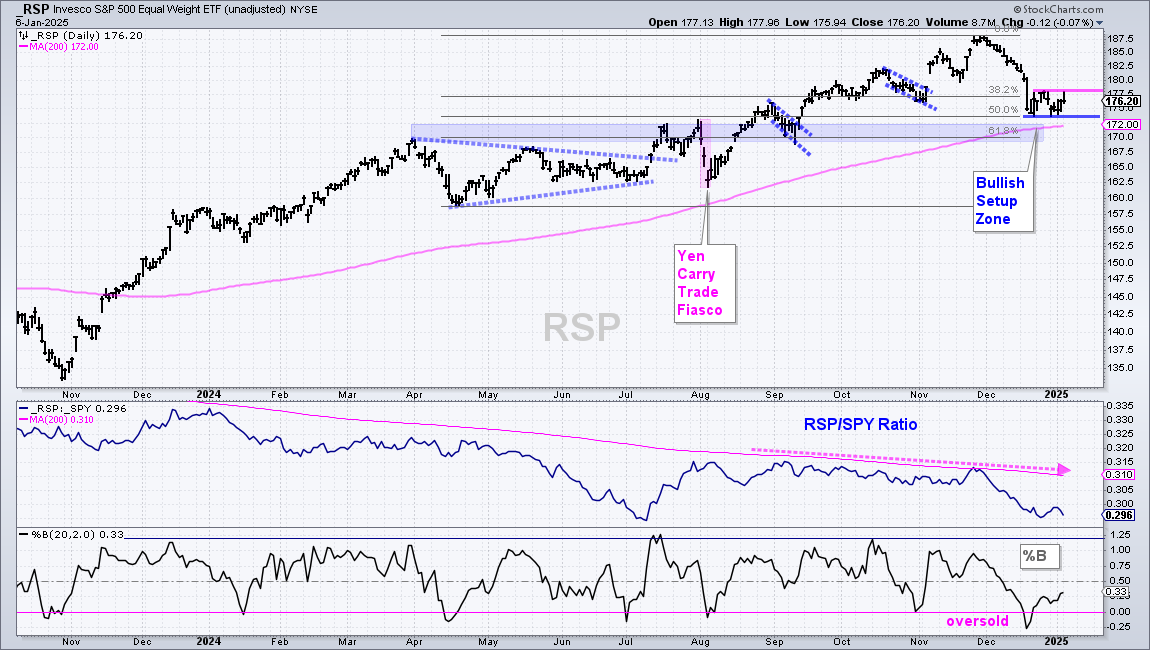
Today’s report starts with long-term and short-term breadth. We then turn to SPY, QQQ, XLK and MAGS. These leaders are in uptrends since their triangle breakouts in mid September and I am using the December lows to mark support. Support breaks in these key ETFs would weigh on stocks and broaden the correction. The S&P 500 EW ETF (RSP), mid-caps and small-caps led the way lower in December and these ETFs firmed the last three weeks with consolidations. The battle lines are drawn. Upside breakouts in these ETFs would show broadening upside participation and be bullish for stocks overall.
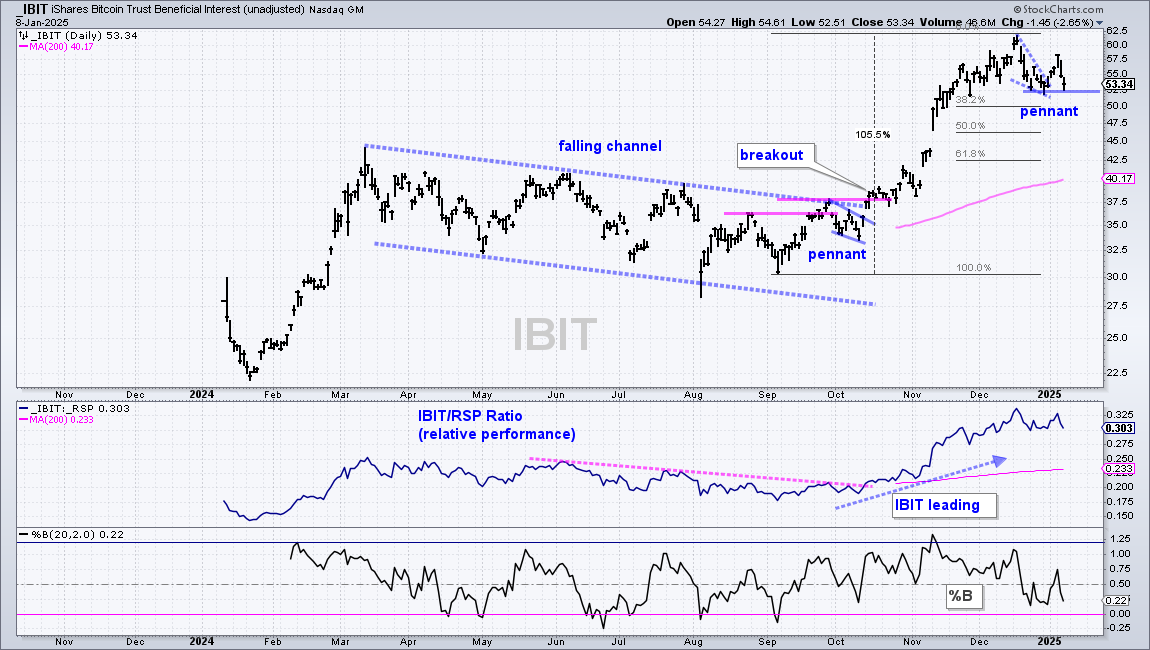
We then focus on a group of ETFs showing strength in January with flag/pennant breakouts (CIBR, FINX, XLC, SKYY, IHI, AMLP). There is also a group with bullish setups working, but no breakouts just yet (XLI, ITA, IGV, CLOU). The Semiconductor ETFs (SMH,SOXX) fell back after their breakouts, but I still think the cup is half full. We close with a bullish triangle in the Gold SPDR and a shaky pennant breakout for the Bitcoin ETF.
Note that the US equity markets are closed on Thursday, January 9th, in observance of a National Day of Mourning for President Jimmy Carter.
Short of a Breadth Thrust
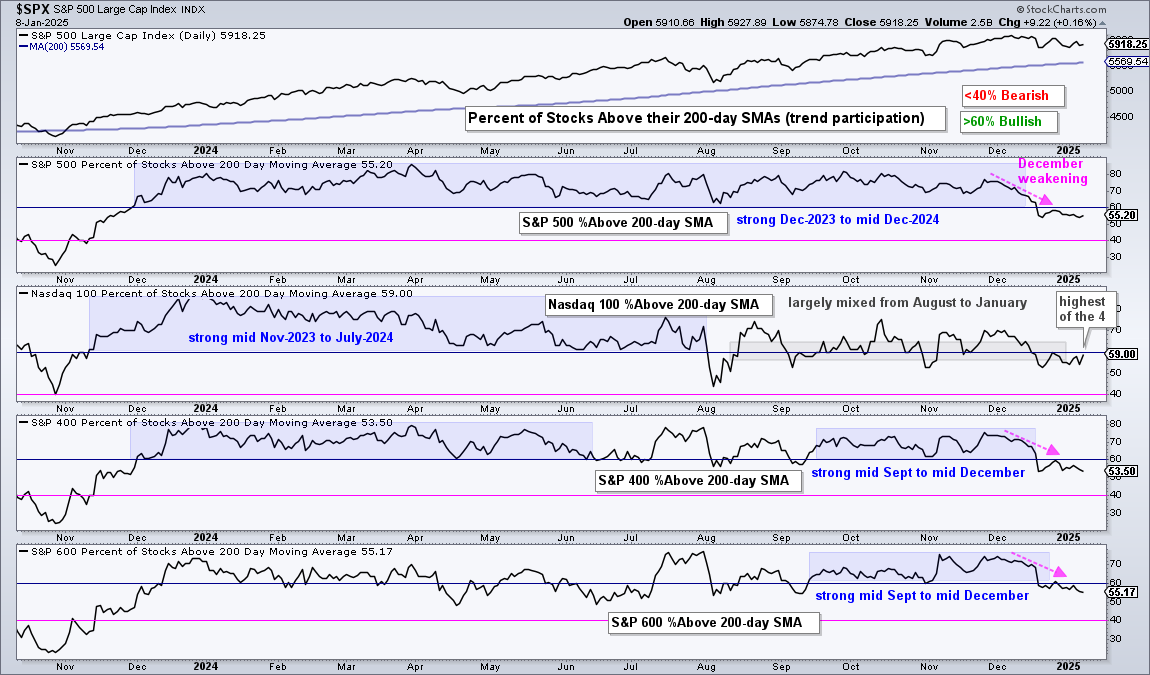
The chart below shows the percentage of stocks above the their 200-day SMAs for the S&P 500, Nasdaq 100, S&P MidCap 400 and S&P SmallCap 600. All four fell below 60% in December and remain below 60%. Some 55% of S&P 500 stocks are above their 200-day SMAs, which means 45% are below and in long-term downtrends. Of note, NDX %Above 200-day is the highest of the four (59%) and showing some relative strength.
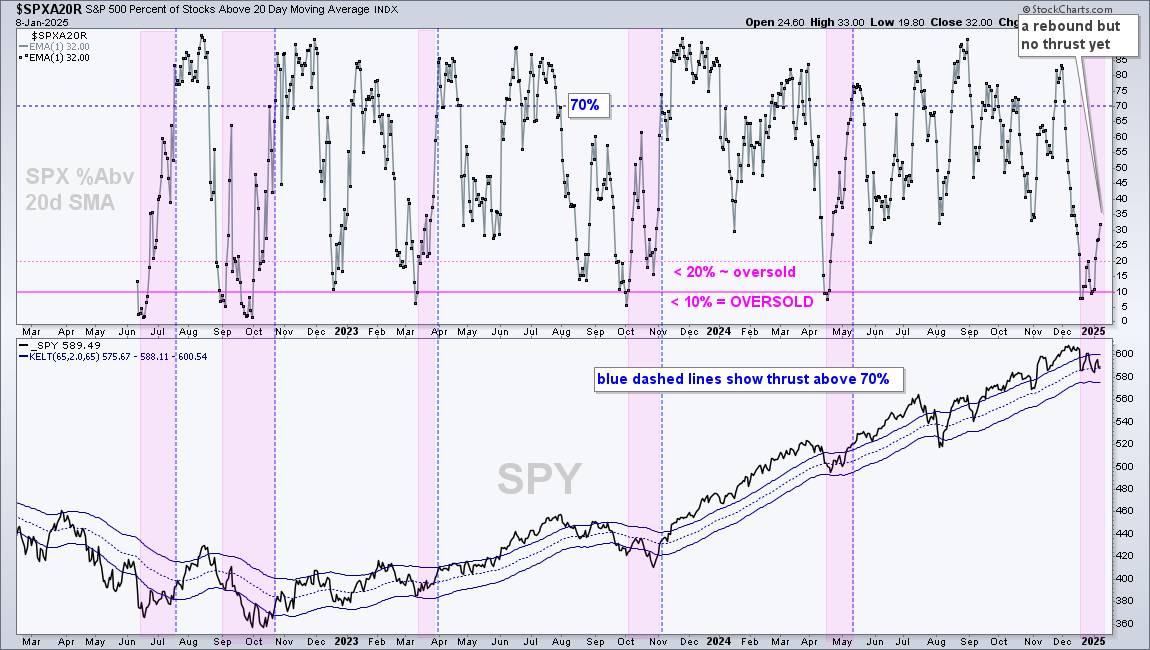
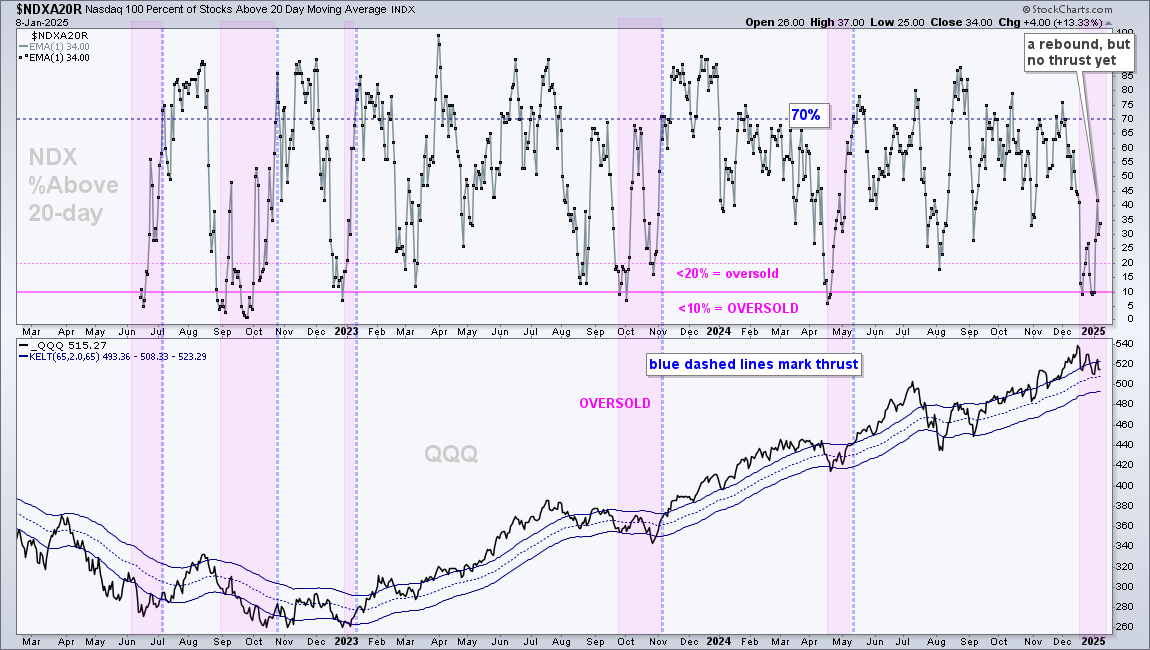
As noted on Tuesday, I am watching S&P 500 Percent Above 20-day SMA ($SPXA20R) and Nasdaq 100 Percent Above 20-day SMA ($NDXA20R) for signs of an upside participation thrust. These needs to exceed 70% to signal a robust rebound. The charts below show these indicators for reference.
SPY Works its Way Higher
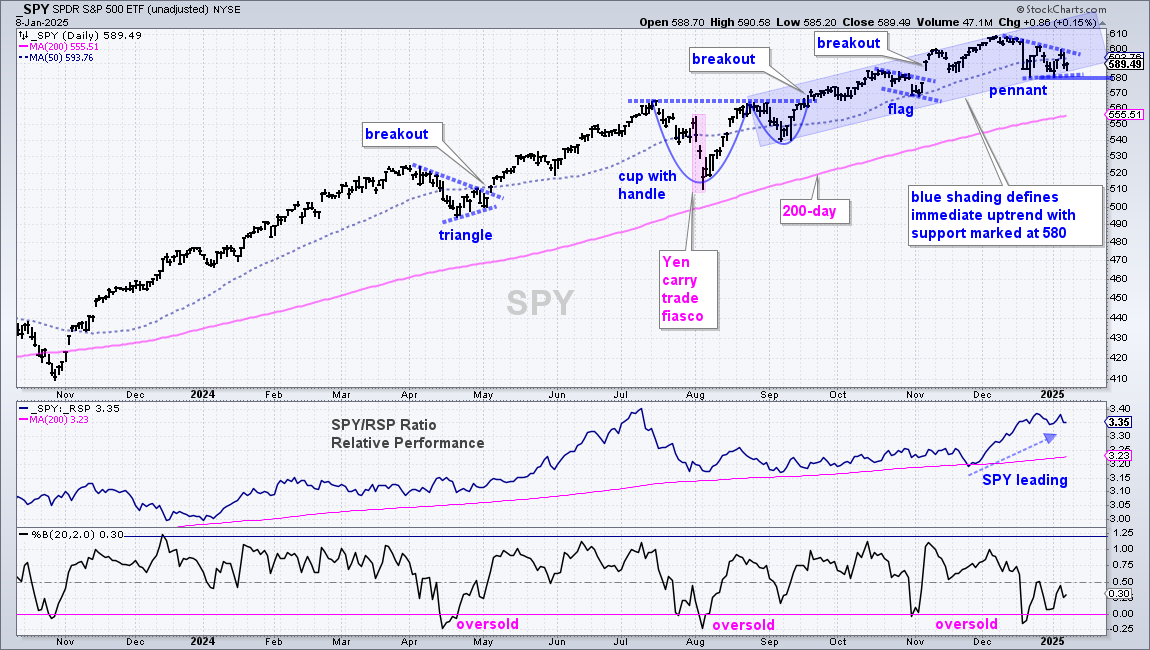
The blue shading defines the immediate uptrend, which kicked off with the cup-with-handle breakout in mid-September. Support is set at 580 and the bulls are clearly in control as long as this level holds. A break below 500 would argue for a correction back towards the rising 200-day SMA. Shorter-term, SPY formed a pennant as it oscillated around the 50-day SMA. Pennants are short-term continuation patterns that get their bias from the prior move, which was up. This pennant is a bullish continuation pattern and a breakout at 600 would be bullish. This setup is valid as long as 580 holds.
QQQ also Works its Way Higher
The blue shading defines the immediate uptrend, which kicked off with the triangle breakout in mid-September. Support is set at 500 and the bulls are clearly in control as long as this level holds. A break below 500 would argue for a correction back towards the rising 200-day SMA. Shorter-term, QQQ formed a pennant and broke the support line with a pop on Monday. The ETF fell back over the last two days, but I attribute this to news cycle noise. Pennants are short-term continuation patterns that get their bias from the prior move, which was up. This pennant is a bullish continuation pattern that is in play as long as 500 holds.
The next charts shows XLK and MAGS with similar setups.
RSP Holds the Key to Broader Market
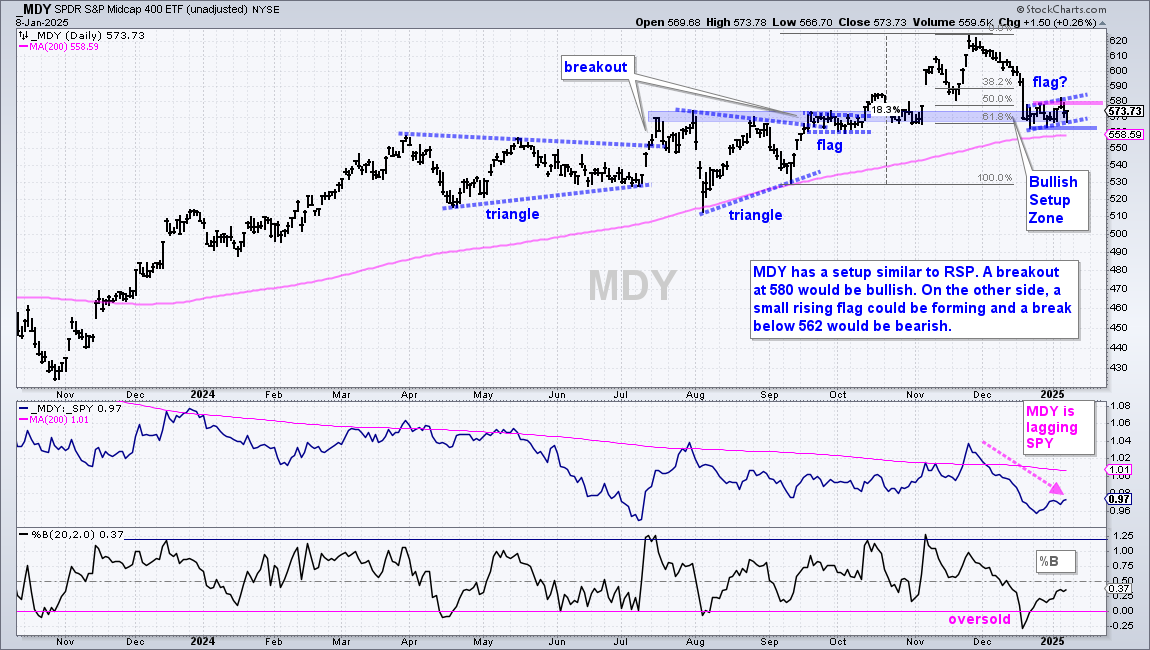
The S&P 500 EW ETF (RSP) consolidated the last three weeks with clear support and resistance levels that will help determine the next move for stocks overall. First, RSP remains in a long-term uptrend with a 52-week high in early December and price above the rising 200-day SMA. RSP fell sharply in December, became oversold as %B dipped below 0 and then firmed near a Bullish Setup Zone. The 50% retracement, broken resistance turned support and rising 200-day mark this zone (blue shading). This zone is where we can expect firming after a pullback and a possible upside reversal. The battle lines are drawn with the three week consolidation. A breakout at 179 would be bullish, while a break below 173 would be bearish. RSP represents the “average” stock in the S&P 500 so the direction of the break will have consequences for the broader market (mid-caps and small-caps).
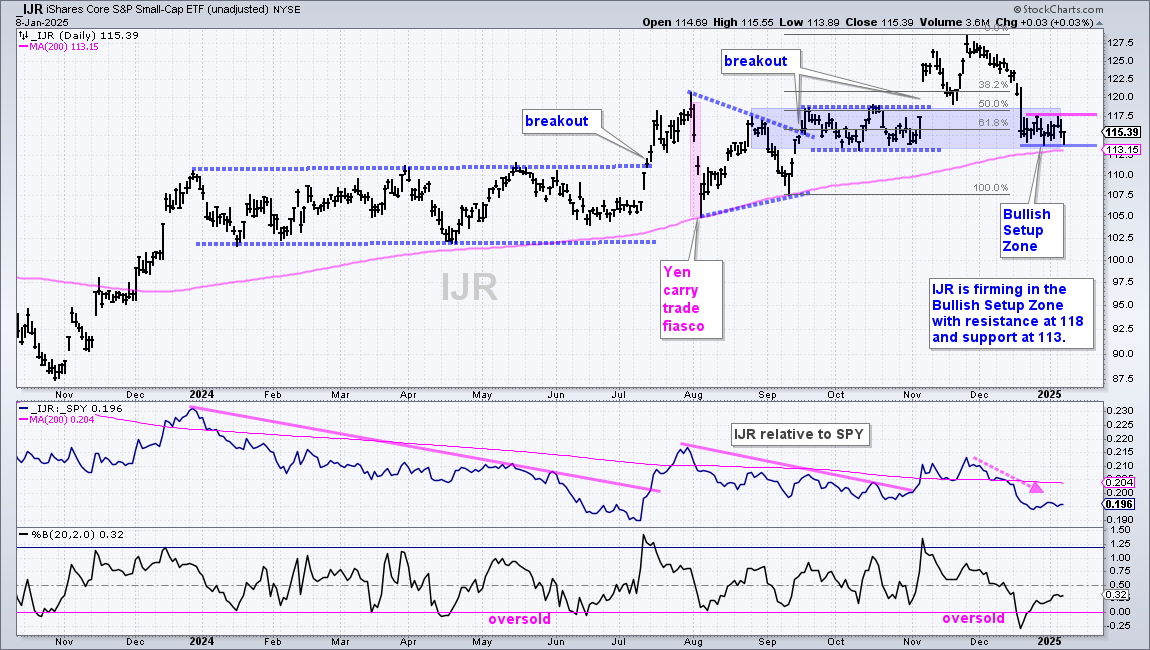
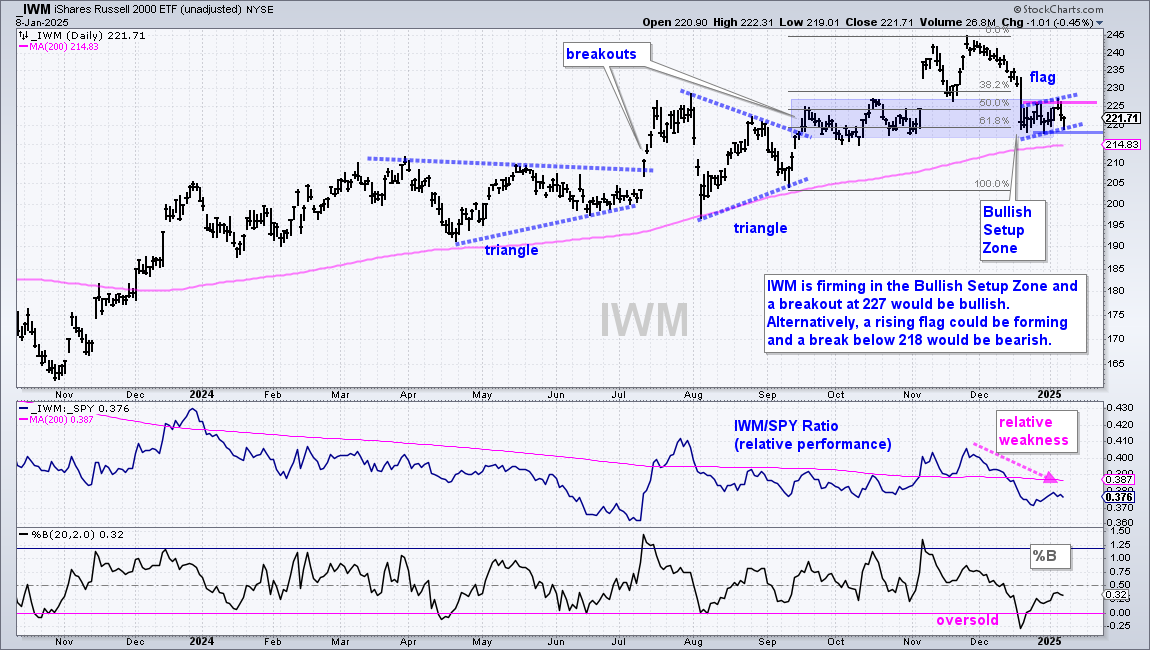
The next charts show MDY, IJR, IWM and XLF, KRE and KIE with similar setups. As noted before, small-caps are more sensitive to interest rates and the recent rise in the 10-yr Treasury Yield is weighing.
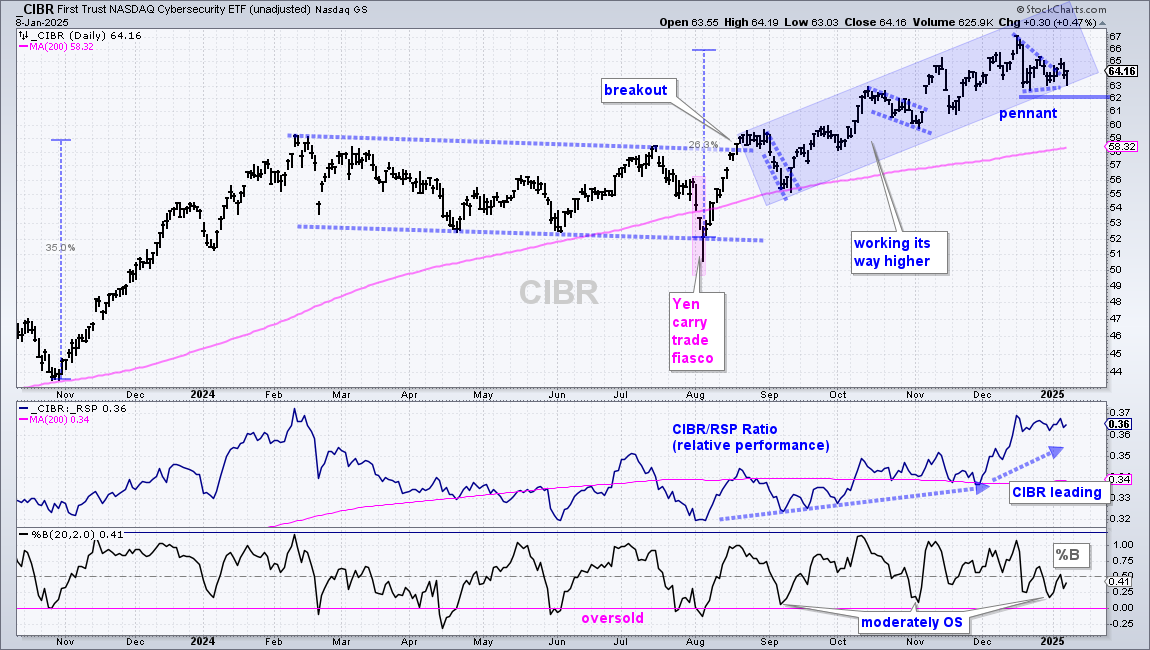
A number of ETFs are in clear uptrends, but they stalled or fell back over the last few weeks. They formed small bullish continuation patterns, such as flags or pennants. These represent a pullback or consolidation within the bigger uptrend and breakouts are bullish. The first chart shows the Cybersecurity ETF (CIBR) with the blue shading defining the immediate uptrend. Support is set at 62 and the bulls are in control as long as this level holds. A pennant (small triangle) formed in the second half of December and CIBR broke the upper line with a surge on Monday. The ETF fell back over the last two days, but the pattern remains in play, and bullish as long as 62 holds.
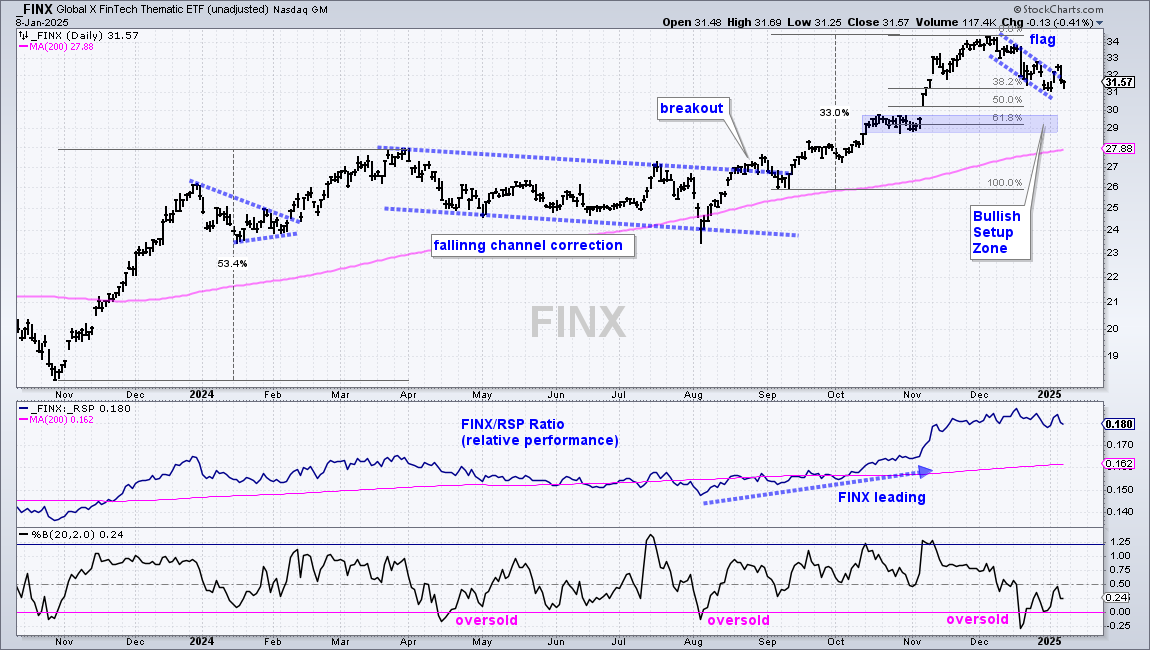
The next chart shows the FinTech ETF (FINX) with a flag breakout on Monday and pullback the last two days.
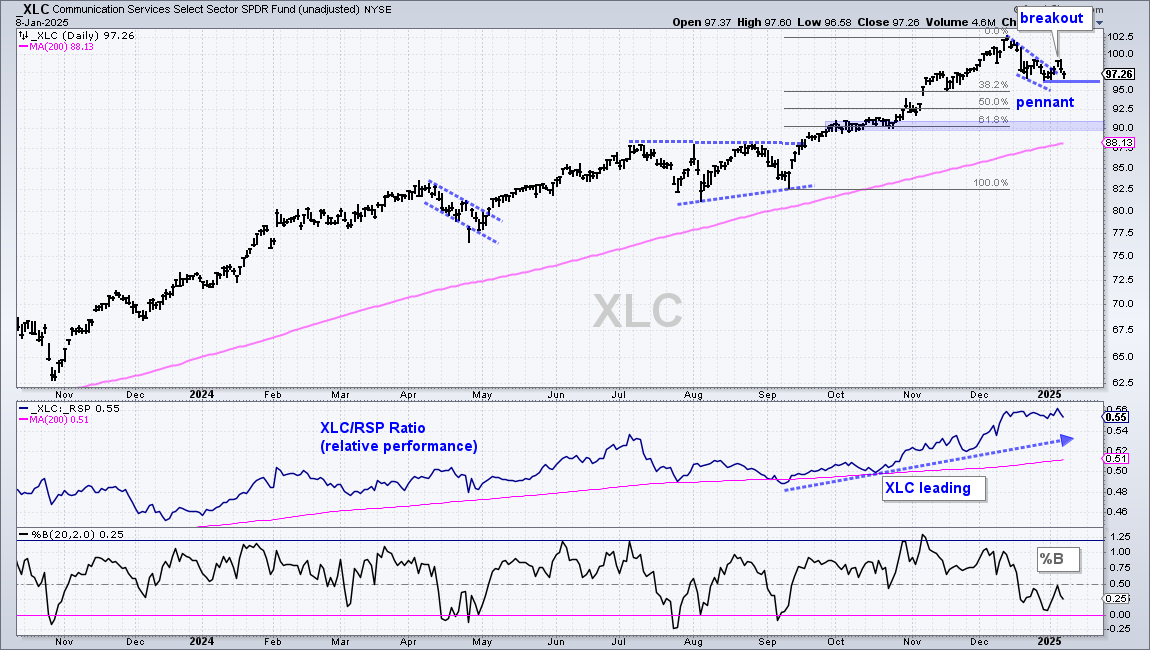
The next chart shows the Communication Services SPDR (XLC) with a pennant breakout on Monday and pullback the last two days.
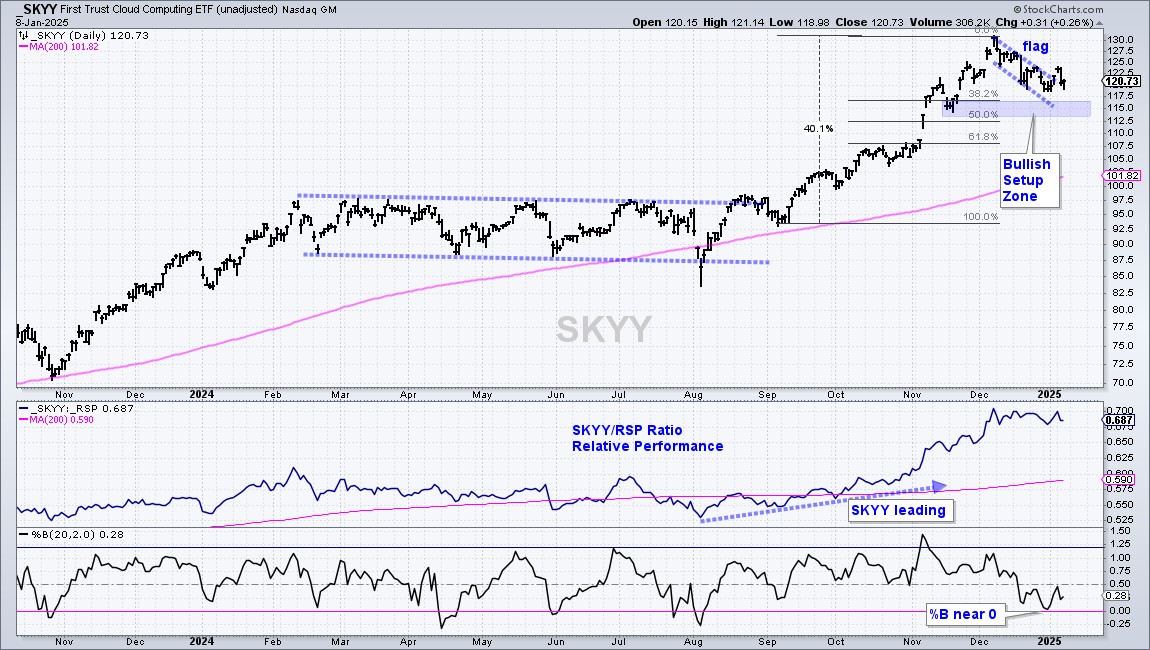
The next image shows the Cloud Computing ETF (SKYY) with a flag breakout and two day pullback after the breakout.
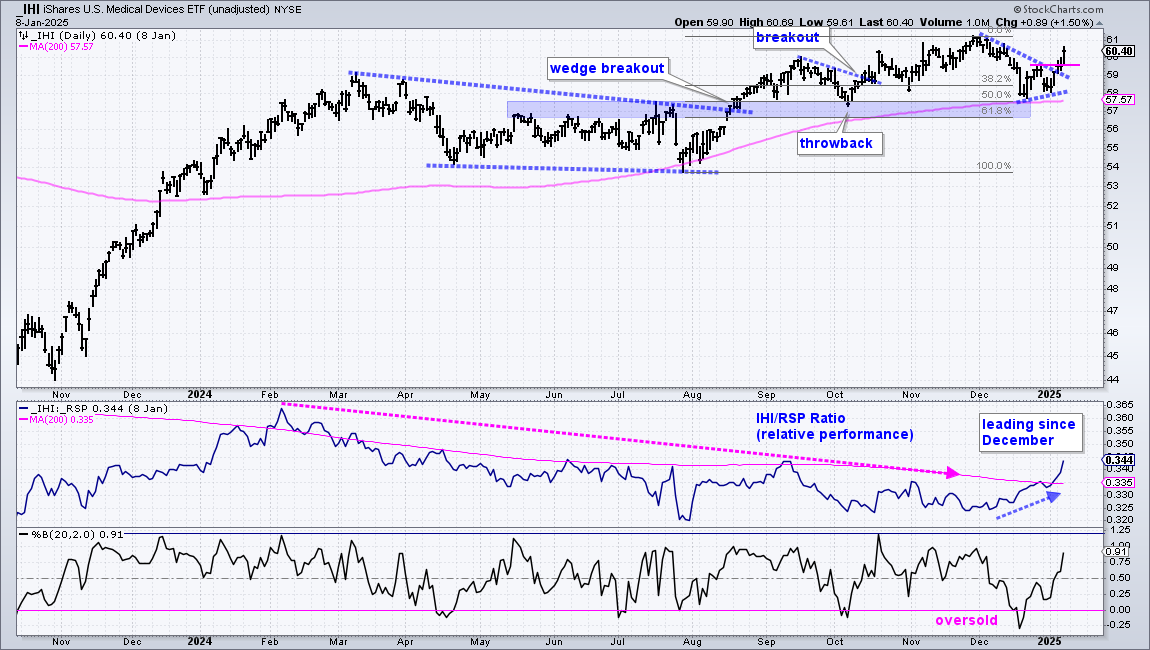
The next image shows the Medical Devices ETF (IHI) with a pennant breakout and continued strength the last two days. IHI is also leading since December as the price-relative moved above its 200-day SMA this year.
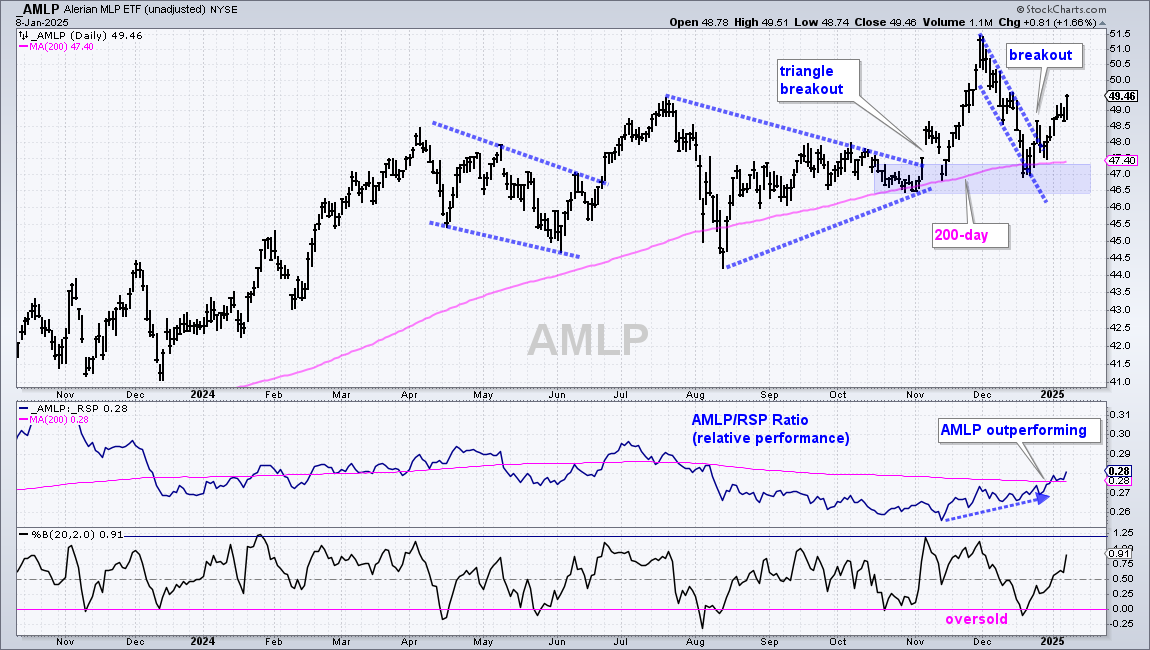
The next image shows the MLP ETF (AMLP) with a rather sharp pullback in December and a channel breakout in late December. AMLP extended higher in January and the AMLP/RSP ratio moved above its 200-day SMA (relative strength).
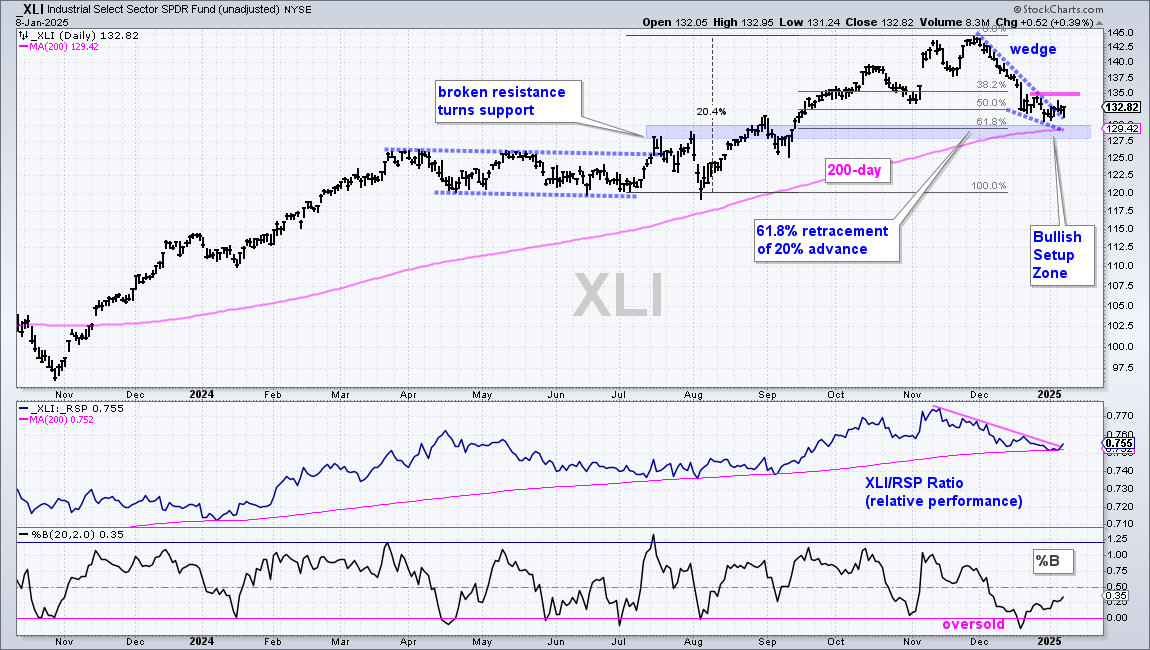
The next four ETFs pulled back in December and have yet to reverse these pullbacks with breakouts. All are in long-term uptrends with new highs in November or December and price above the 200-day SMA. The first chart shows XLI trading near a Bullish Setup Zone. The blue shading marks broken resistance turned support, the 61.8% retracement and the rising 200-day SMA. %B also became oversold in mid December. XLI is firming, but remains short of a breakout. Resistance is set at 135 and a breakout here would be bullish. This would be positive for the market.
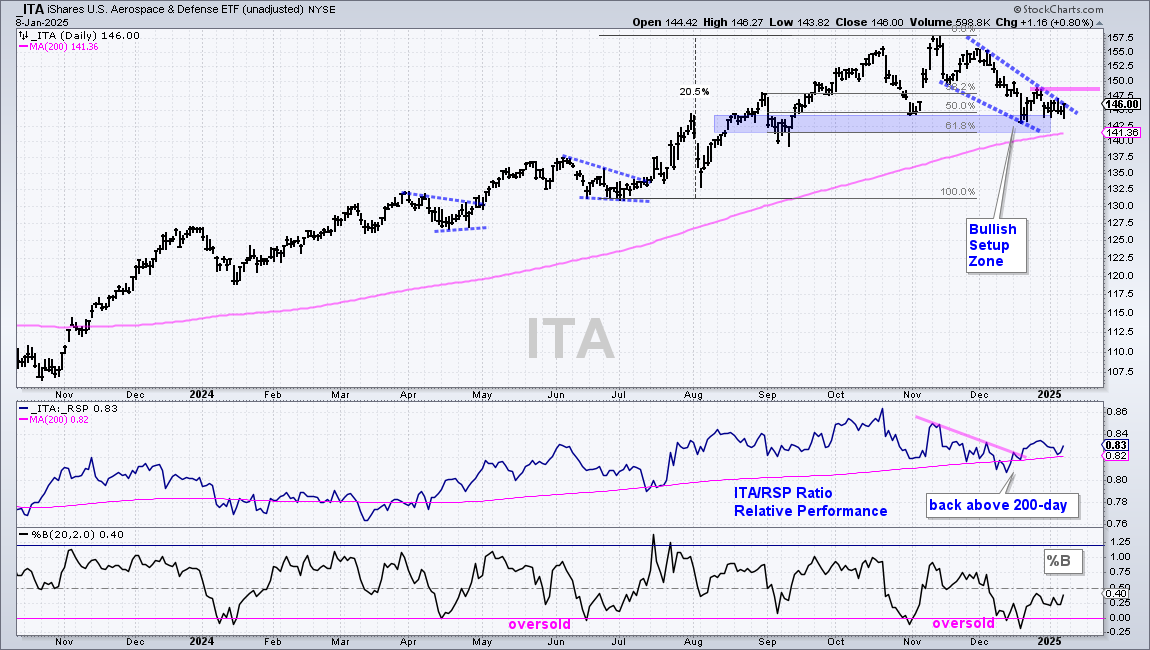
The next chart shows the Aerospace & Defense ETF (ITA) with a similar setup.
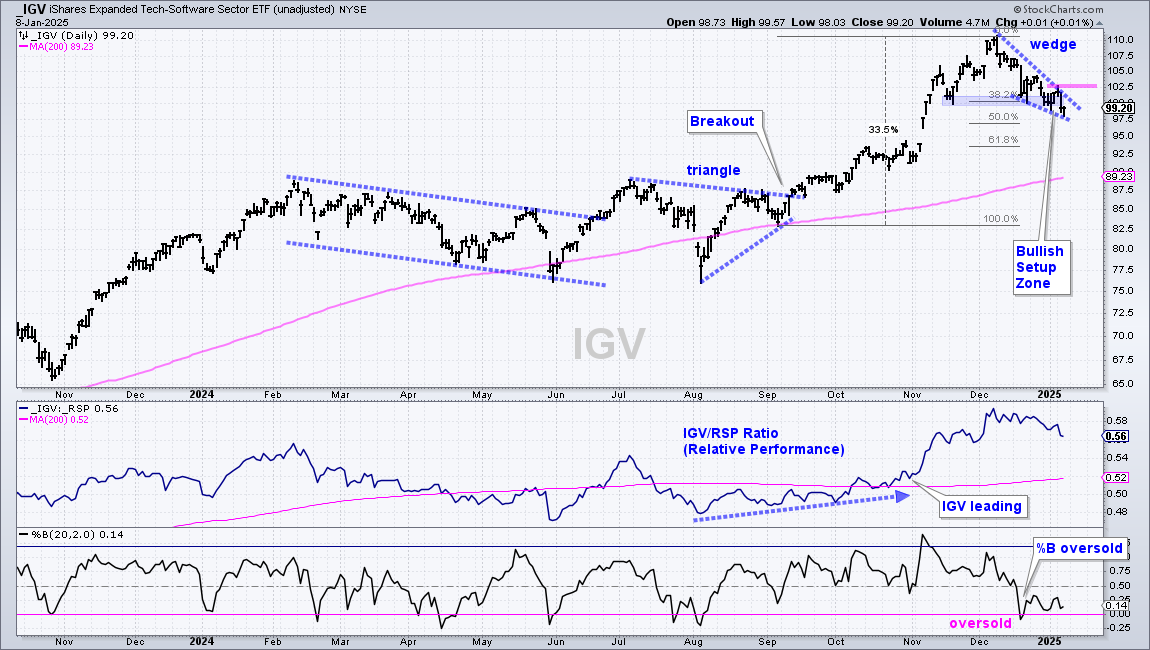
The next chart shows the Software ETF (IGV) with a falling wedge and resistance marked at 103.
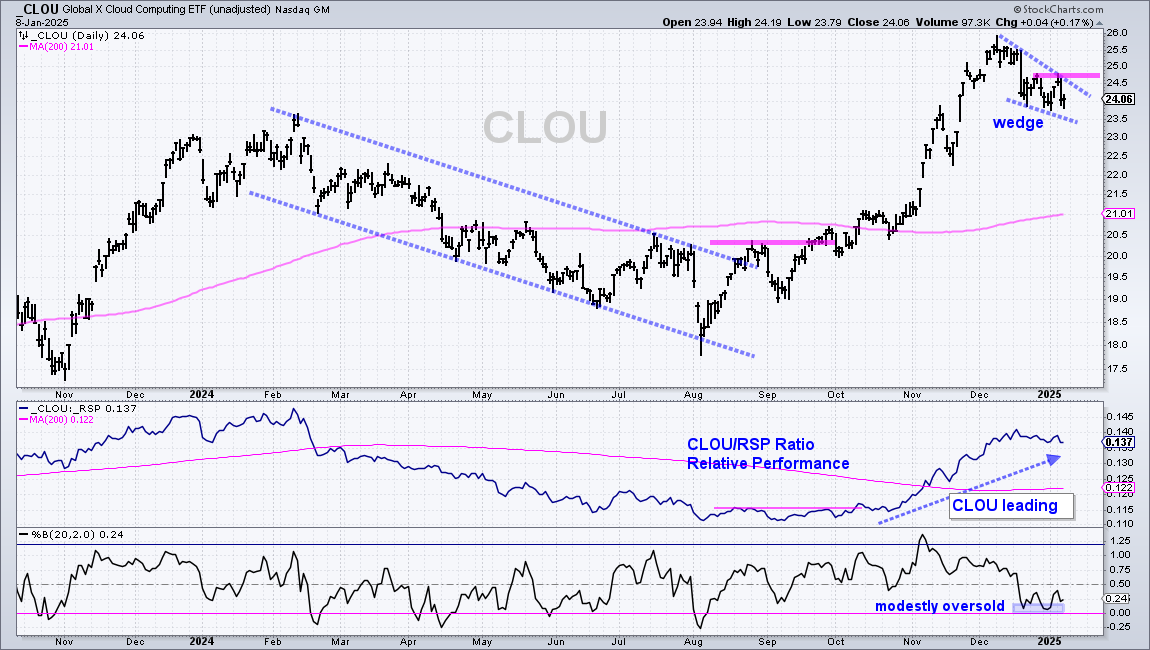
The next chart shows the Cloud Computing ETF (CLOU) with falling wedge resistance at 24.80.
Semiconductor ETFs Fall Back after Breakouts
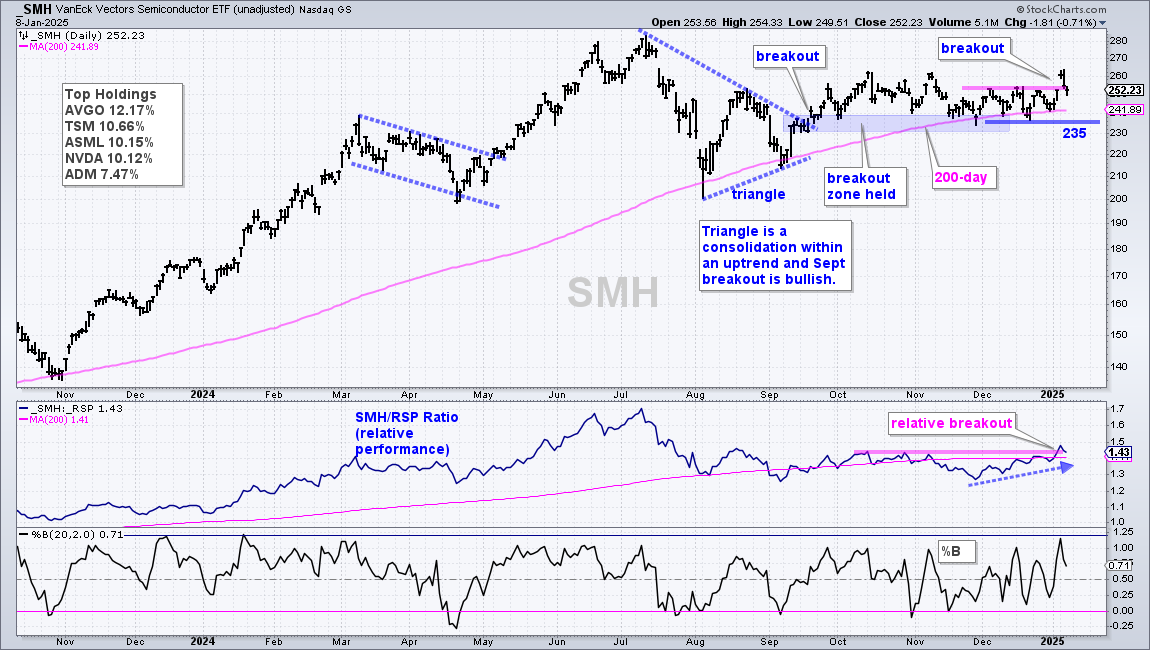
The Semiconductor ETF (SMH) broke its December highs with a surge on Monday and then fell back with the rest of the market over the last two days. I am not ready to call this breakout a failure and view the cup as half full. We need to allow some wiggle room, especially with the crazy news flow, which is unlikely to stop. Overall, the triangle breakout is the dominant pattern and this breakout held, as did the 200-day SMA. The bulls get the benefit of the doubt as long as 235 holds.
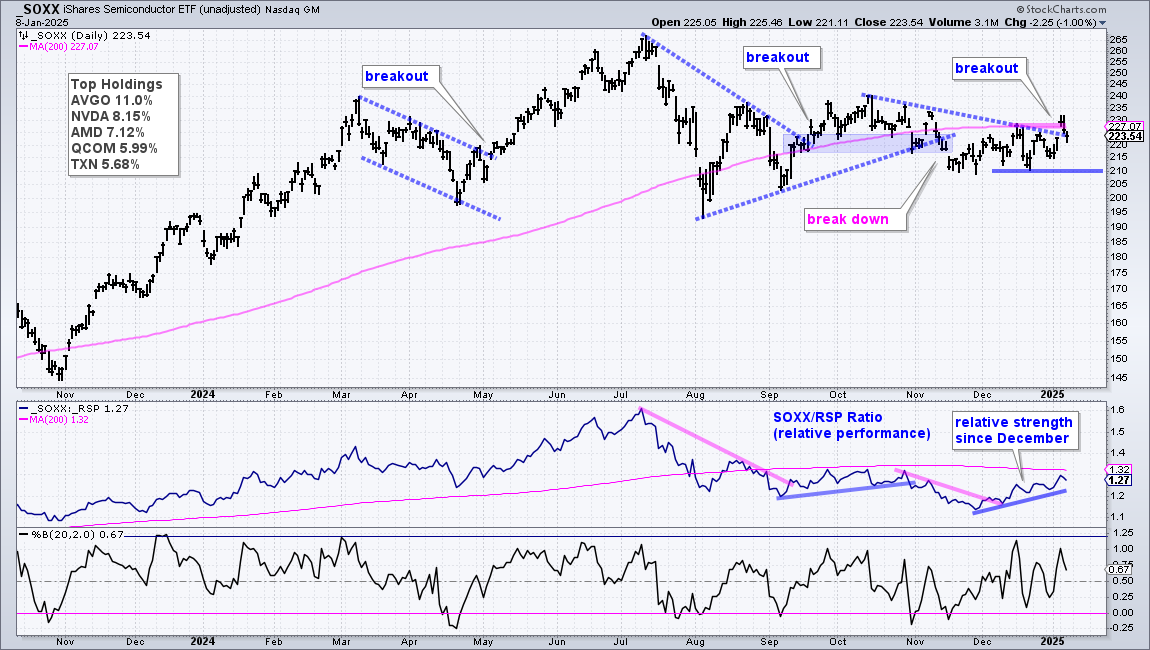
The Semiconductor ETF (SOXX) is not as strong as SMH, but it has a breakout working as well. First, the triangle breakout in mid September did not hold as SOXX broke support in mid November. The ETF did not fall apart, but did remain below its 200-day SMA until early January. With a surge on Monday, SOXX broke the mid December high and 200-day SMA. This move reverses the downswing from mid October to December. I am setting support at 210.
Gold SPDR Forms Bullish Triangle (GLD)
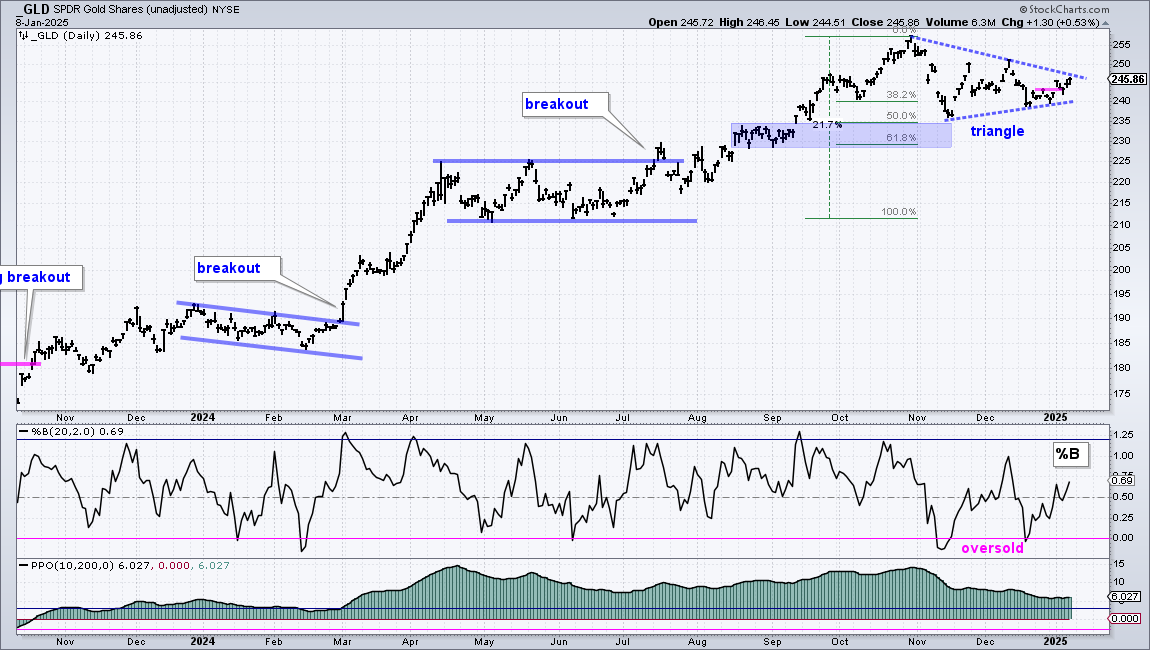
The Gold SPDR (GLD) is forming a triangle consolidation within a long-term uptrend. GLD hit a new high in late October and then corrected with a triangle the last two months. The swing within the triangled turned down with a sharp decline in mid December, but GLD firmed around 240 and broke short-term resistance with a bounce the last two days. The swing within the triangle is now up and this increases the chances for a bigger breakout at 250. Also notice that there were two oversold readings as %B dipped below 0 in mid November and mid December.
IBIT Falls Back after Pennant Breakout
The Bitcoin ETF (IBIT) doubled from early September to mid December and then fell back into yearend. The ability to double in three months tells us that this is one volatile ETF. Be prepared for a wild ride. A pennant formed with the pullback into late December and IBIT broke out with a surge above 55 to start the year. This surge is already faltering as IBIT fell back the last two days. The ETF has support from the pennant lows so the first test is at hand. A break below 52 would argue for a deep pullback, perhaps to the 50% retracement line.