Stocks fell sharply the last two days and these declines were enough to reverse the short-term uptrends in many stock-based ETFs. In particular, the short-term uptrends reversed for SPY and QQQ. This is a big deal because the Composite Breadth Model was already bearish and these two were already in long-term downtrends. These short-term reversals suggest that the bigger downtrends are continuing and to expect lower prices in the coming weeks. As noted on Thursday, September is also one of the weakest months. Downside participation was very broad on Monday and this shows that correlations rise in bear market declines. This means most stock-based ETFs would be affected if SPY were to test or break its June lows.
About the ETF Trends, Patterns and Setups Report
This report contains discretionary chart analysis based on my interpretation of the price charts. This is different from the fully systematic approach in the Trend Composite strategy series. In this ETF Trends, Patterns and Setups report, I am looking for leading uptrends and tradable setups within these uptrends. While I use indicators to help define the trend and identify oversold conditions within uptrends, the assessments are mostly based on price action and the price chart (higher highs, higher lows, patterns in play). Sometimes the chart assessment can be at odds with the indicators.
This Week's Commentary Schedule
Tuesday – 23 August: Market-ETF Report and Signal-Rank Table Update
Wednesday – 24 August Market-ETF Video and Market Regime Update
Thursday – 25 August: Market-ETF Report and Signal-Rank Table Update
Saturday – 27 August: ETF Signal and Rank Table
AD% and 1-day ROC Confirm Broad Participation
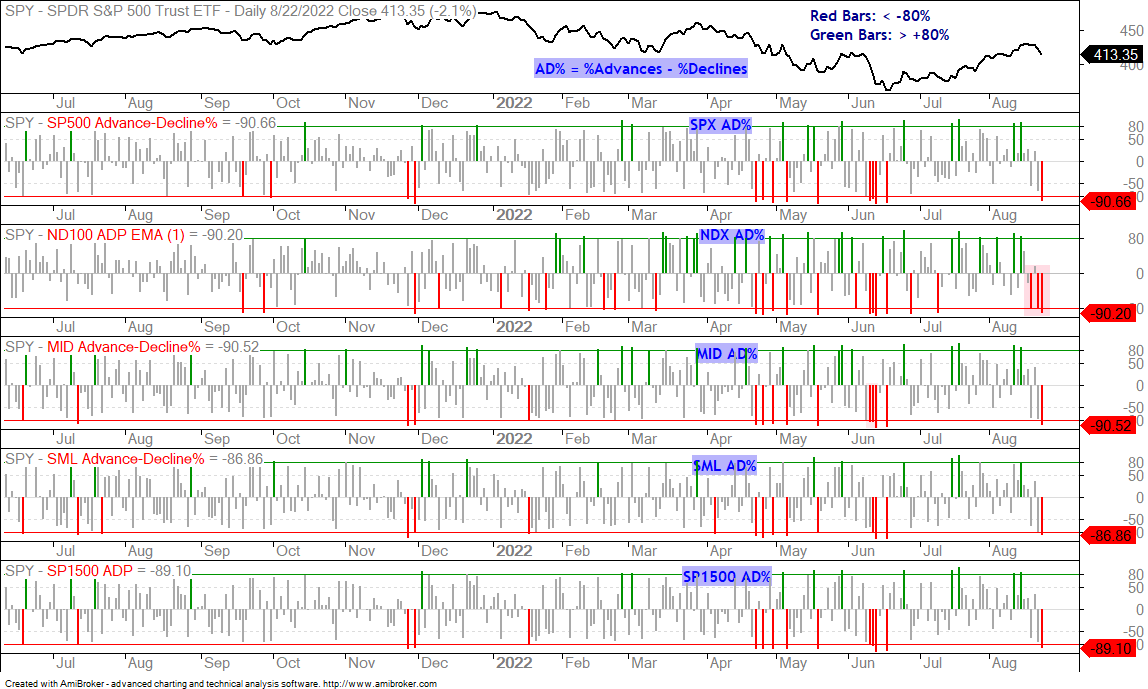
The chart below shows AD% for four indexes. AD% is the percentage of advances less the percentage of declines. A dip below -80% means more than 90% of stocks declined (10% advances – 90% declines = -80%). AD% exceeded -90% for the S&P 500, Nasdaq 100 and S&P MidCap 400, and exceeded -85% for the S&P SmallCap 600 and S&P 1500 (red bars). Selling pressure hit 10 of 11 sector SPDRs and most industry groups. Nasdaq 100 AD% experienced three -80% down days within the last four days (red shading), which shows strong selling pressure within the Technology sector.
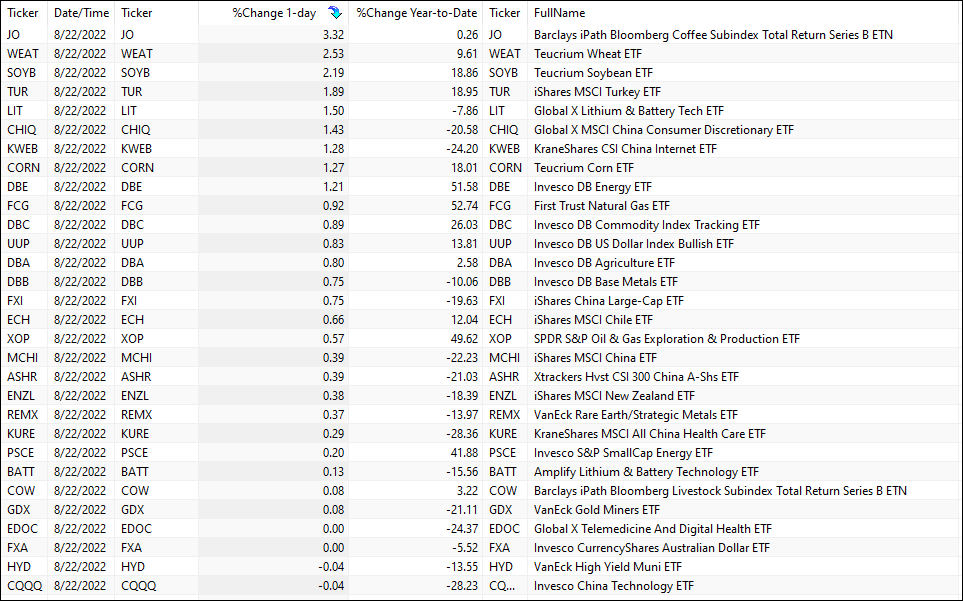
The table below shows ETFs that bucked the selling pressure and advanced on Monday. The table is sorted by the %Change 1-day and also shows the %Change Year-to-date for reference. Several commodity-based ETFs moved higher (JO, WEAT, SOYB, CORN, DBE, DBC, DBA, DBB). There are a few China-based ETFs and some energy-based ETFs in the mix as well. I am not interested in China-based ETFs at the moment, but strength in commodity and energy ETFs is something to note.
Composite Breadth Model Remains Bearish
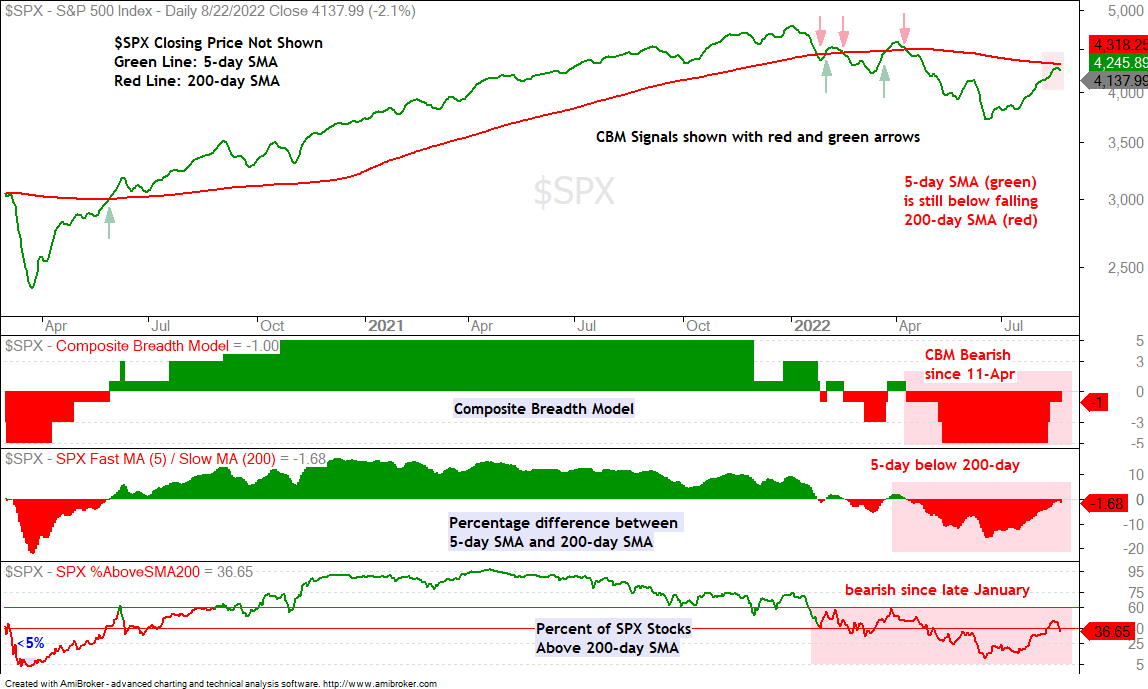
The Composite Breadth Model (CBM) hit its make or break point in mid August and broke as SPY fell 3.4% the last two days. This was the largest two day decline since mid June. The breadth inputs within the CBM remain split with the S&P 500 and S&P 1500 Thrust Models bullish, the S&P 500 and S&P 1500 Trend Models bearish. The S&P 500 5/200 cross remains bearish and this means the model has remained bearish (-1). The 5-day SMA for the S&P 500 is currently 1.68% below the 200-day. Also note that less than 40% of S&P 500 stocks are above their 200-day SMAs (bottom window).
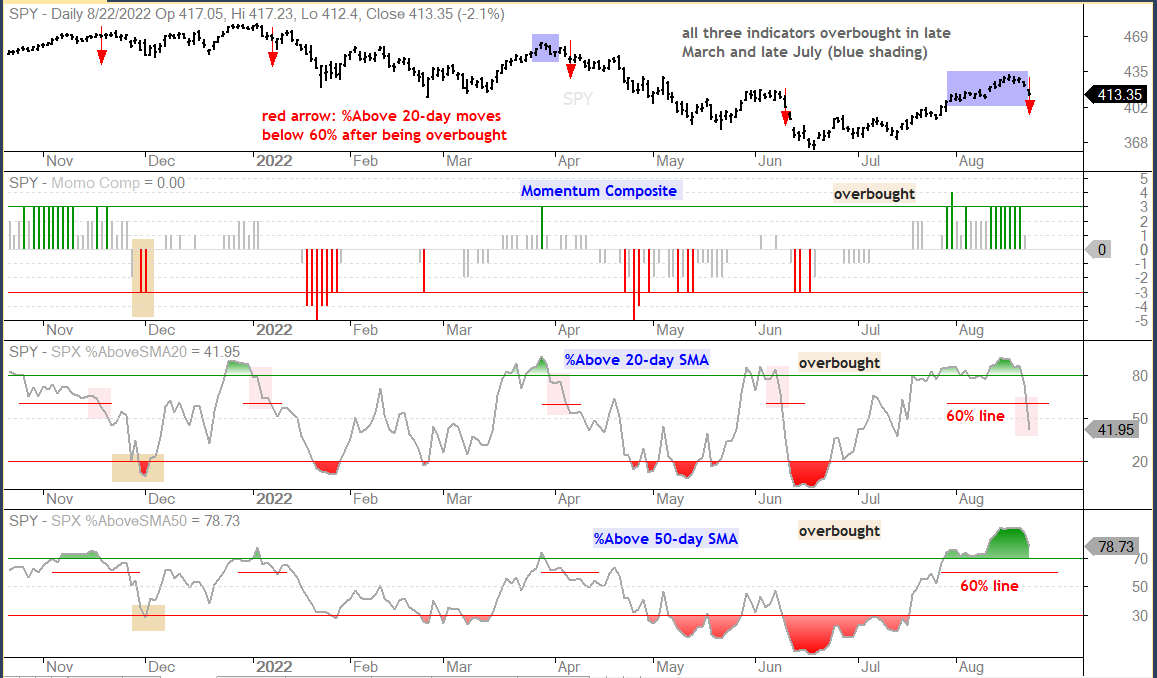
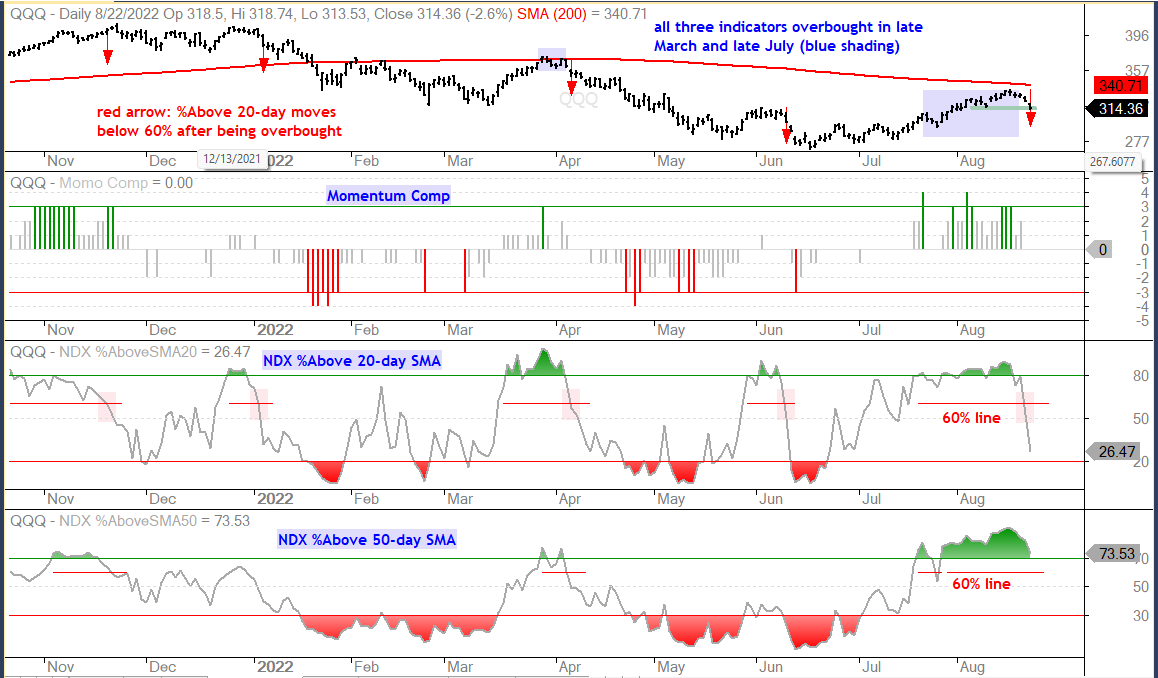
The percentage of stocks above the 20-day SMA for the S&P 500 and Nasdaq 100 fell below 60% on Monday to trigger a short-term bearish signal. Both became overbought in late July and remained overbought into mid August. The red arrows on the price chart and red shading on SPX %Above 20-day SMA show the current signal and prior signals.
The next chart shows the same for NDX %Above 20-day SMA. These signals suggest that the short-term uptrend has reversed and we are now in a short-term downtrend. Note that the long-term trend was down and remains down. This means the new short-term downtrend is signaling a continuation of the bigger downtrend.
SPY Fails at Falling 200-day SMA (plus QQQ and IWM)
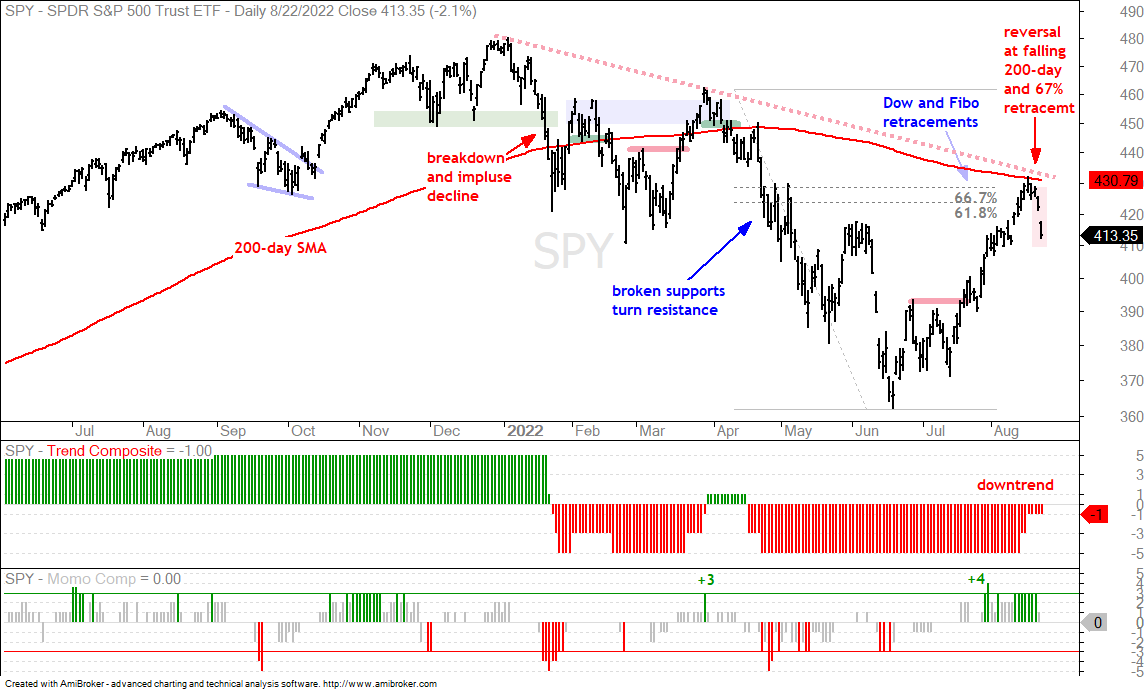
The S&P 500 SPDR (SPY) surged to its falling 200-day SMA and reversed with a sharp decline on Friday and a gap-plunge on Monday. The gap is a breakaway gap and the sharp decline marks a clear failure at the 200-day. This reversal also occurred near the 66.7% retracement line, which means SPY retraced around 2/3 of the March-June decline. Think of this retracement as two steps up after three steps down. The downtrend continues as long as there are more down steps than up steps. Thus, while the July-August surge was strong when viewed on its own, it was still a counter trend bounce when looking at the bigger picture.
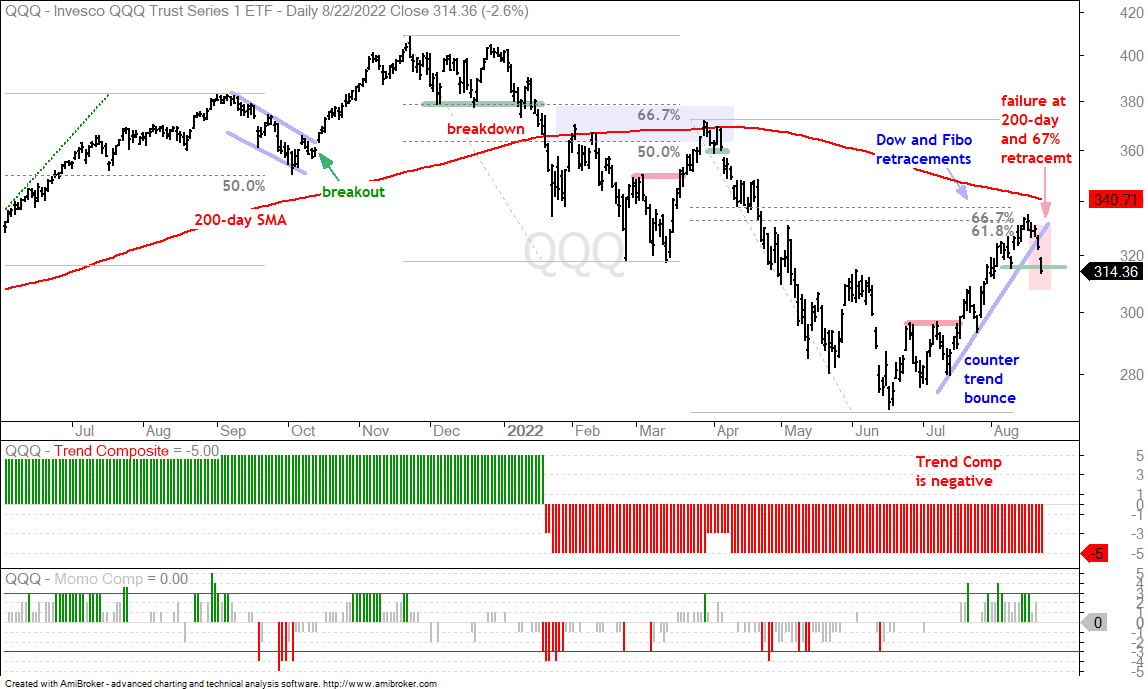
The next chart shows QQQ reversing near the Dow-Fibo retracements with a sharp decline the last four days and a gap-plunge on Monday. This advance was a counter-trend bounce within a bigger downtrend and the counter-trend bounce has not reversed. Note that the Trend Composite remains negative.
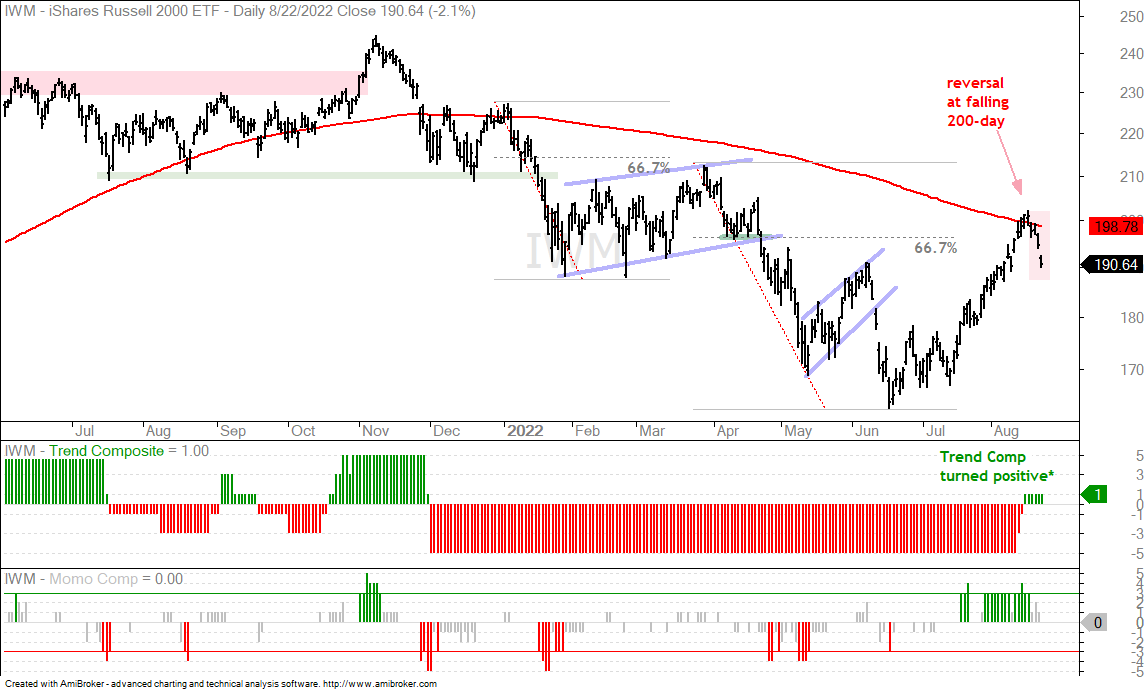
The Russell 2000 ETF (IWM) was the only one of the big three with a positive Trend Composite* (+1). Despite this “uptrend” signal, the odds were stacked against IWM because the Composite Breadth Model was bearish, SPY was in a long-term downtrend and QQQ was in a long-term downtrend. Hence, the asterisk. IWM exceeded the 67% retracement and closed above the falling 200-day SMA for three days. Despite relative strength in small-caps, the broader market environment dominates and IWM ultimately failed at the falling 200-day SMA.
Junk Bonds, C-Discretionary and Semis Reverse Upswings
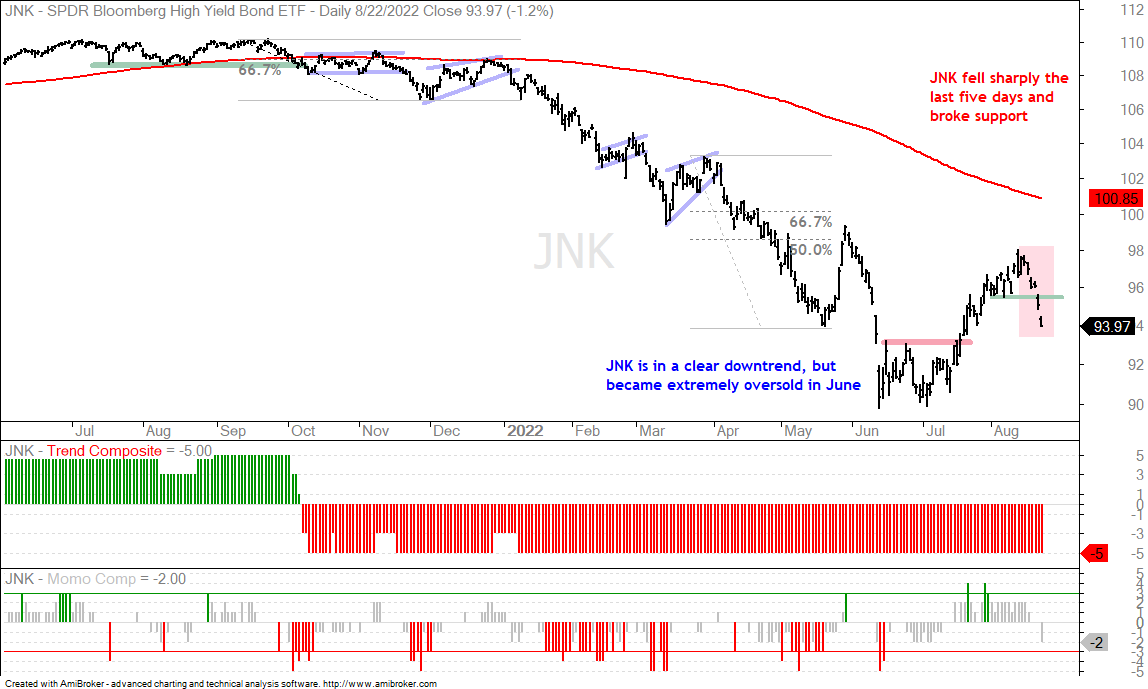
We can see the fear in the market with the plunge in the Junk Bond ETF (JNK). The ETF is down four of the last five days and broke short-term support with a sharp decline on Friday. This declined extended into Monday as junk bonds fell along with stocks. Junk bonds represent the risk-on trade because these are the riskiest bonds. They have the highest yields, they are dependent on a strong economy and they have the highest chances of default. Money moving out of junk bonds shows risk aversion in the financial markets. Note that the long-term trend was already down and the bounce into mid August was viewed as a counter-trend move. This bounce has reversed and the long-term downtrend is taking over again (risk-off).
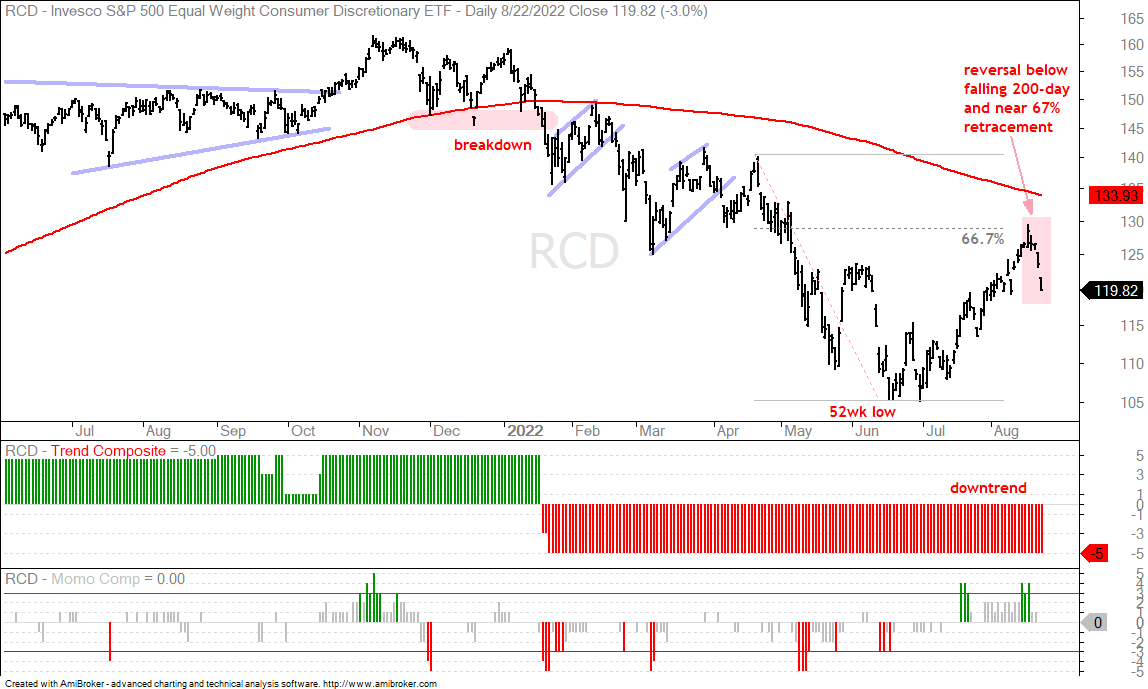
The next chart shows the EW Consumer Discretionary ETF (RCD) reversing after retracing around 2/3 of the prior advance. Again, the long-term trend was already down and RCD was well below the falling 200-day SMA. The reversal here signals that the counter-trend bounce has ended and the long-term downtrend is continuing. Note that the Consumer Discretionary sector includes housing and retail, which are key to the economy.
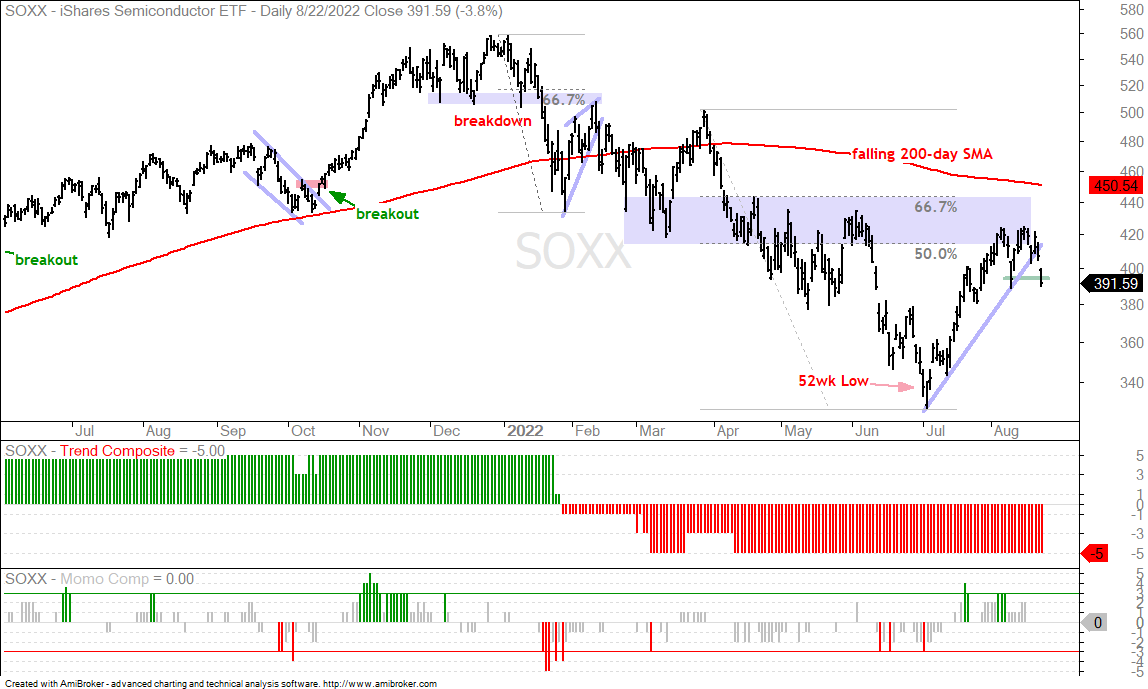
The next chart shows the Semiconductor ETF (SOXX) hitting resistance in the 420 area twice in August and falling sharply the last two days. On a closing basis, SOXX closed below the early August low and the short-term uptrend has reversed. Notice that this reversal occurred in the 50-67% retracement zone and well below the falling 200-day SMA. Semis are an important part of the tech sector, the semiconductor business is cyclical and this breakdown bodes ill for the biggest sector in the stock market.
Big Sectors Reverse Near 200-day SMAs (XLK, XLY, XLF)
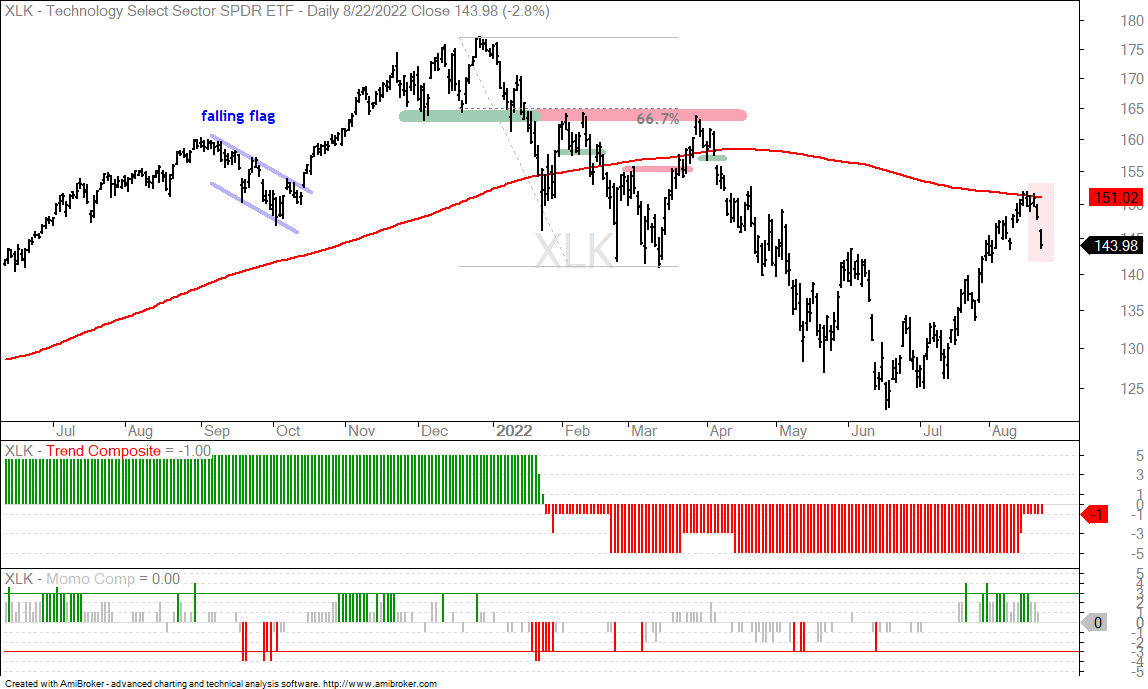
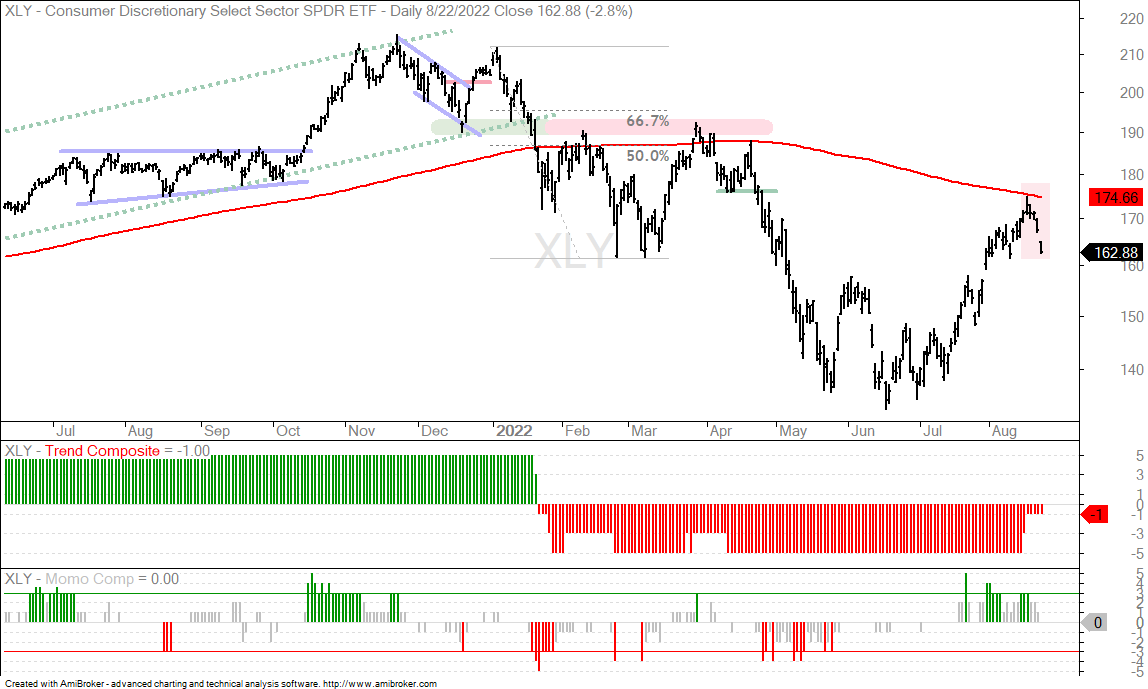
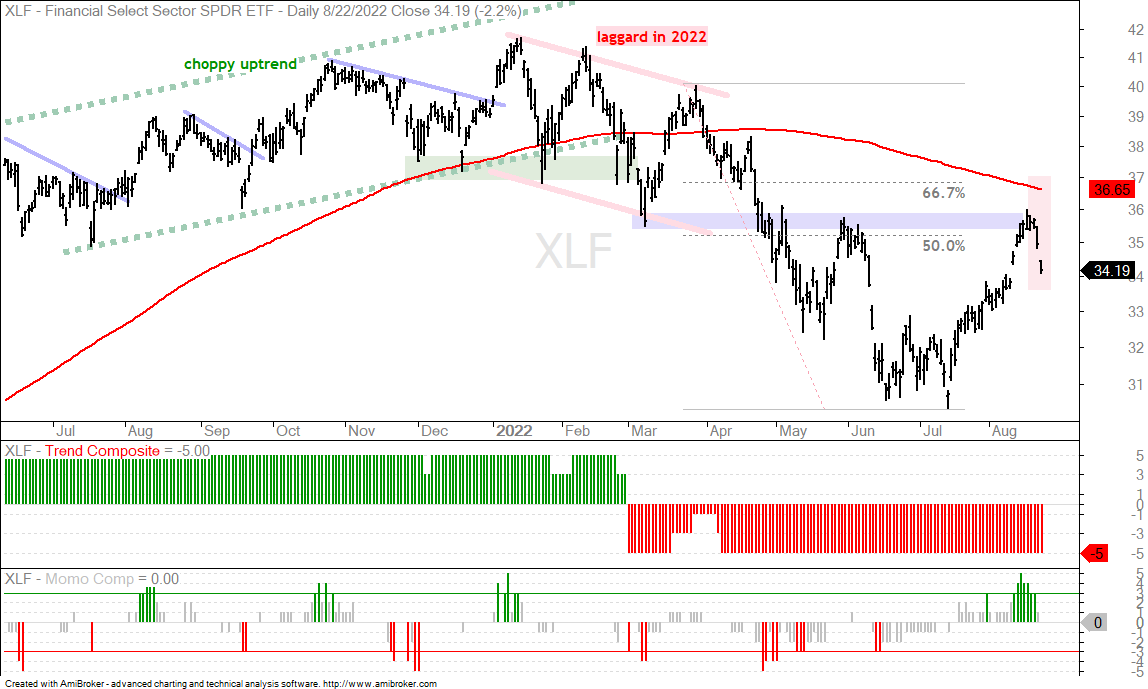
Elsewhere, the Technology SPDR (XLK) and Consumer Discretionary SPDR (XLY) failed at their falling 200-day SMAs. The Industrials SPDR (XLI) exceeded the 200-day for a few days and then plunged. The Finance SPDR (XLF) fell well short of the falling 200-day SMA and turned sharply lower. All four are in downtrends overall and these reversals near the 200-day bode ill for the broader market.
You can learn more about the ATR Trailing Stop and exit strategies in this post, which includes a video and charting options for everyone.
Tech-Based ETFs Fail to Hold Breakouts (IGV, CIBR)
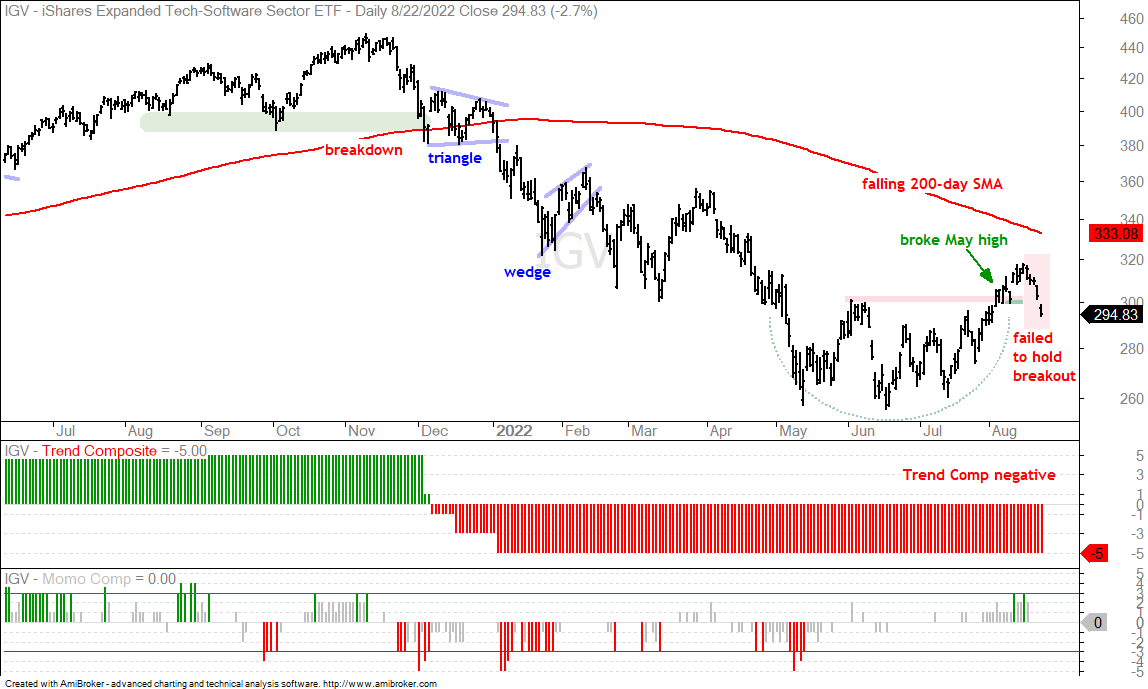
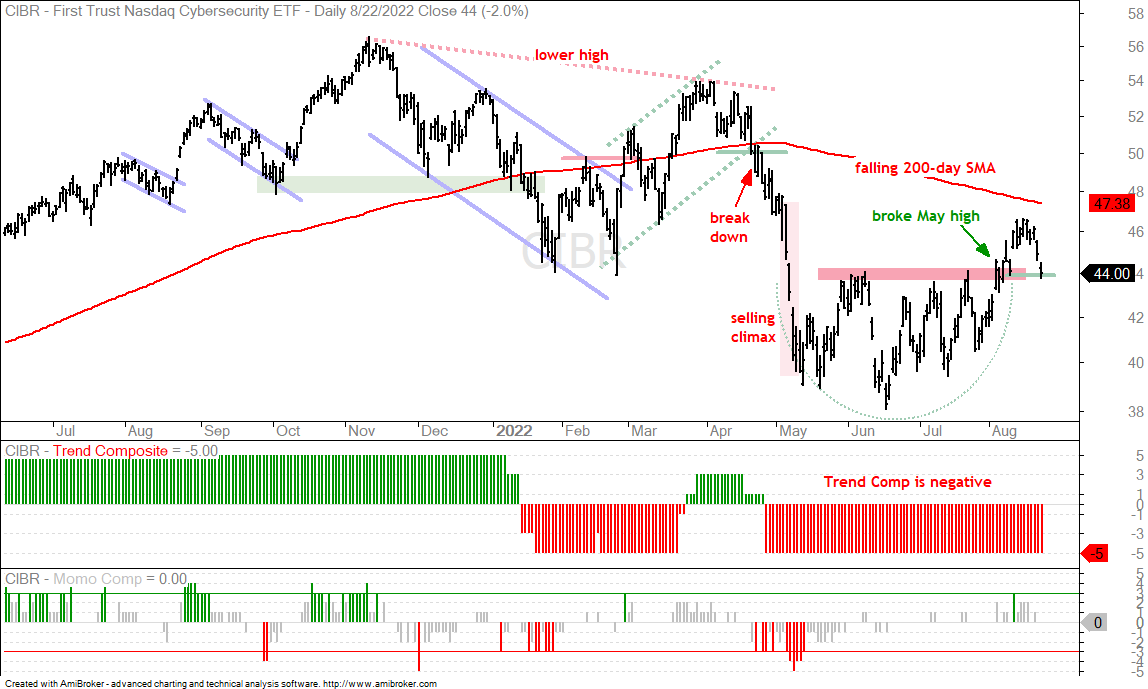
The Cloud Computing ETF (SKYY), Internet ETF (FDN) and Software ETF (IGV) broke above their May highs in early August, but fell back below these breakout zones with sharp declines over the last few days. The Trend Composites were already negative and these breakouts failed to hold. The Cybersecurity ETF (CIBR) is currently testing its breakout zone and holding up better than the others.
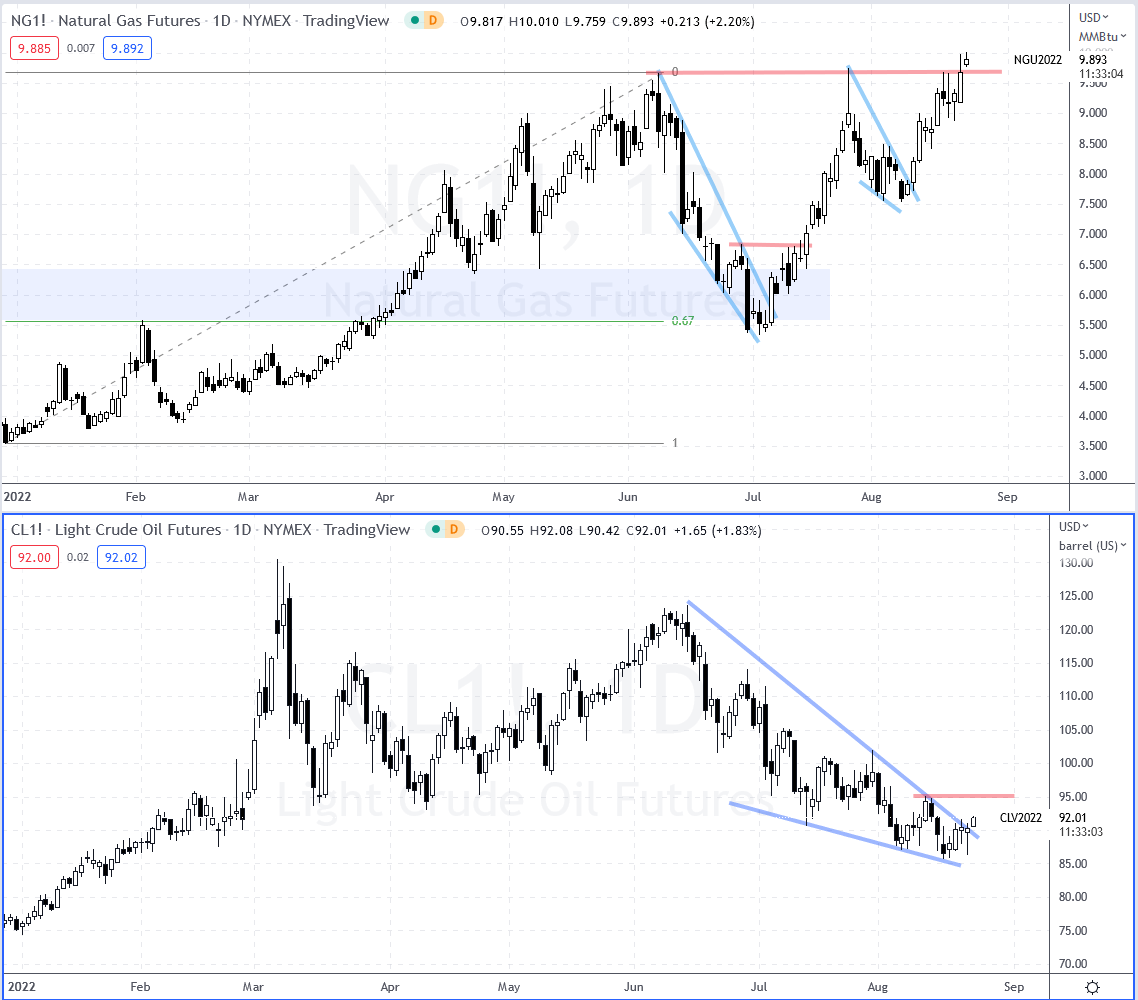
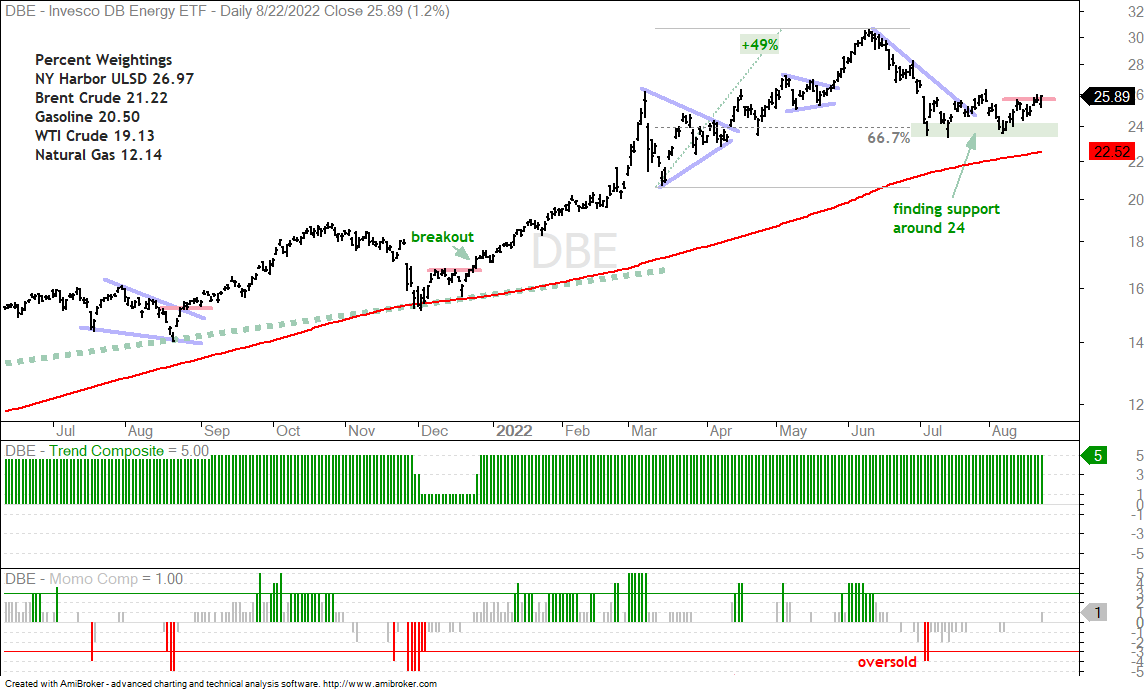
NatGas Hits New High as Oil Strengthens (NG1!, CL1!, DBE)
The next chart shows Natural Gas Futures (NG1!) breaking out to a new high. Overall, the big wedge into early July is the cup and the small wedge into early August is the handle. The break above rim resistance is bullish. Keep in mind that natty is VERY volatile and known as the widow maker in the commodity markets.
The other chart shows Light Crude Futures (CL1!) with a long falling wedge into August and a break above the upper line working. The early August high marks resistance at 95 and a break above this level would fully reverse the downtrend. Note that oil held up very well when stocks plunged the last four days.
The next chart shows the DB Energy ETF (DBE) bouncing off support in the 24 area the two weeks and breaking the 10-Aug high (red line). Overall, DBE hit a new high in June, retraced around 2/3 of the March-June advance and then firmed in the 24 area. It looks like the correction is ending and the bigger uptrend is resuming.
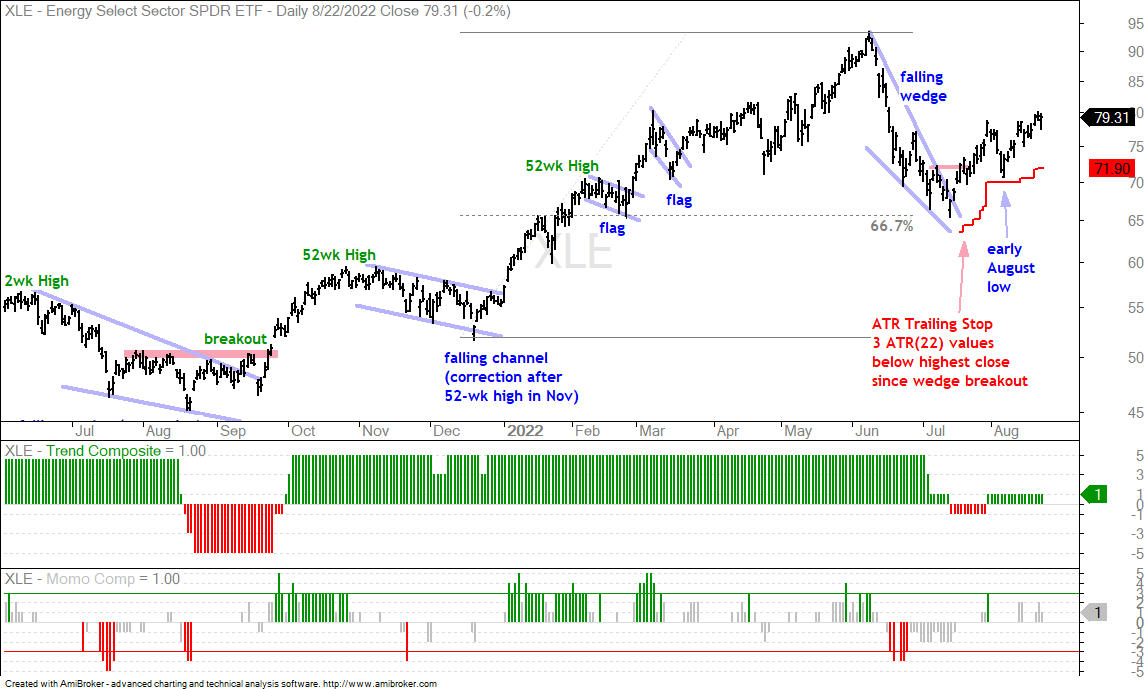
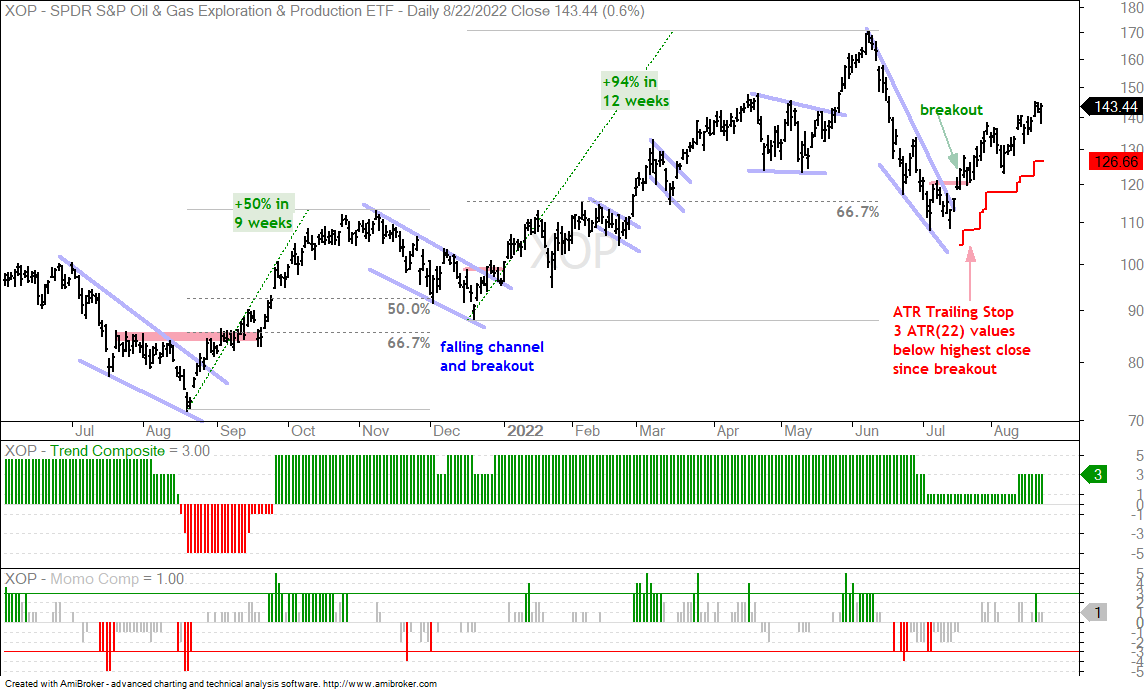
Energy ETF Update (XLE, XOP, FCG, AMLP, XES, PSCE)
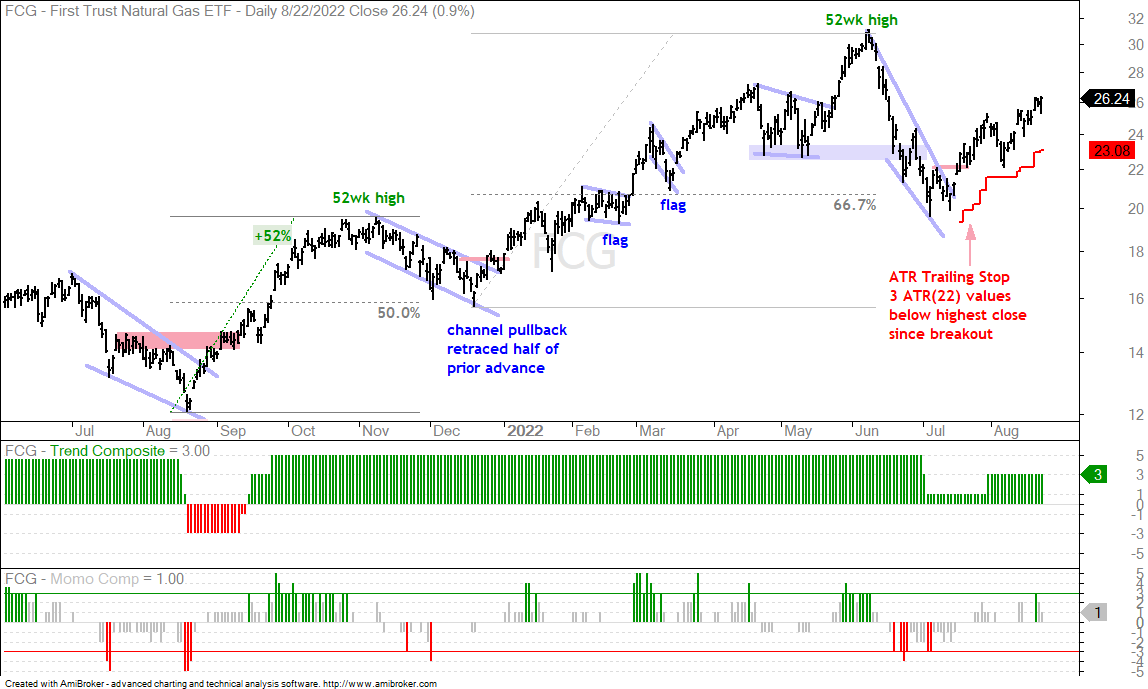
There is no change in the energy-based ETFs as they edged higher the last few days. The Energy SPDR (XLE), Oil & Gas Exploration & Production ETF (XOP) and Natural Gas ETF (FCG) are extending on their wedge breakouts from mid July and remain well above their ATR Trailing Stops. The wedges are viewed as corrections within a bigger uptrend and the breakouts signaled a continuation of these uptrends.
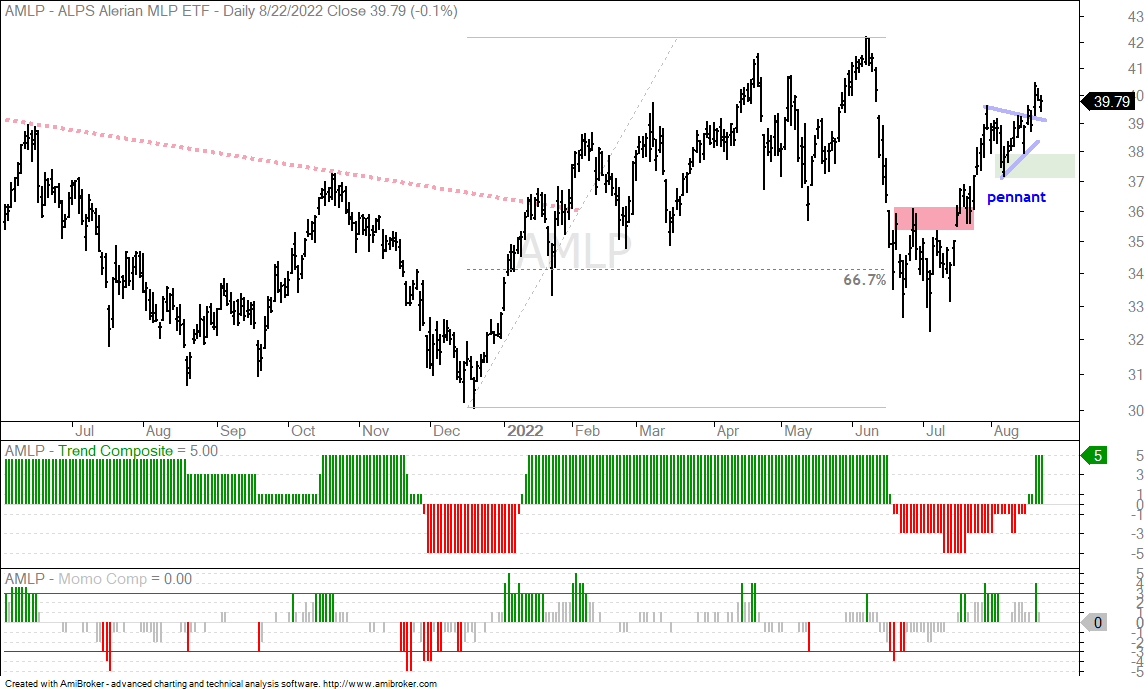
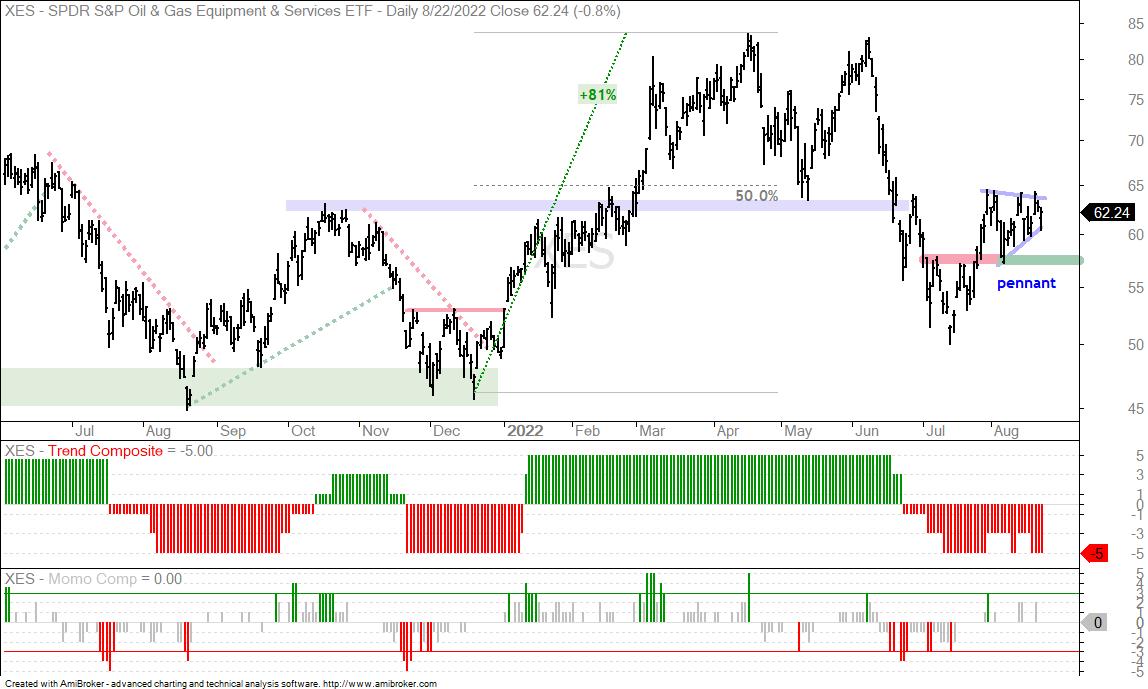
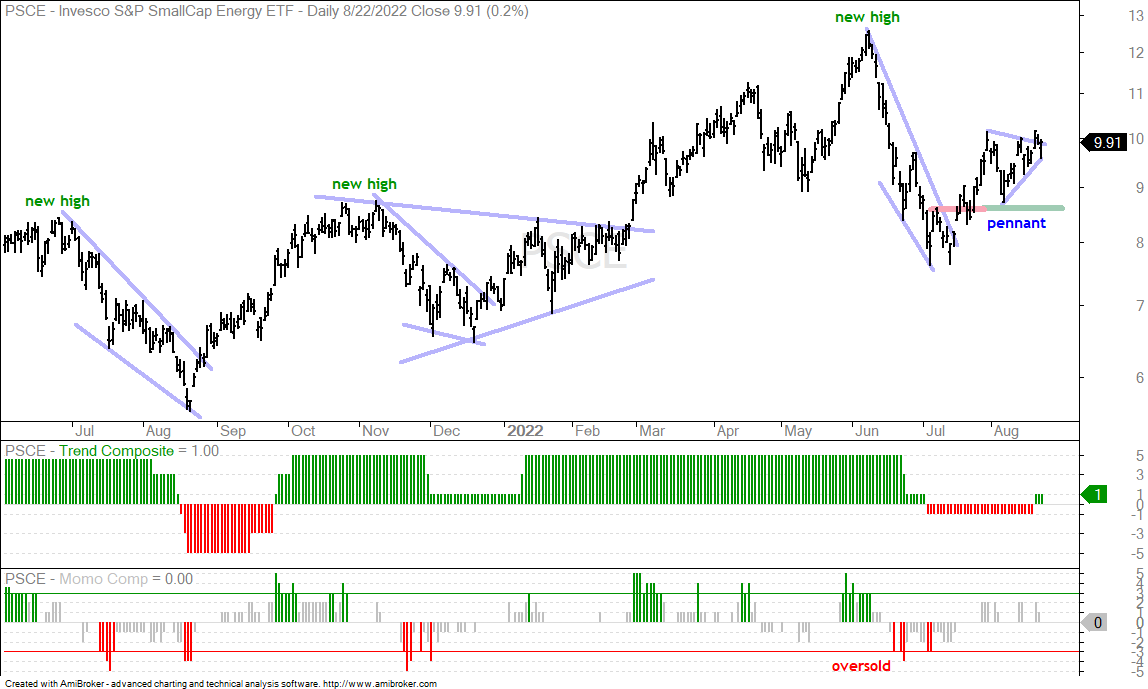
The next charts show the MLP ETF (AMLP), Oil & Gas Equipment & Services ETF (XES) and Small-cap Energy ETF (PSCE) with pennants forming after sharp advances in late July. These advances broke short-term resistance (red lines) and these breakouts held. AMLP and PSCE broke out of these pennants, while XES challenged the pennant highs last week. Pennants after an advance are short-term bullish continuation patterns and breakouts are bullish. The pennant lows (green lines) mark support to watch going forward.
You can learn more about my chart strategy in this article covering the different timeframes, chart settings, StochClose, RSI and StochRSI.
Clean Energy ETF Update (TAN, ICLN)
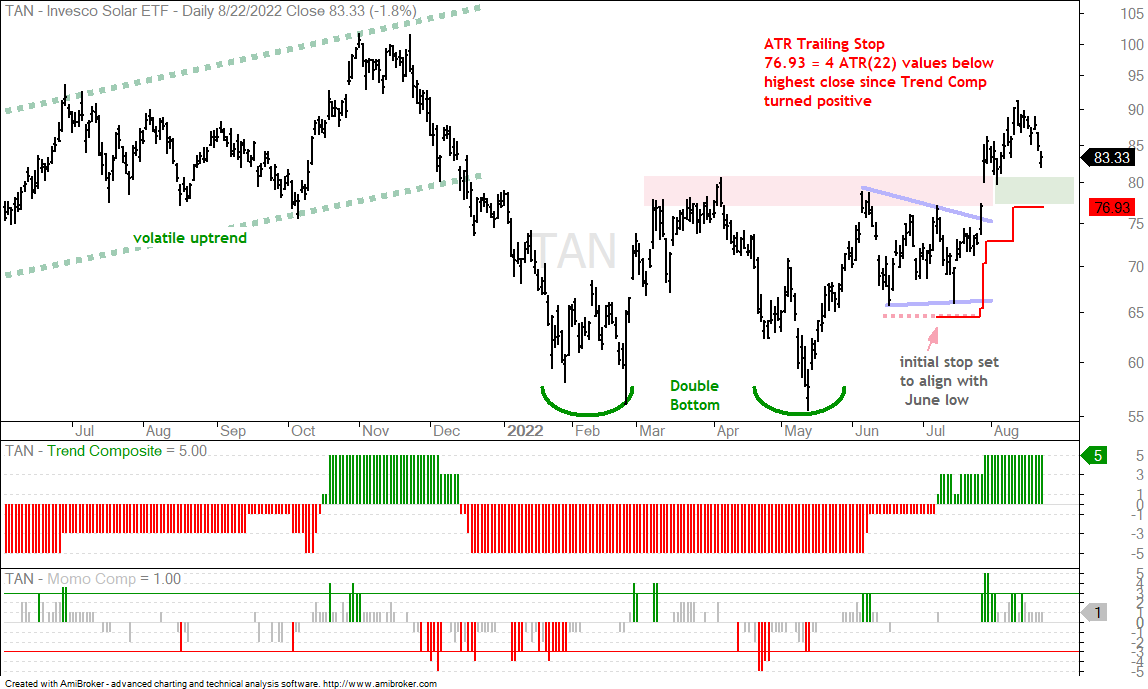
The Solar Energy ETF (TAN) and Global Clean Energy ETF (ICLN) fell back with the rest of the market, which proves that correlations rise as declines in the major indexes deepen. TAN and ICLN are still part of the stock market. The first chart shows TAN with the Trend Composite turning positive in early July and the ETF breaking out of a triangle with a gap-surge in late July. This is the trend-following signal and the ATR Trailing Stop remains at 76.93.
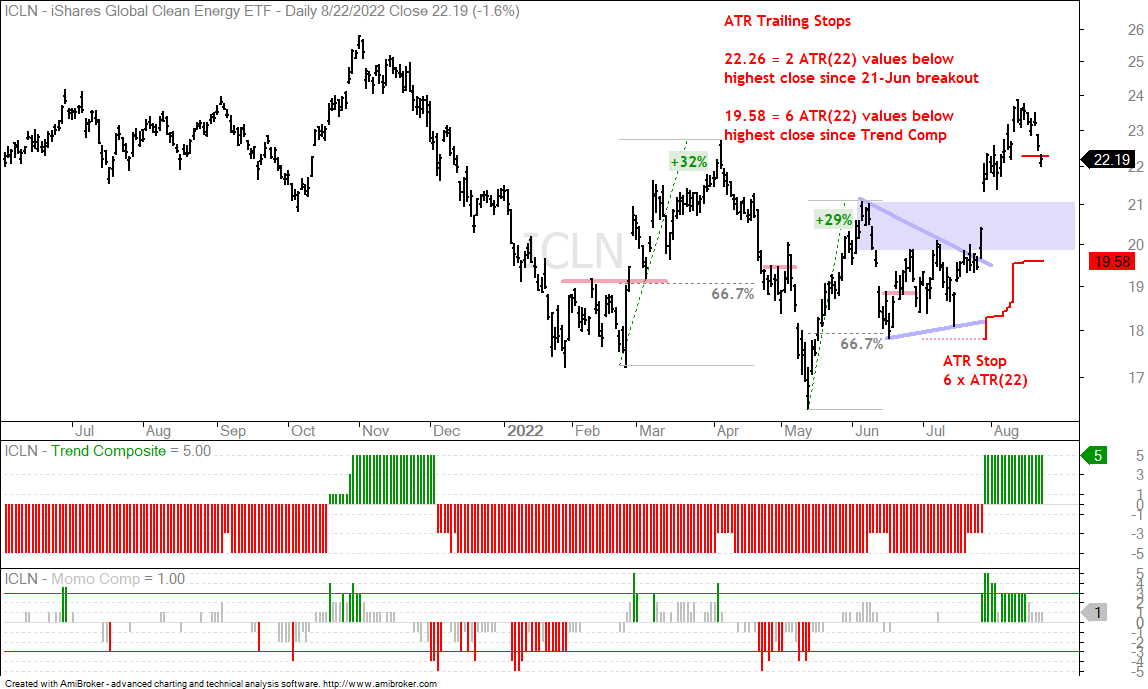
The Global Clean Energy ETF (ICLN) fell sharply over the past week and triggered the tight ATR Trailing Stop, which was 2 ATR(22) values below the highest close since the mid June breakout (short red line). The wider trend-following stop is at 19.58 and just below a possible support zone (blue shading). ICLN broke out with a surge and the breakout zone turns first support to watch on a throwback.
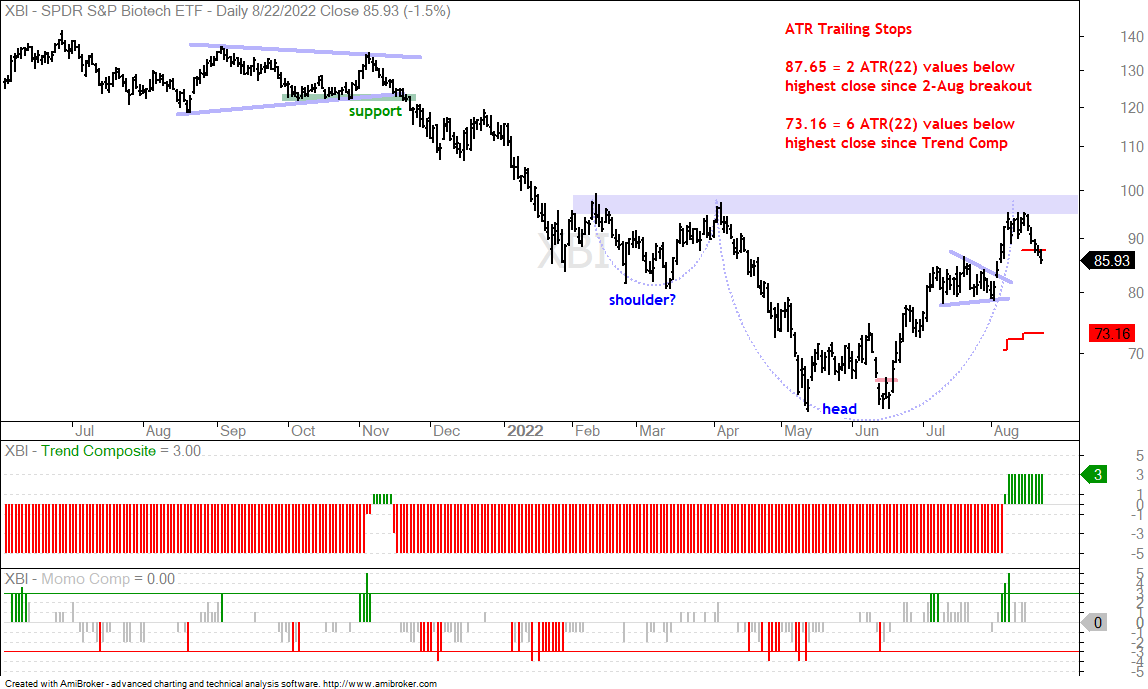
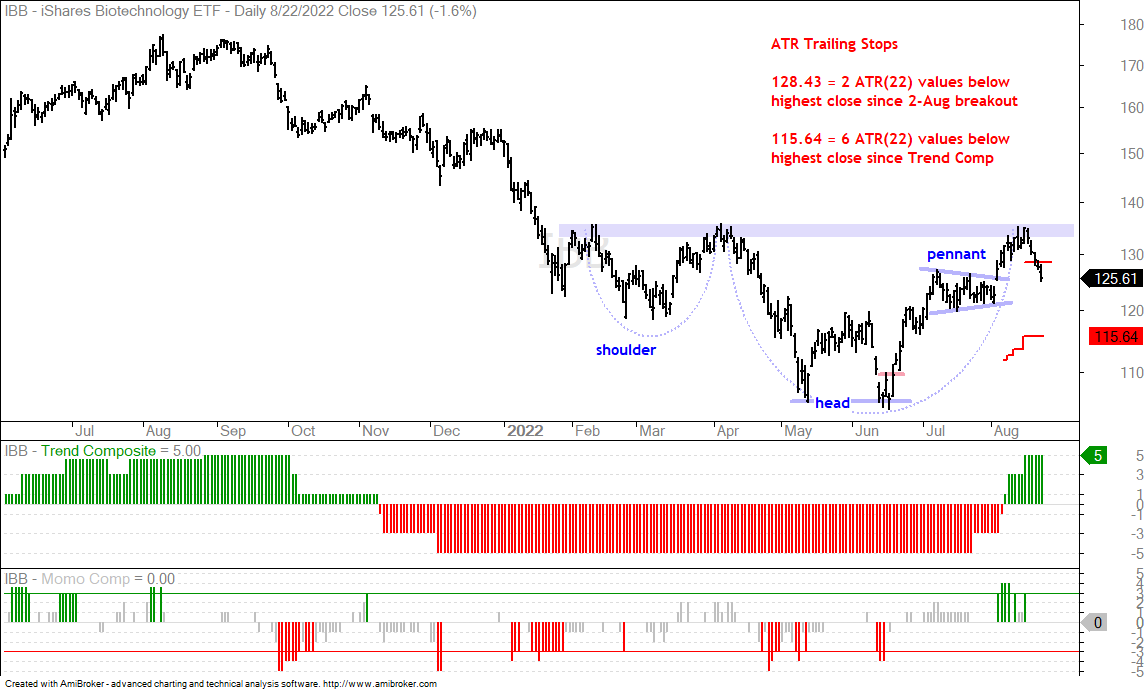
The Biotech SPDR (XBI) and Biotech ETF (IBB) also fell back with the rest of the market over the past week. Both hit resistance from the February-April highs and fell rather sharply the last five days. They triggered the tight ATR Trailing Stop (short red line), but remain well above their trend-following stops, which offer more wiggle room.
I do not want to get too far ahead here, but these two could trace out big inverse head-and-shoulders patterns. The blue dashed lines mark the left shoulder, the May-June lows mark the head and the right shoulder could form into September-October. Thus, a dip into the 120 area for IBB or 80 area for XBI may provide a setup in the future. We will cross that bridge when and if it gets here.
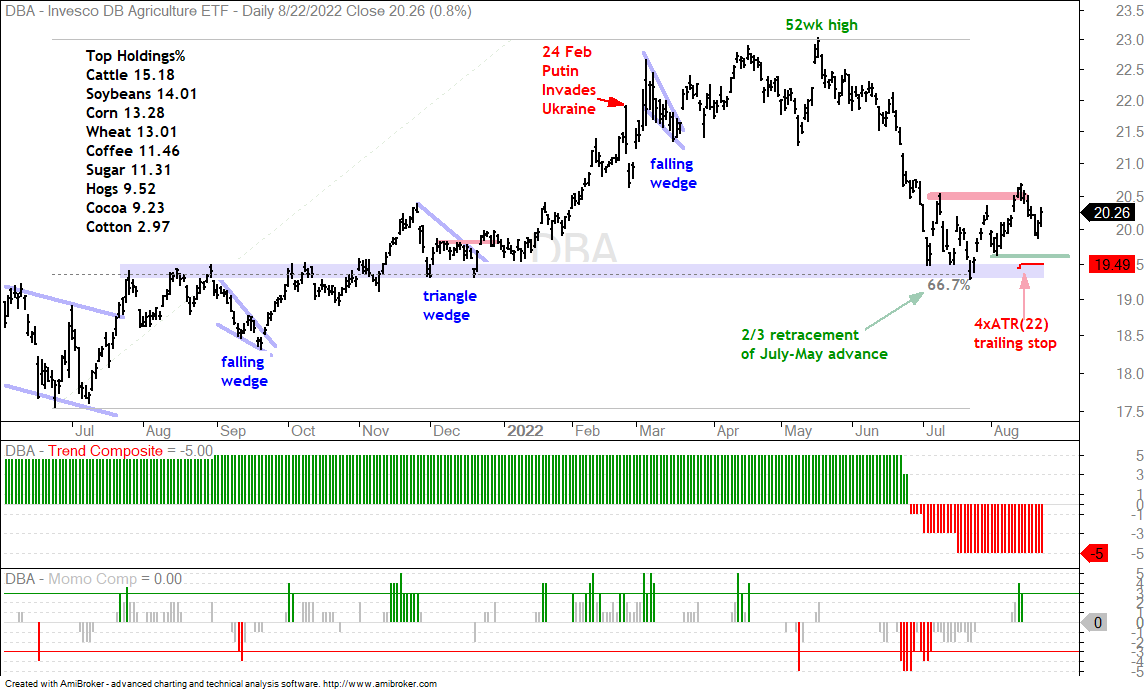
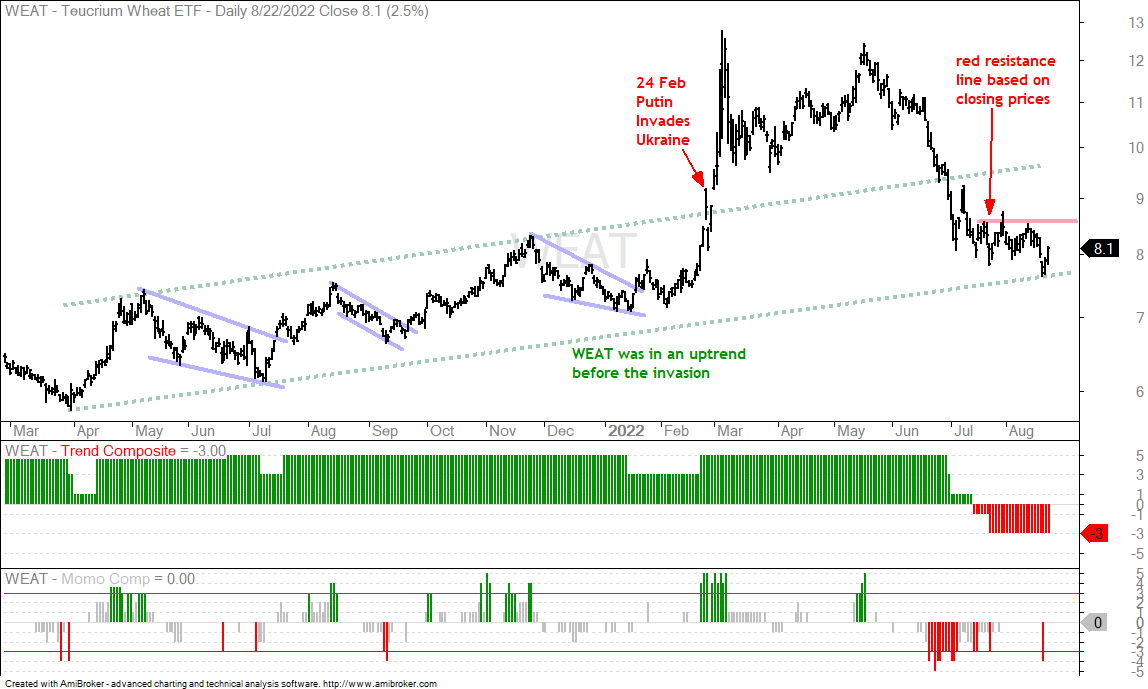
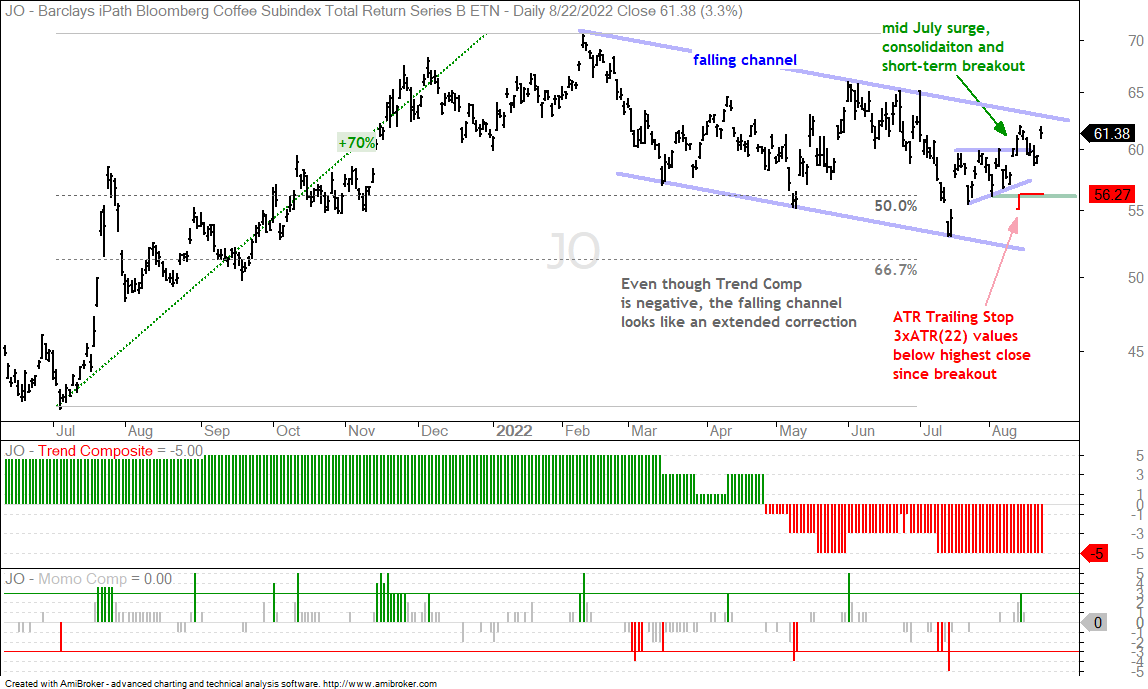
Agriculture ETFs Buck the Stock Market (DBA, WEAT, JO)
The DB Agriculture ETF (DBA) ignored the stock market and bounced the last two days. Overall, DBA hit a new high in May, retraced 2/3 of the July-May advance and firmed in the 19.50 area in July. The ETF broke short-term resistance in mid August and the early August low marks first support (green line). The 4 x ATR(22) trailing stop is just below.
The Wheat ETF (WEAT) fell last week and then bounced the last two days. Notice that the ETF touched the lower trendline of a rising channel that was in place before Putin invaded Ukraine. This is an area to watch for a reversal and short-term breakout. Resistance is set at 8.5 and a close above this level would be short-term bullish.
The Coffee ETF (JO) perked up on Monday with a 3.3% surge to keep the short-term breakout alive. Short-term, there is a surge in mid July, a small Ascending Triangle and a breakout working. Longer term, JO remains within a long falling channel, but this channel looks like a correction after the 70% advance. Support is set at 56 and the ATR Trailing Stop is at 56.27. A close below 56 would argue for a re-evaluation.
Palladium ETF Falls Along with Stocks (PALL)
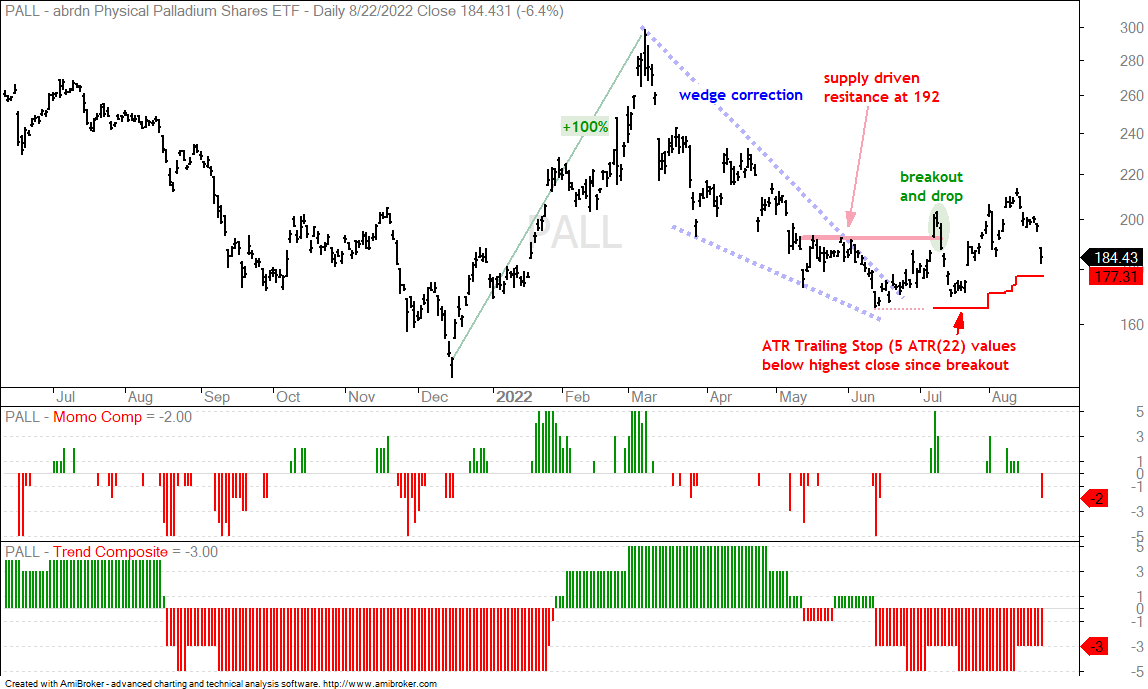
The Palladium ETF (PALL) did not buck the stock market and fell sharply the last seven days. This positive correlation with stocks is potentially negative so I will be watching closely. Overall, PALL broke out in early July and I then placed the ATR Trailing Stop (5 x ATR(22)) to match the June low. This stop rose as PALL advance into mid August and is currently at 177.31. A close below this level would call for a re-evaluation.
Previous Commentary
Thecommentary (here) on Thursday, August 11th, covered the following:
Inflation and Stocks
TLT Breaks Down as 10yr T-Yield Breaks Out
Dollar Breaks Out Along with T-Yield
SPY and QQQ Hit Dow-Fibo Retracements
Seasonal Tendency for September is Negative
%Above 20-day SMA for SPY and QQQ
Watching Junk Bonds, Housing and Semis for Clues
NatGas Forms Bullish Pattern as Oil Forms Falling Wedge
Small-cap Energy ETF Forms Pennant (PSCE)
Tech ETFs Hold Breakouts, but Underperform (SKYY, CIBR, IGV, FDN)
Short-term Uptrends in Base-Metals ETFs (DBB, CPER, COPX)
You can learn more about my chart strategy in this article covering the different timeframes, chart settings, StochClose, RSI and StochRSI.