
SPY and QQQ Get the Headlines, but Small and Mid Caps are Leading
- Arthur Hill, CMT
Welcome to the Chart Fix!
SPY and QQQ may be grabbing the headlines, but don’t be fooled because small-caps and mid-caps are leading the way. Smalls and mids held up better during the March decline and they are trading near new highs after the April breakouts. Today’s report will compare performance for the major index ETFs and analyze the Russell 2000 ETF in detail. Read until the end to see our offer for a Master ETF ChartList to jump start your analysis process.
Recent Reports and Videos at TrendInvestorPro
- Rate and Energy Shock Weigh – Gold Headwinds and Set Up
- Semiconductor Equipment and Testing Stocks Set Up
- Early August Breakouts back in Play for Tech, AI and Semis
- ETF Master ChartList ~300 ETFs Organized in Top-Down Manner
- Click here to take a trial and gain full access.
Small-caps and Mid-caps are Outperforming SPY and QQQ
The summary table below shows performance for SPY, QQQ and seven other major index ETFs. This table is sorted by the SMA(200) column, which shows the percentage above the 200-day SMA. The Russell Microcap ETF (IWC) is leading because it is 11.91% above its 200-day. Small-caps are are next with the Russell 2000 ETF (IWM) and S&P SmallCap 600 SPDR (IJR) over 10% above their 200-day SMAs. SPY and QQQ, in contrast, are less than 5% above their 200-day SMAs.
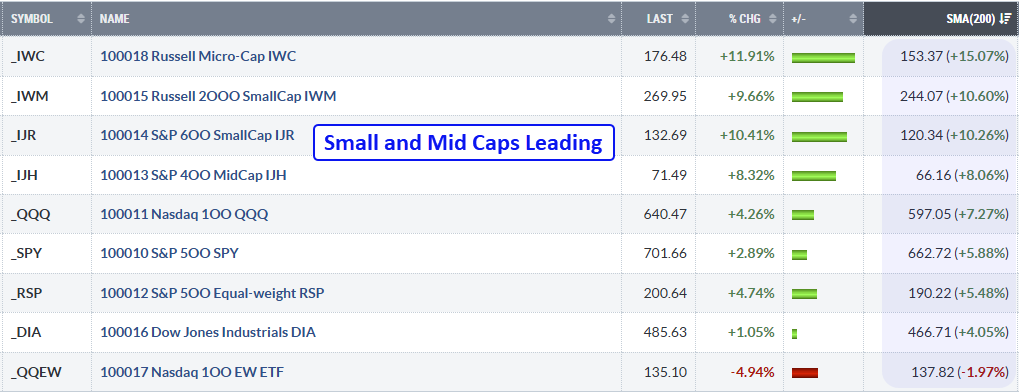
The %Chg column shows the year-to-date percentage gain/loss for each ETF. Again, the small and mid cap ETFs show much bigger gains. Note that the Nasdaq 100 Equal-Weight ETF (QQEW) is down around 5% year-to-date.
See our report testing Zweig Breadth Thrusts based on S&P 500 and S&P 1500 stocks. ZBT signals are used for entry and a trend signal for exits.
IWM Follows Through on Breakout Surge
The Russell 2000 ETF (IWM) held up better than SPY and QQQ in March. On the chart below, IWM fell to its 200-day SMA and closed below this key average for one day. It was back above the very next day. SPY and QQQ, in contrast, clearly broke their 200-day SMAs and their November lows. Chartists can use the November lows to gauge relative chart performance. ETFs that held above their November lows performed much better in March. IWM held above its November low and showed relative chart strength.
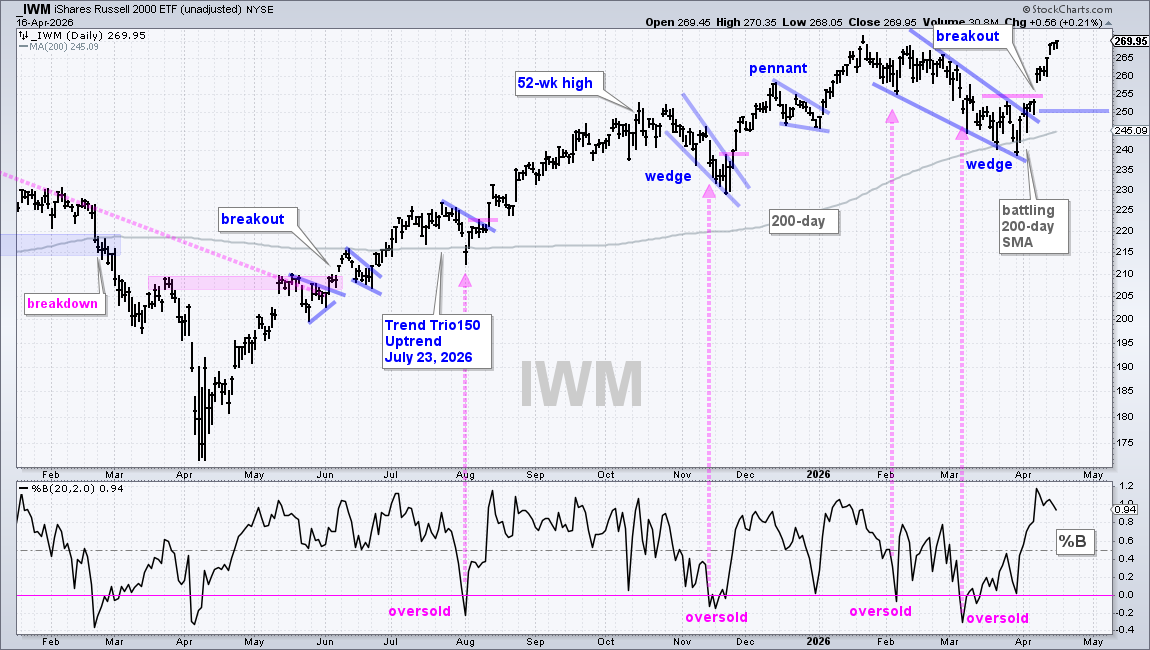
Not only did IWM show relative strength, a bullish continuation pattern also formed on the price chart. TrendInvestorPro featured this setup on April 7th. The falling wedge is typical for a correction within an uptrend. As long as the bigger trend is up, a pullback is considered a correction within the uptrend. %B became oversold in early March, but broad market weakness weighed as the correction extended. This downswing reversed with the gap-breakout on April 8th. Strong follow through further validates the breakout.
It is now important that the breakout holds. A close below 250 would fill the gap, negate the breakout and call for a re-evaluation.
Get the Analytical Edge with Our Master ETF ChartList
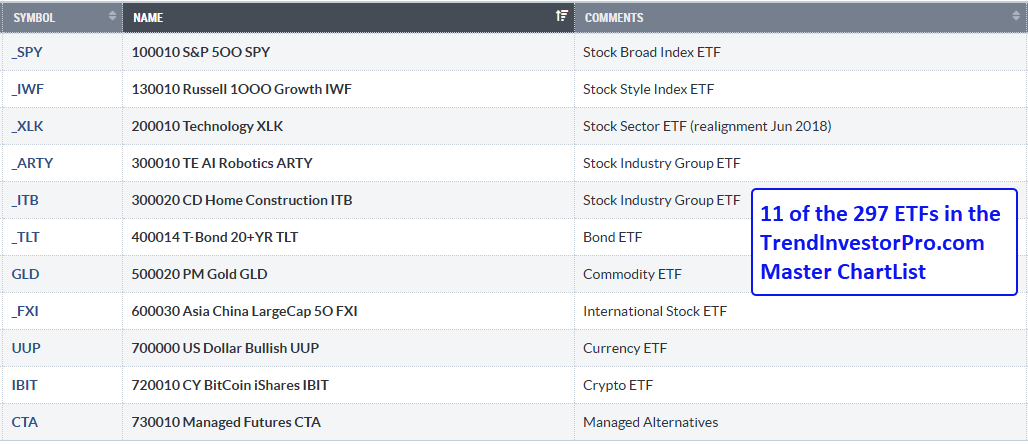
A robust analysis process starts with an organized and comprehensive ChartList. This is where we run scans, view performance tables, browse CandleGlance charts and perform detailed chart analysis. TrendInvestorPro subscribers get access to our Master ETF Chartlist, which has over 290 ETFs organized in a logical top-down manner. Sections include broad index ETFs, sectors, industry groups, bonds, commodities, crypto, currencies and alts. Below is a screen shot showing some ETFs and groups covered.
Click here to take a trial to TrendInvestorPro and get this list. Note that you must be a StockCharts member with a Extra subscription to receive the ChartList.
Recent Reports and Videos at TrendInvestorPro
- Rate and Energy Shock Weigh – Gold Headwinds and Set Up
- Semiconductor Equipment and Testing Stocks Set Up
- Early August Breakouts back in Play for Tech, AI and Semis
- ETF Master ChartList ~300 ETFs Organized in Top-Down Manner
- Click here to take a trial and gain full access.