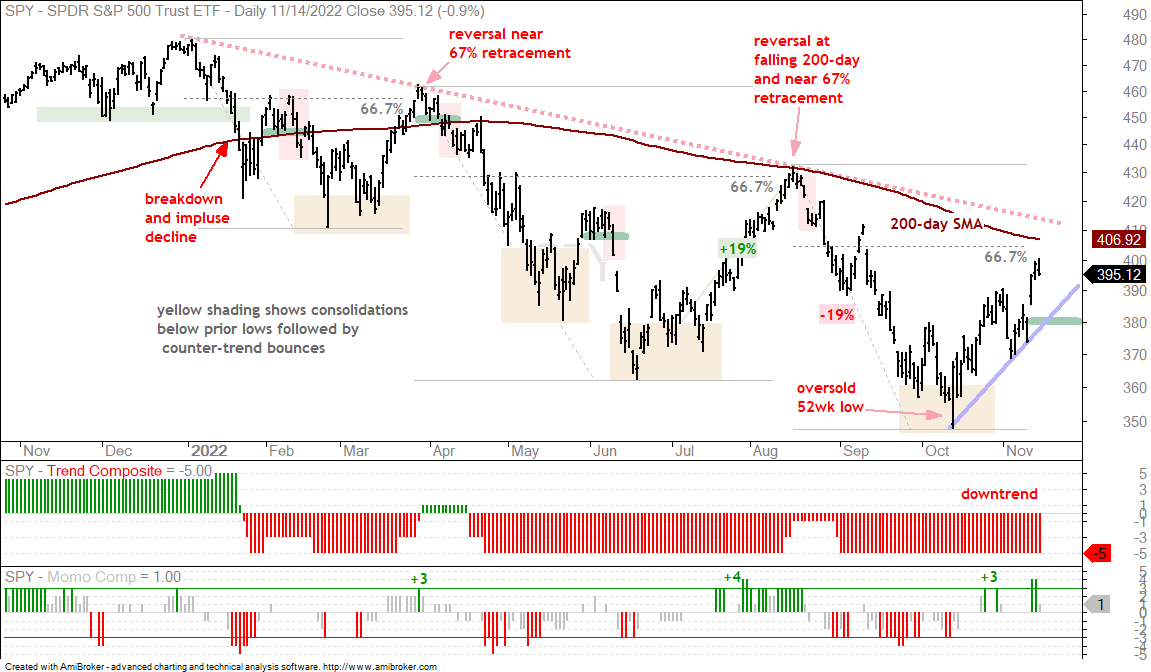
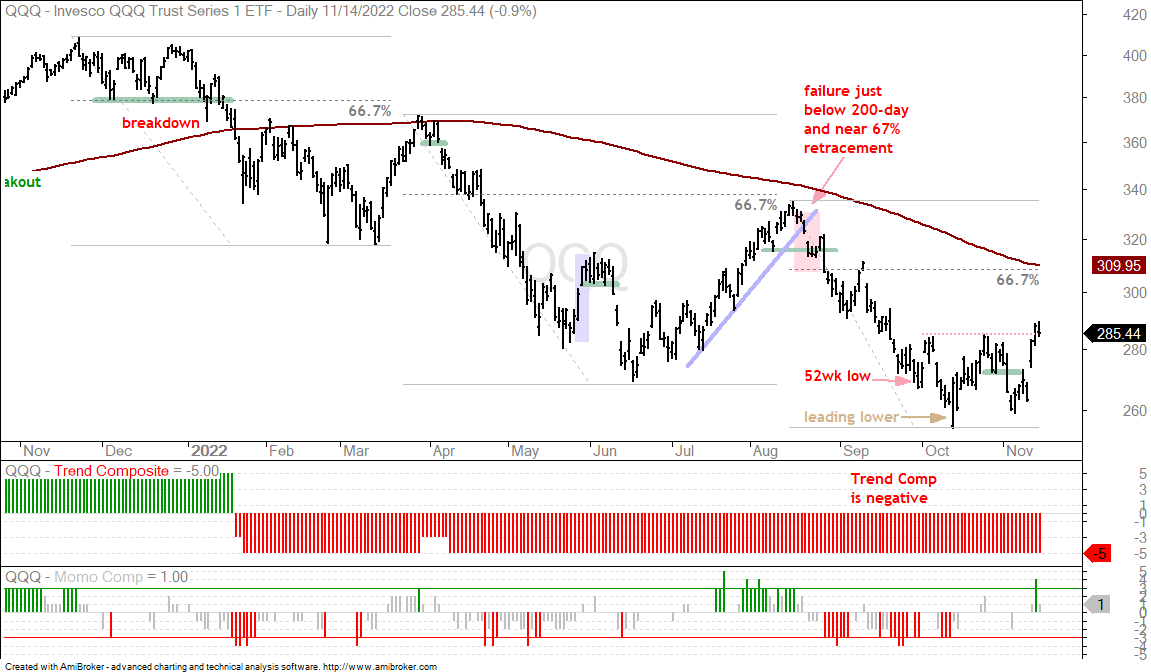
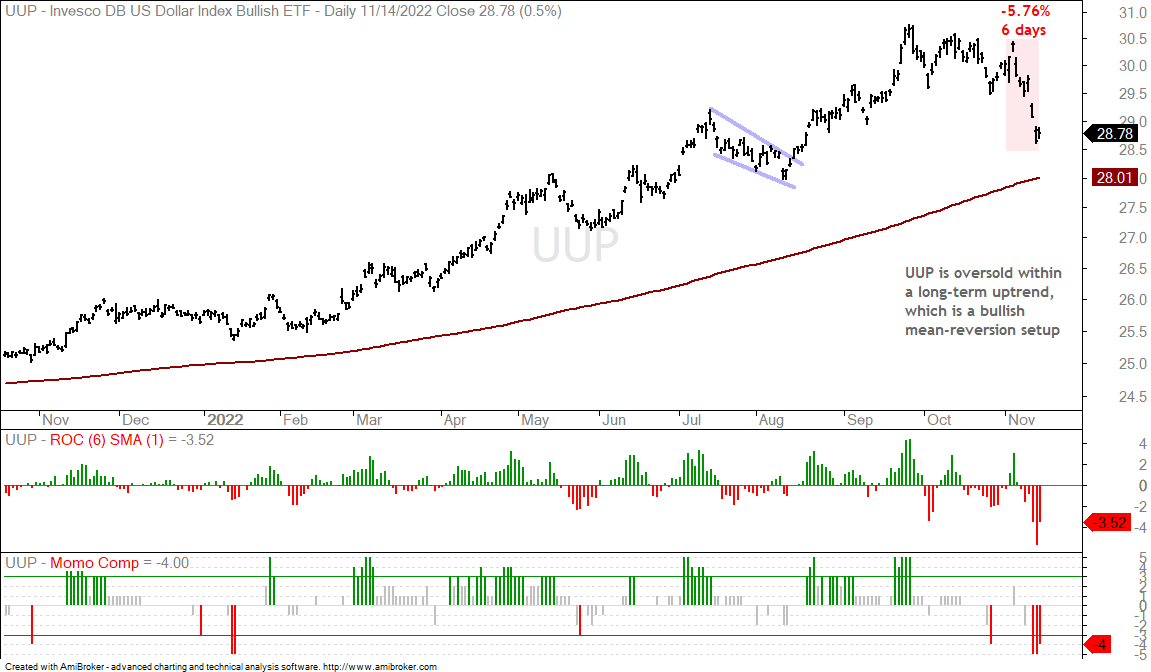
There were some big moves over the last three days as the markets reacted to lower-than-expected inflation numbers. Stocks have been moving higher since mid October with many ETFs sporting double digit gains the last five weeks. Many of these big moves, however, are still counter-trend moves. For example, the advance in SPY runs counter to the bigger downtrend, while the decline in the Dollar runs counter to the bigger uptrend. Many ETFs are reverting back to their 200-day SMAs and these counter-trend moves could stall as the 200-day SMAs (bigger downtrends) come into play.
About the ETF Trends, Patterns and Setups Report
This report contains discretionary chart analysis based on my interpretation of the price charts. This is different from the fully systematic approach in the Trend Composite strategy series. In this ETF Trends, Patterns and Setups report, I am looking for leading uptrends and tradable setups within these uptrends. While I use indicators to help define the trend and identify oversold conditions within uptrends, the assessments are mostly based on price action and the price chart (higher highs, higher lows, patterns in play). Sometimes the chart assessment can be at odds with the indicators.
This Week's Commentary Schedule
- Tuesday – 15 November: Market-ETF Report and Signal-Rank Table Update
- Wednesday – 16 November Market-ETF Video and Market Regime Update
- Thursday – 17 November: Market-ETF Report and Signal-Rank Table Update
- Saturday – 19 November: ETF Signal and Rank Table
Thanksgiving Week Pause
Note that TrendInvestorPro will not publish reports during Thanksgiving week, which extends from November 21st to 26th. The stock market is closed on Thursday (25-Nov) and hours are reduced on Black Friday (26-Nov). I will update the ETF Trend Signal and Ranking Table on Tuesday, Thursday and Saturday.
TradingView Black Friday
If you ever wanted to try TradingView, Black Friday and Cyber Monday are great opportunities to get a deep discount. I subscribed a few years ago on Black Friday and I renew every year to capture these discounts. TradingView has a robust charting platform with a plethora of indicators, settings and datasets. Yep, it is a rabbit hole. Affiliate links are below.
Composite Breadth Model Remains Bearish
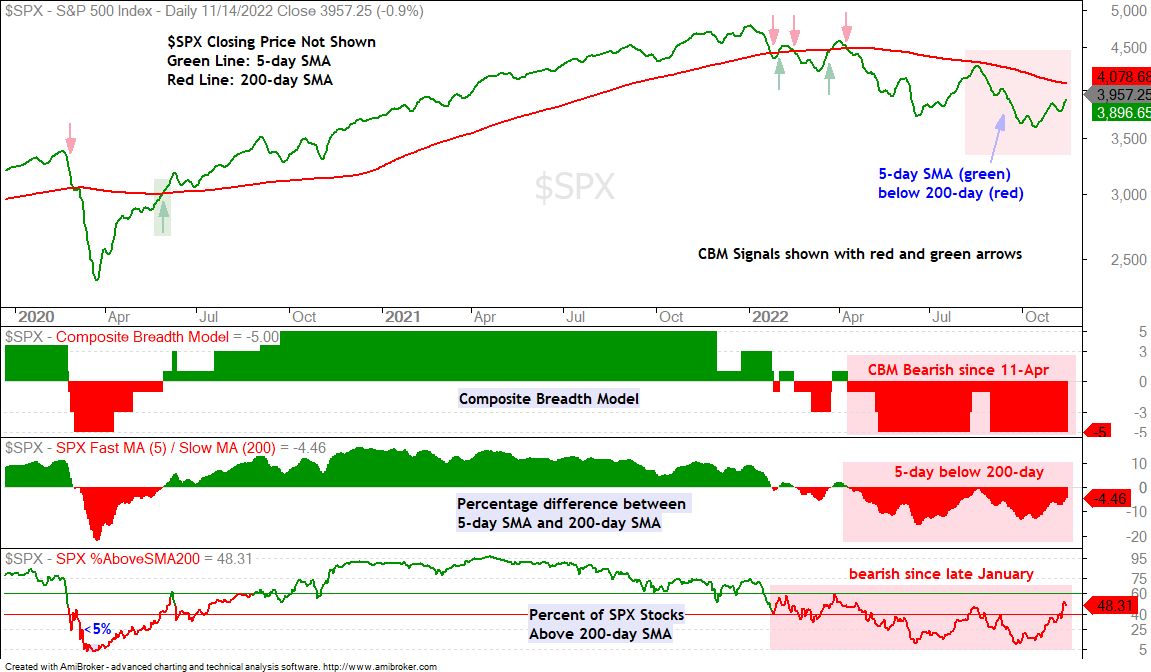
The Composite Breadth Model remains at -5, which means all five inputs are bearish and we are still in a bear market environment for stocks. The S&P 500 is up some 10% since mid October and this move includes a 5.5 percent surge last Thursday. These big moves are still within the context of a bigger downtrend. The S&P 500 remains below the falling 200-day SMA, the 5-day SMA is around 4.5% below the 200-day SMA and 51.6% of stocks are below their 200-day SMAs. The market is more split than it was a month ago, but a split market is not the same as a bull market. Bullish signals from the Composite Breadth Model inputs are required to turn bullish and these have yet to trigger.
You can learn more about my chart strategy in this article [2] covering the different timeframes, chart settings, StochClose, RSI and StochRSI.
SPX %Above 20-day SMA Holds Up
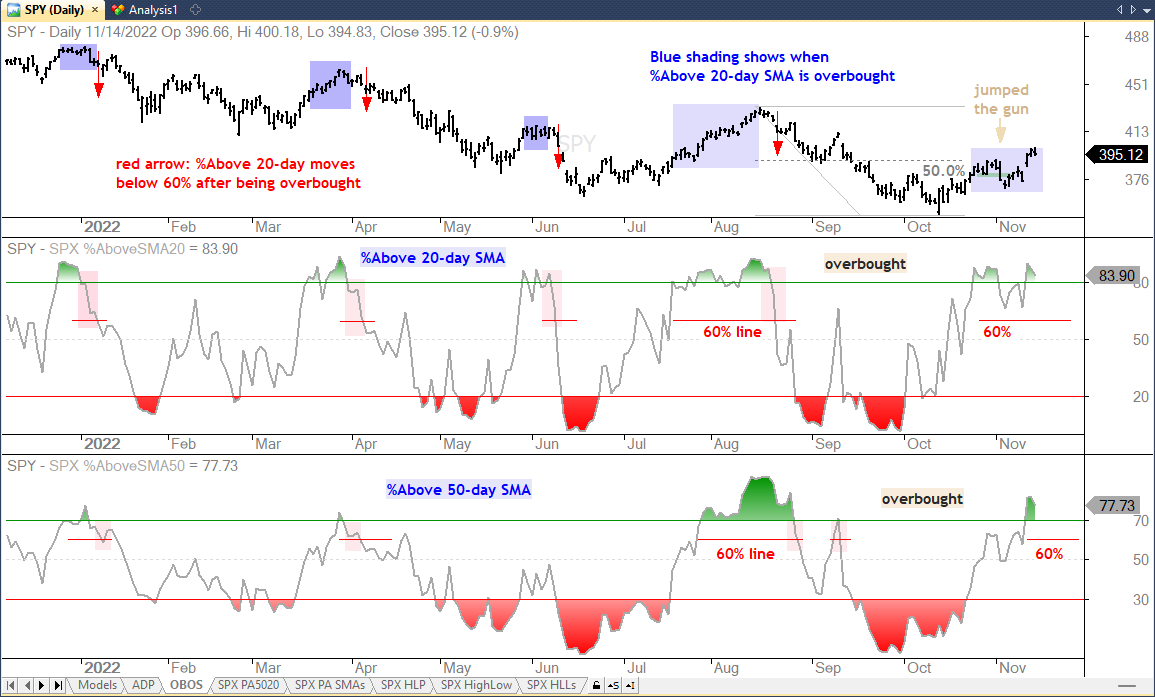
I jumped the gun when thinking that the short-term uptrend reversed with the support break in SPY on November 2nd (green line). Being early is pretty much the same as being wrong in this business. Bullish seasonal patterns and a lower-than-expected inflation report buoyed the bulls. SPX %Above 20-day SMA did not confirm the short-term support break with a move below 60% and remains overbought. Overbought and staying overbought is short-term bullish. SPY was overbought for an entire month from July 19th to August 19th (blue shading). A move below 60% would end overbought conditions and show enough deterioration to reverse the short-term uptrend. SPX %Above 50-day SMA (bottom window) is also overbought and 60% is the line in the sand.
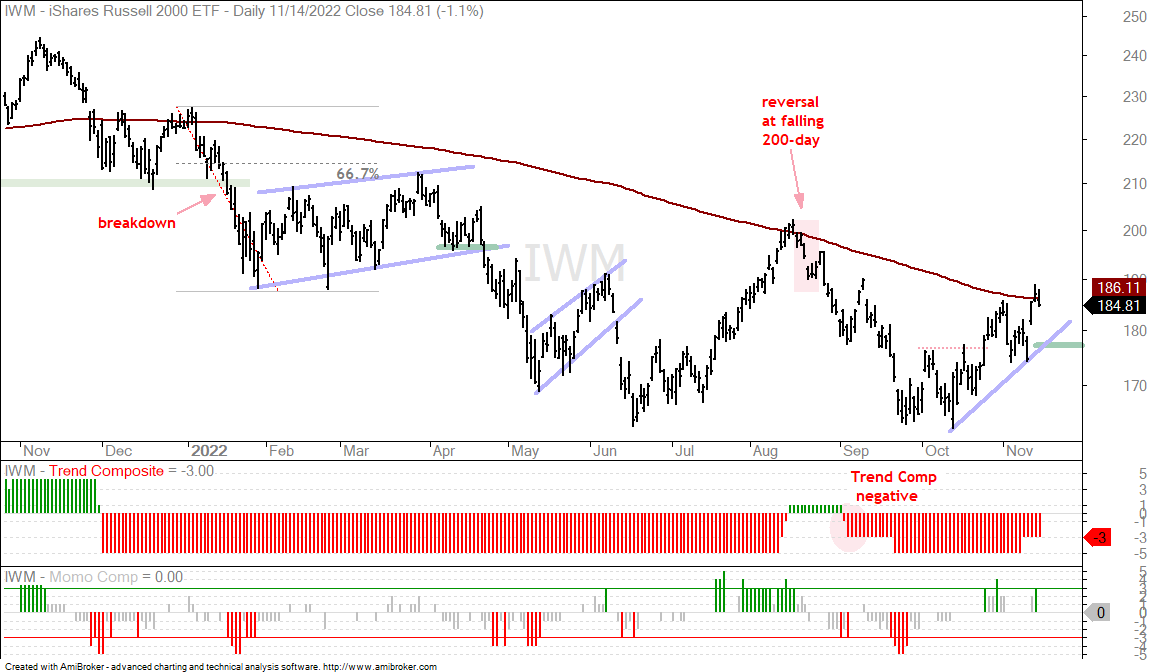
The Russell 2000 ETF (IWM) is actually leading the big three because it is the only one to tag the falling 200-day SMA. IWM closed above the 200-day on Friday and edged below it on Monday. Even so, we are still in a bear market and the bigger trend for IWM remains down. The short-term trend is up with support set at 178.
Overall, the long-term trend for SPY is down and we are still in a bear market. Stocks bottomed on October 12th (close) and almost all stock-based ETFs are up over the last 23 days. Dozens are up double digits and getting short-term overbought. Even though overbought conditions can persist and short-term counter-trend bounces can extend further, being short-term overbought within a bigger downtrend and bear market is not a bullish setup.
XLK, XLC and XLY Lag as XLI, XLF and XLV Lead
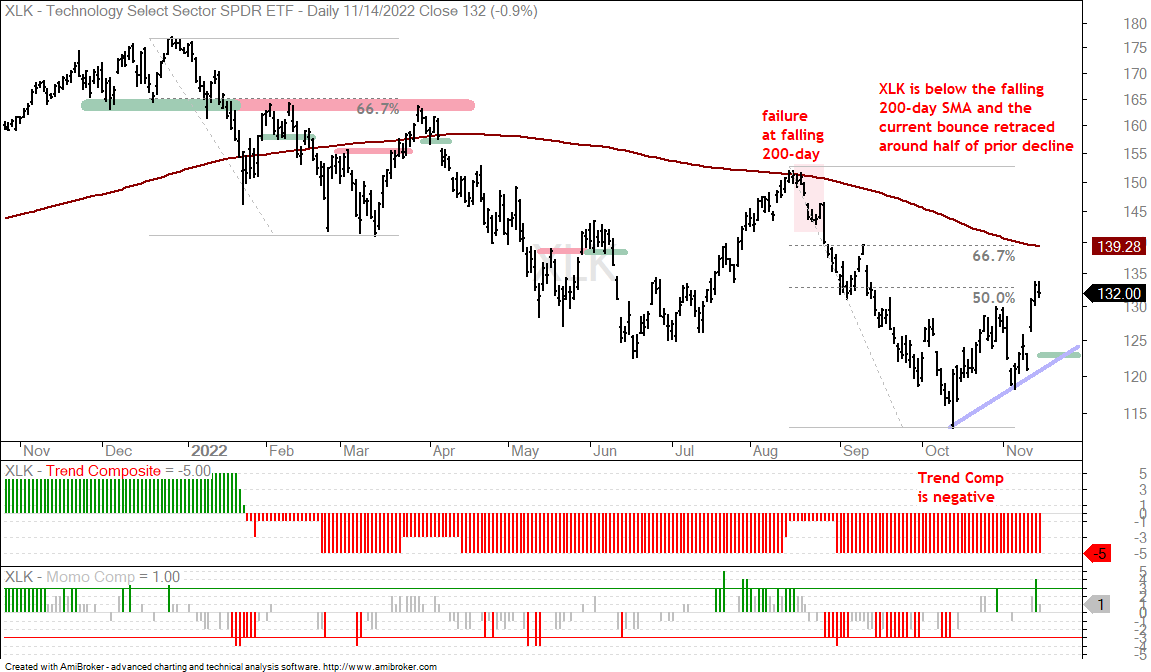
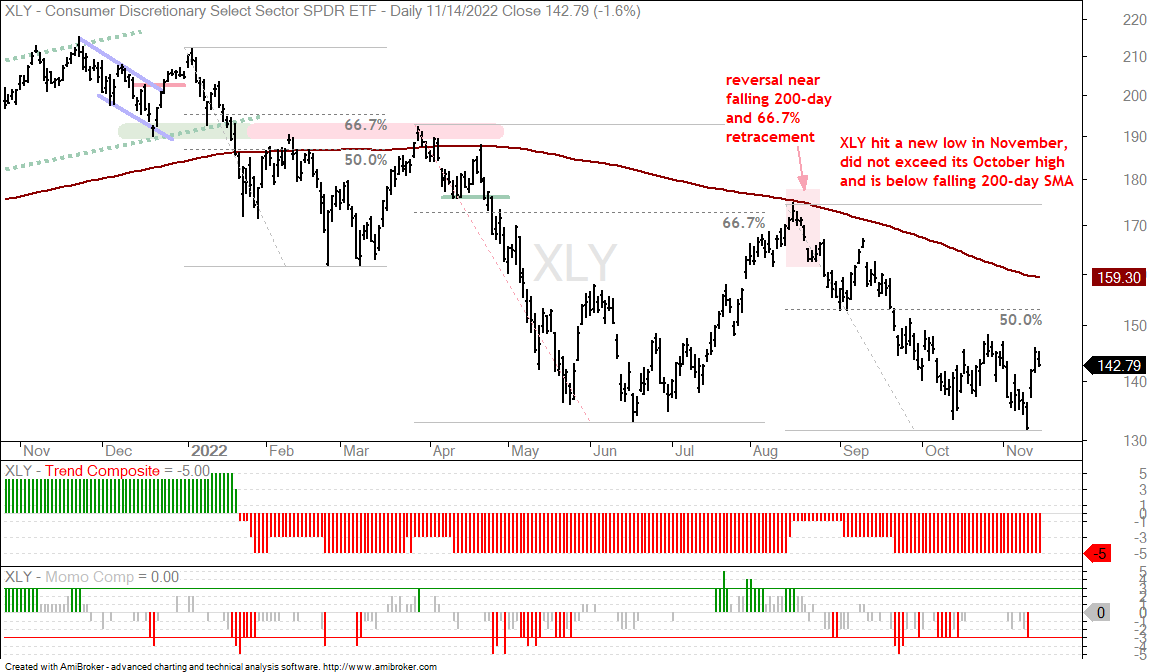
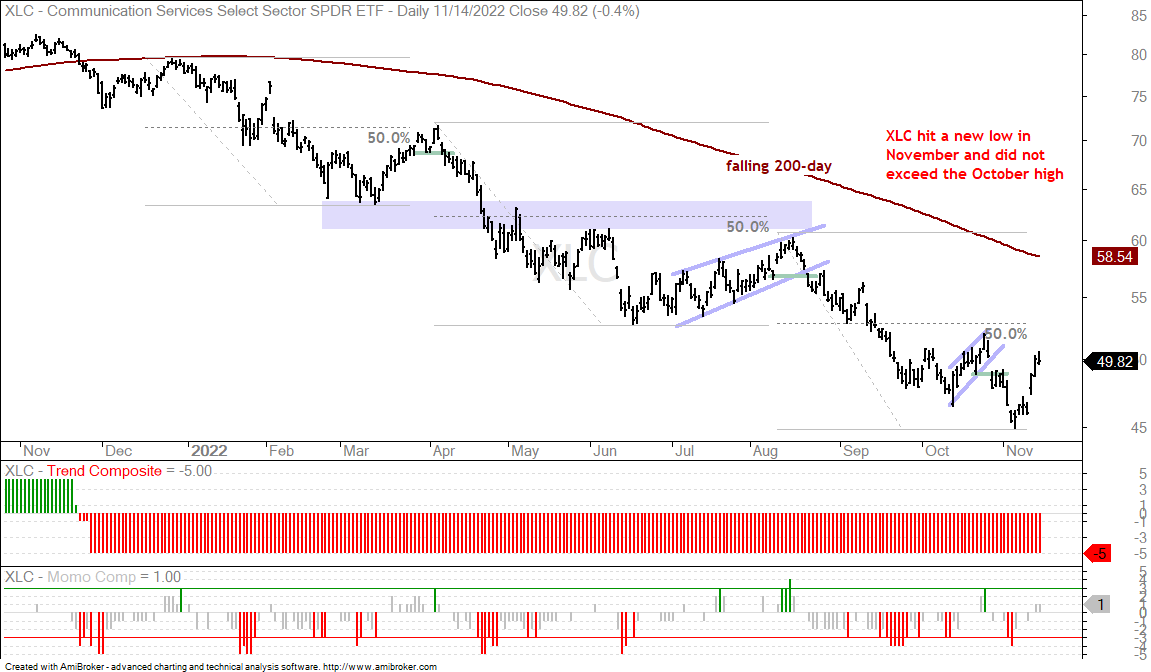
The six biggest sectors in the S&P 500 reflect the current split in the stock market. The Technology SPDR (XLK) hit a new low in mid October, while the Communication Services SPDR (XLC) and Consumer Discretionary SPDR (XLY) recorded new lows in early November. All three remain well below their 200-day SMAs. These three sectors account for 44.5% of the S&P 500.
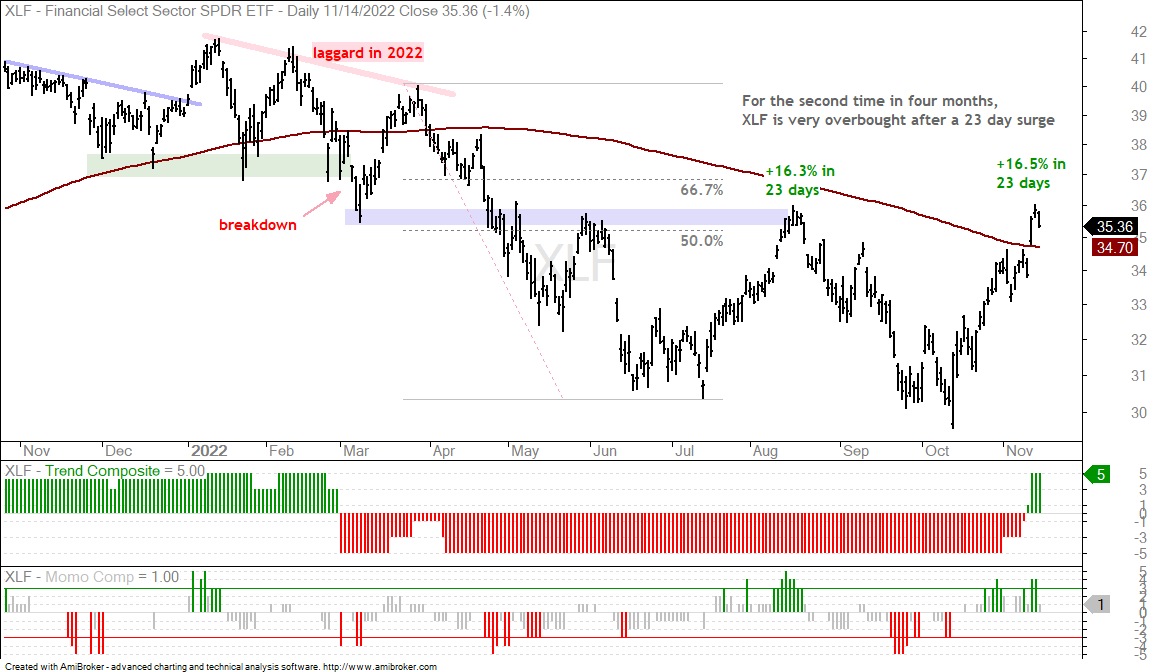
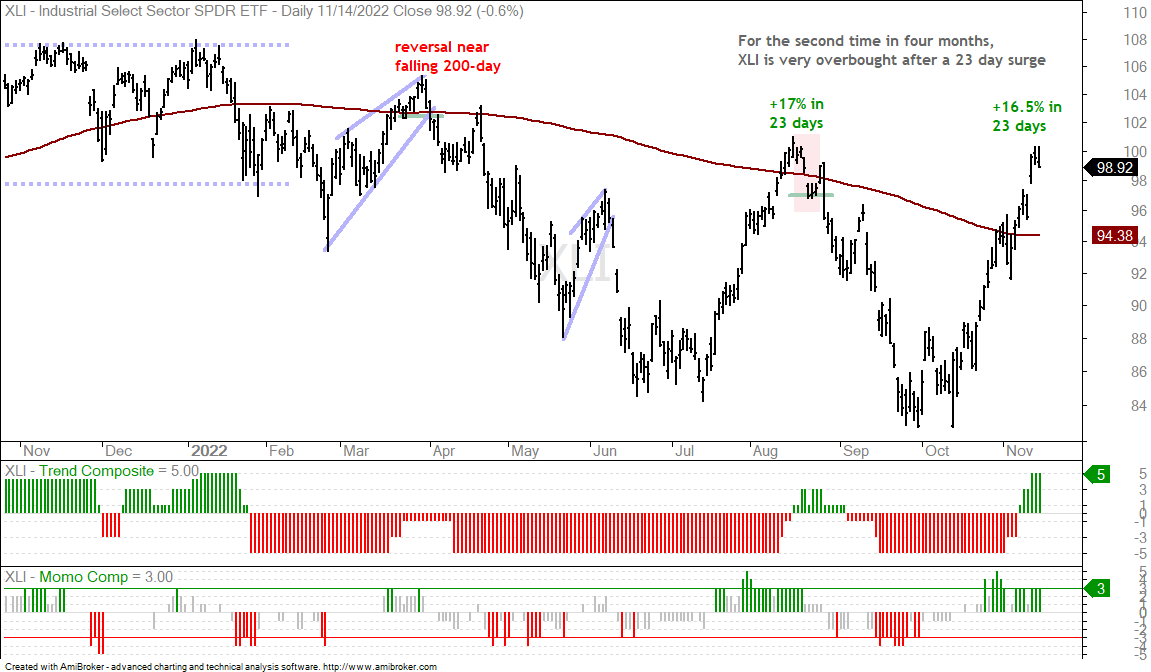
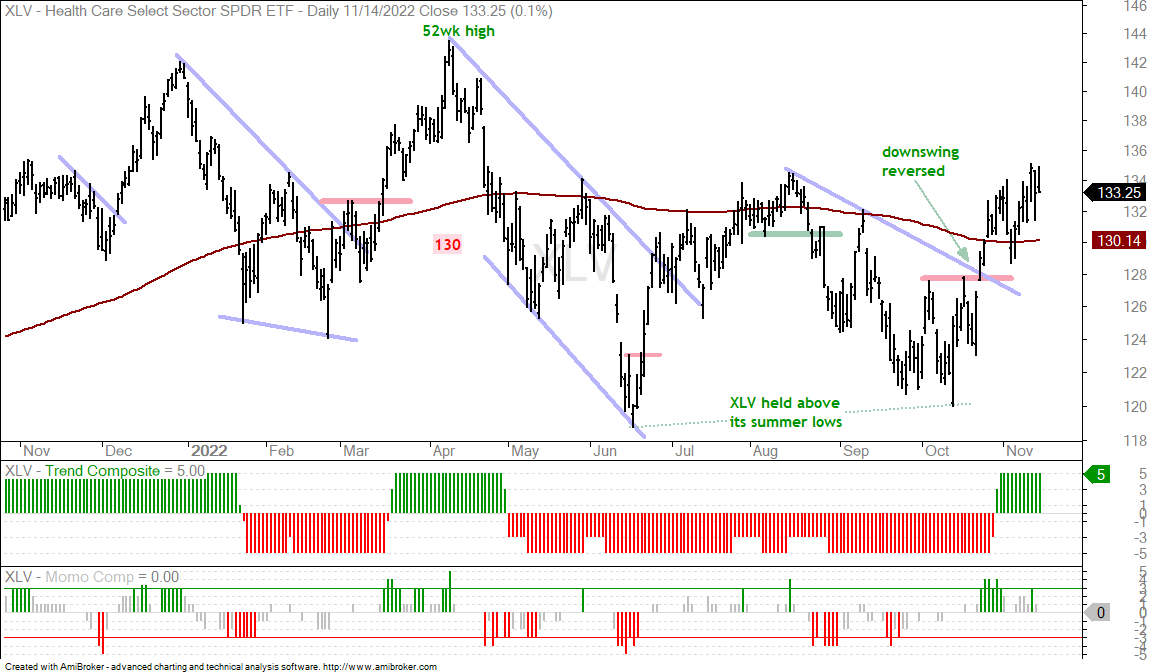
The Industrials SPDR (XLI), Finance SPDR (XLF) and Healthcare SPDR (XLV) are above their 200-day SMAs and their Trend Composites are bullish. These three, which account for 35% of the S&P 500, are clearly stronger than the other three. Even so, XLI and XLF are quite extended after sharp advances the last five weeks. Both are up around 16.5% in 23 days and the current advance looks eerily similar to the surge from mid July to mid August, which was also 23 days. At the very least, these two are very overbought and ripe for a consolidation or a pullback.
You can learn more about exit strategies in this post [3],
which includes a video and charting options for everyone.
The Macro Movers (Euro, Dollar, Bonds, Metals)
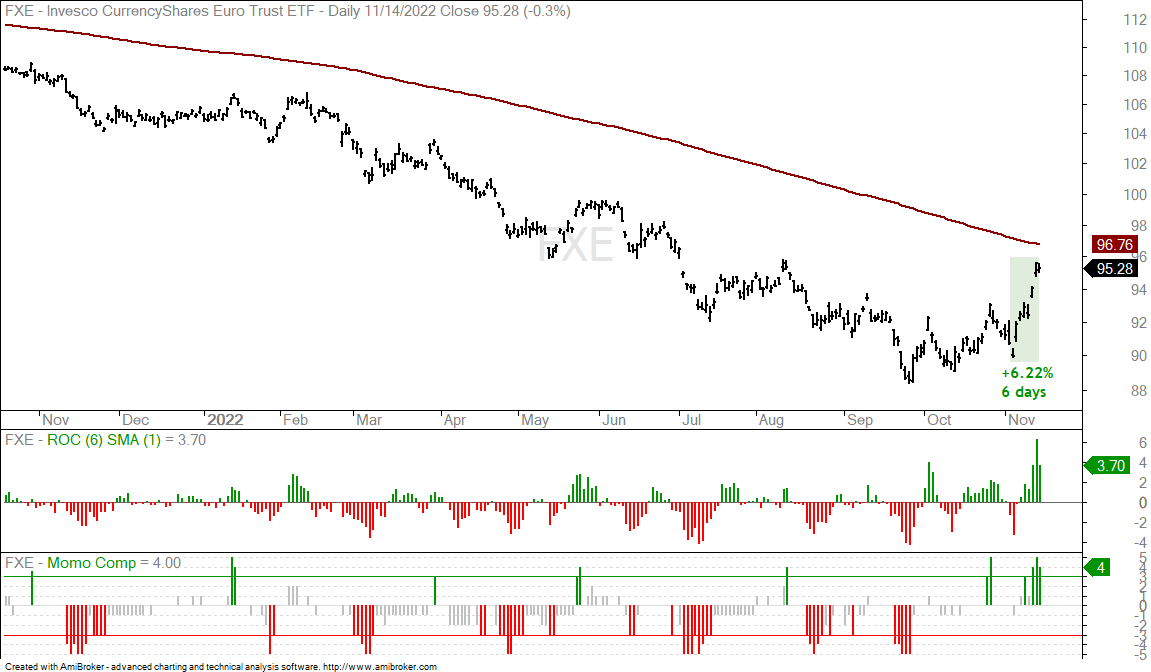
The macro picture is driving the markets right now and last week’s reaction to lower-than-expected inflation highlights the key relationships. The Euro surged, the Dollar plunged, the 20+ Yr Treasury Bond ETF (TLT) advanced, the 10-yr Treasury Yield fell, stocks surged and metals surge. Not all commodities surge because energy and agriculture were noticeably absent. The first chart shows the Euro ETF (FXE) surging towards the falling 200-day SMA. FXE was up 6.22% in six days and this is the biggest six-day advance since March 2009! Even so, the Euro remains in a downtrend and below the falling 200-day SMA. The Momentum Composite is also overbought. As with SPY, the Euro is overbought within a bigger downtrend.
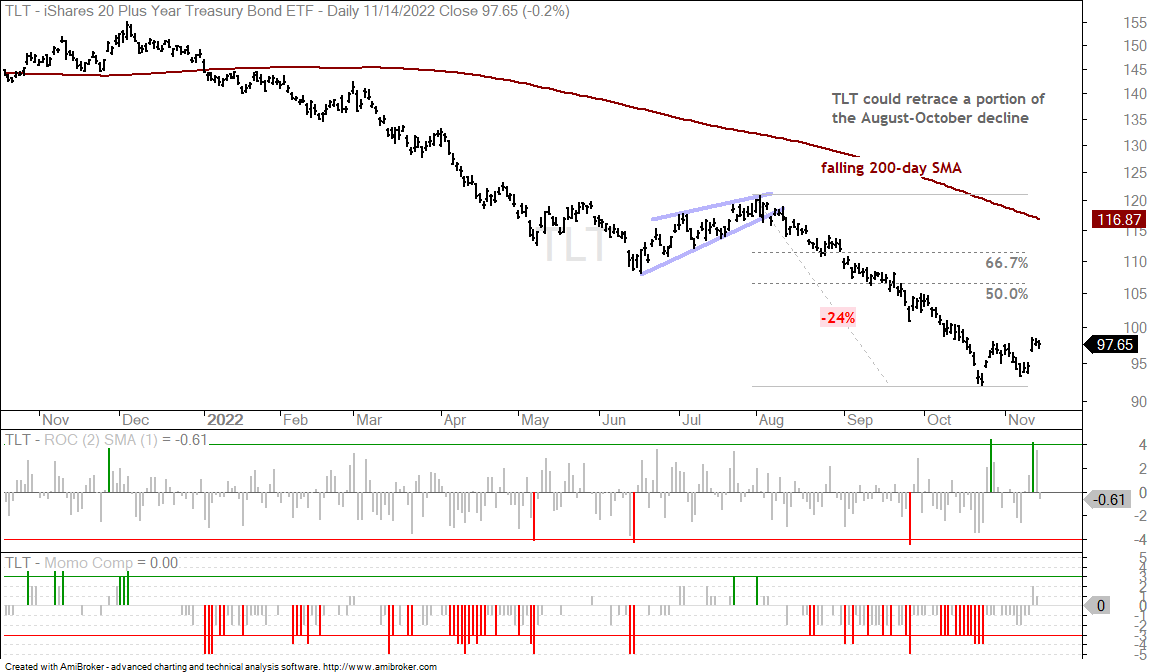
The 20+ Yr Treasury Bond ETF (TLT) surged 4% in two days and this was the second 2-day 4+ percent surge since mid October. The indicator window shows the 2-day Rate-of-Change exceeding 4% (green lines) twice. These strong moves could lead to a counter-trend bounce that retraces a portion of the August-October decline. Note that TLT is still in a downtrend and well below the falling 200-day SMA.
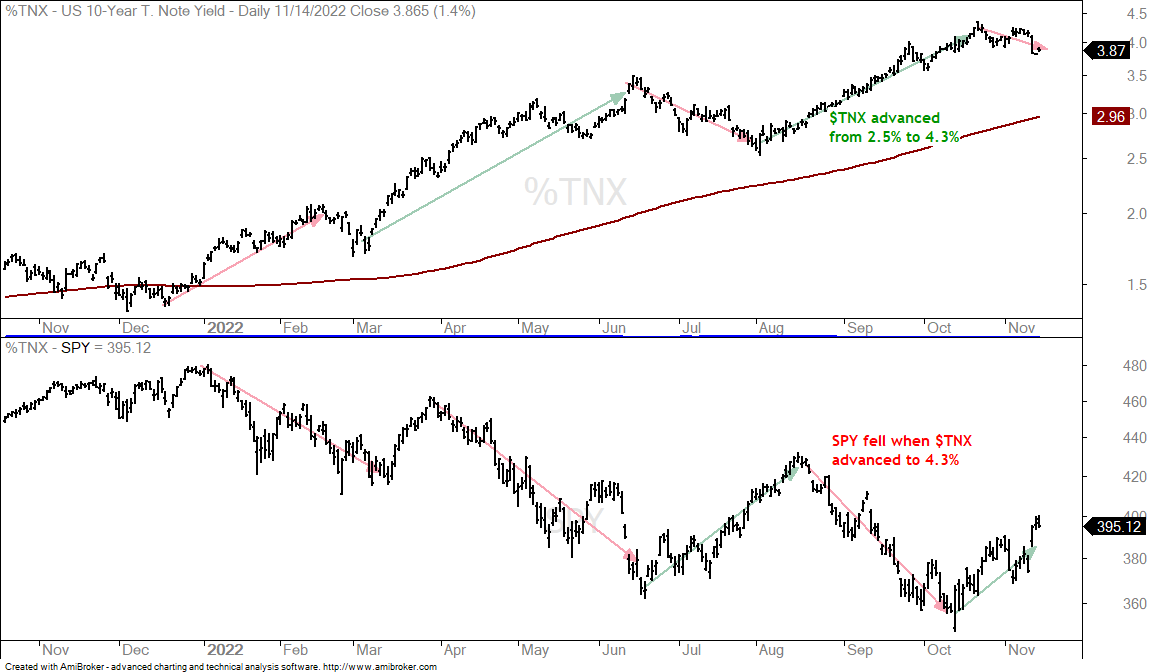
The stock market has been positively correlated with the bond market in 2022, which means negatively correlated to the 10-yr Treasury Yield. A negative correlation means they move in opposite directions. The chart below shows the swings in the 10-yr Treasury Yield and the S&P 500 SPDR with the red and green arrows. Most recently, the 10-yr yield surged from 2.5% to 4.3% (August to October) and SPY fell to new lows. The 10-yr yield is currently pulling back from its high and an extended correction back to the rising 200-day could be positive for SPY.
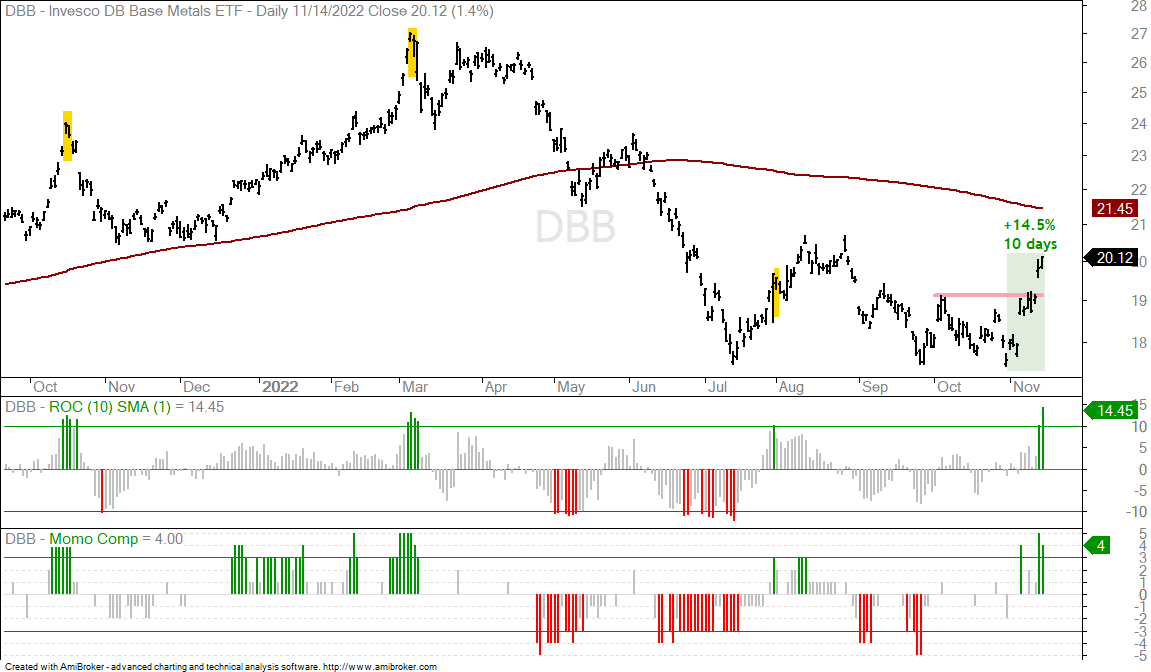
The DB Base Metals ETF (DBB) participated in the macro move with a 14.5% surge in ten days. The ETF broke above the October highs and is challenging the August highs. Note that DBB is still well below the falling 200-day SMA and this is the third 10% surge since October 2021. The yellow shading shows DBB peaking with the October 2021 surge and the March 2022 surge. DBB extended higher after the August 2022 surge and then fell back to the July lows. DBB is currently overbought and below its 200-day SMA.
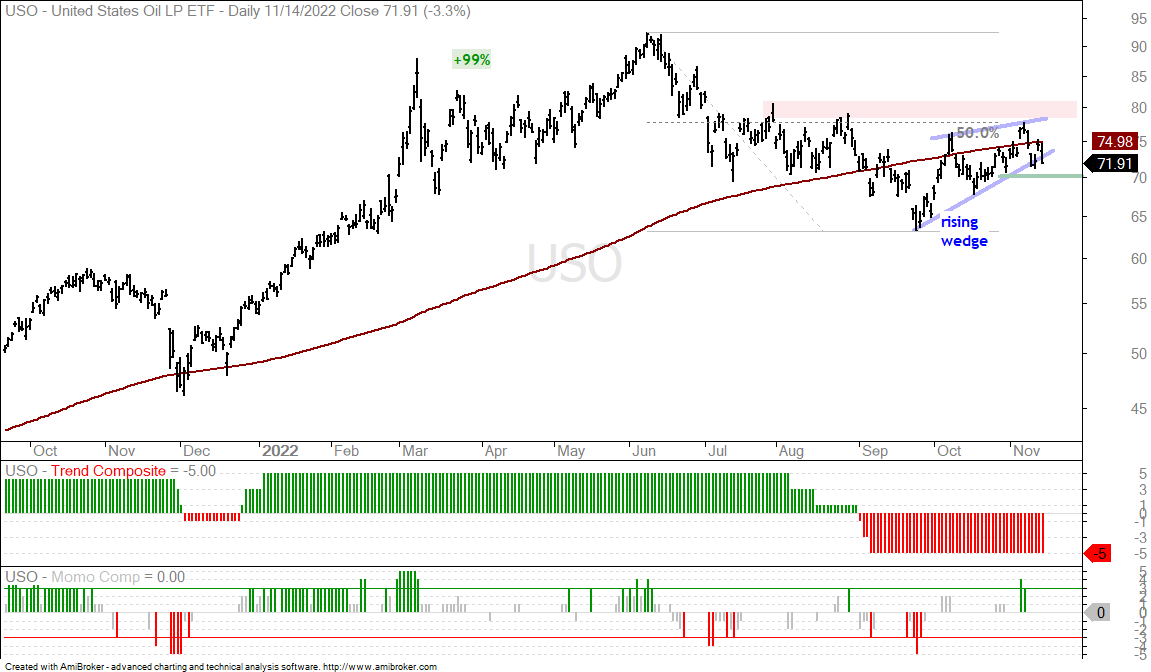
The US Oil Fund (USO) is conspicuously absent from this macro move. Oil is down 6.39% over the last six days and unchanged over the last ten days. The chart below shows USO hitting resistance from the July-August highs (red shading). A rising wedge is taking shape the last two months and the bulls have the edge as long as the wedge rises. Support is set at 70 and a break here would be bearish for oil.
You can learn more about exit strategies in this post [3],
which includes a video and charting options for everyone.
IBB Challenges August High (IBB, XBI)
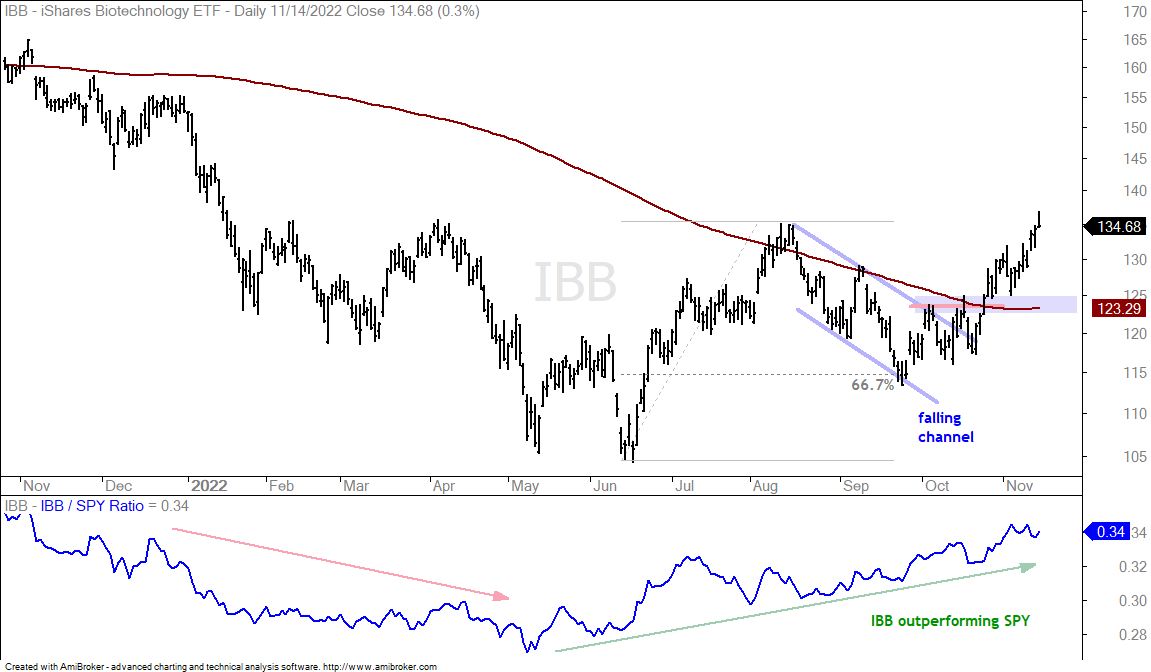
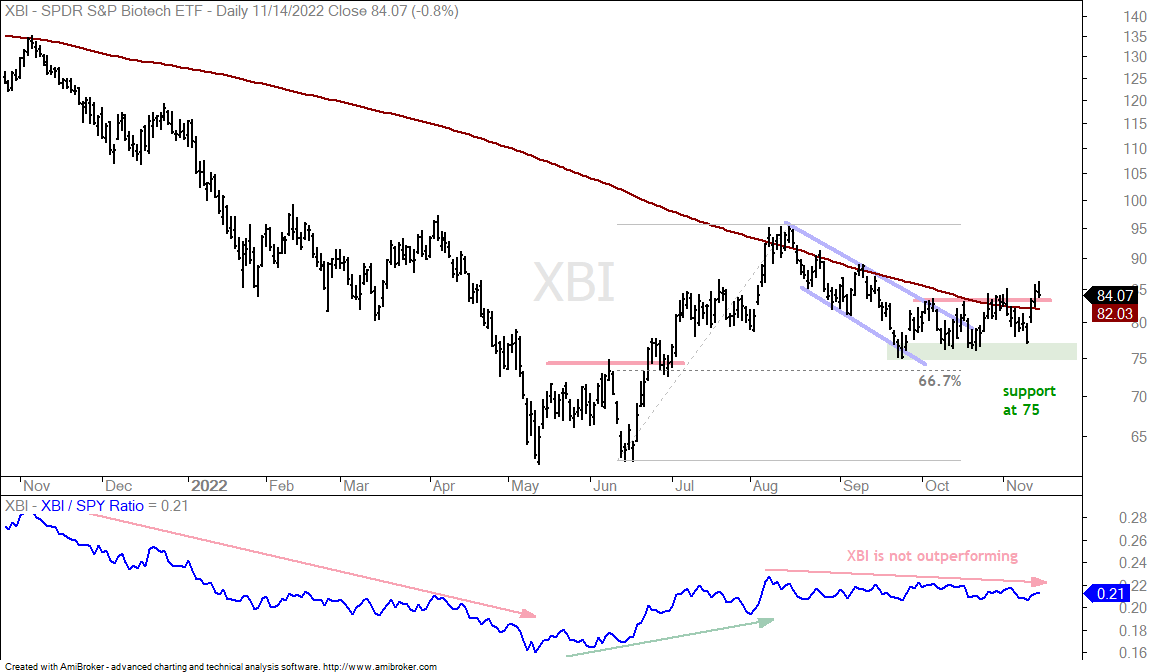
The Biotech ETF (IBB) continues to outperform its small-cap brother (XBI) and is also outperforming the broader market. The chart below shows IBB with the classic surge (mid-June to mid-August), falling channel that retraced 2/3 and a breakout in late October. IBB held well above the summer lows when SPY was hitting new lows. IBB has been above its 200-day SMA since October 25th and the price-relative (IBB:SPY ratio) in the bottom window has been rising since May. The blue shading marks support from broken resistance and an area to watch should we get a pullback.
The Trend Composite aggregates signals in five trend indicators: Bollinger Bands (125,1), Keltner Channels (125,2), 5-day Rate-of-Change of 125-day SMA, StochClose (125,5) and CCI-Close (125). The Trend Composite and ten other indicators are part of the TIP Indicator Edge Plugin for StockCharts ACP [4]
Water Resources ETF hits New Relative High (PHO)
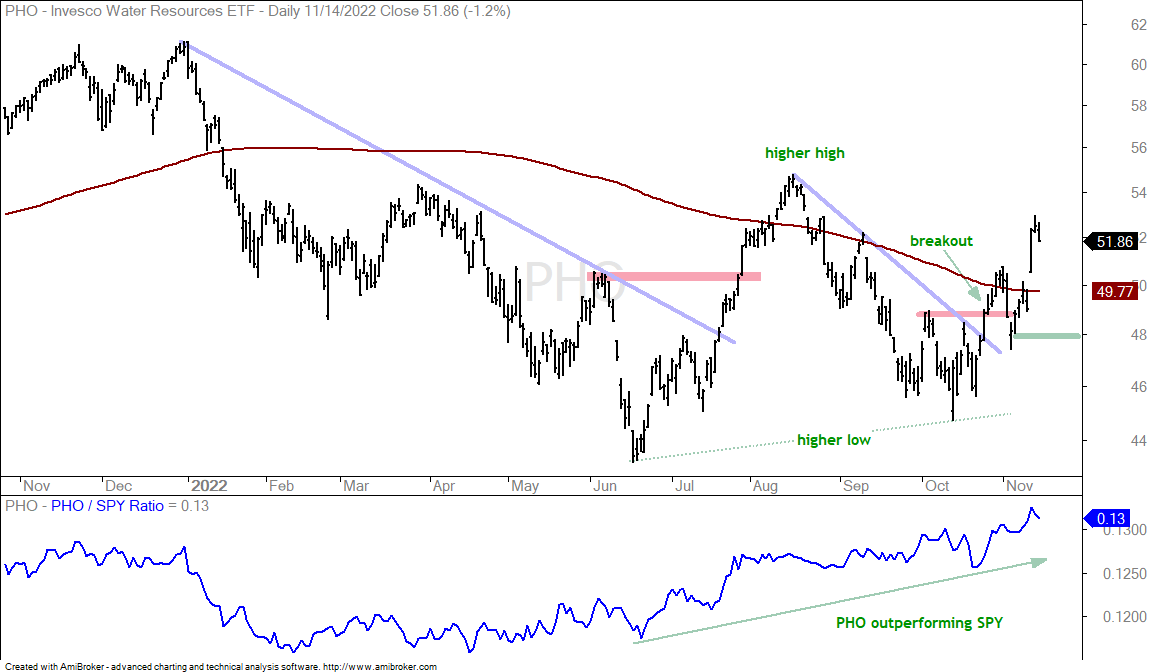
The Water Resources ETF (PHO) showed relative strength because it formed a higher low when SPY was recording lower lows (October). The ETF continues to lead because the price-relative (PHO:SPY ratio) hit a new high last week. On the price chart, PHO broke out with a surge in late October, fell with the market in early November and surged with the market the last three days. The green line marks support at 48 and a close below this level would warrant a re-evaluation.
Clean Energy ETFs Catch a Bid (TAN, ACES, QCLN)
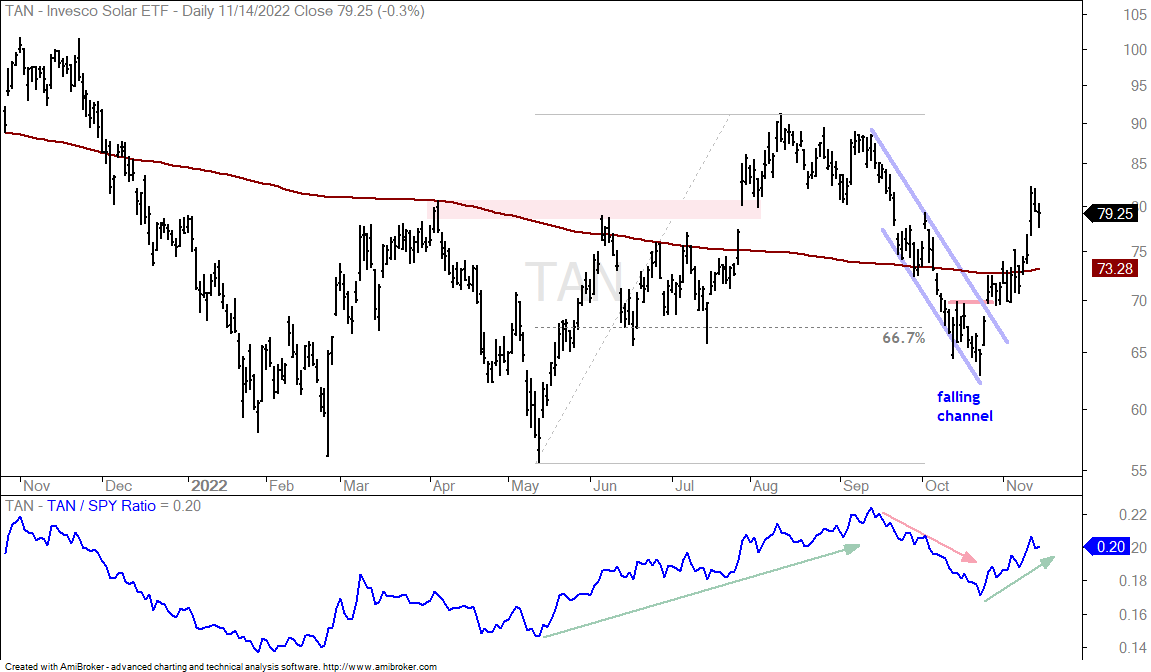
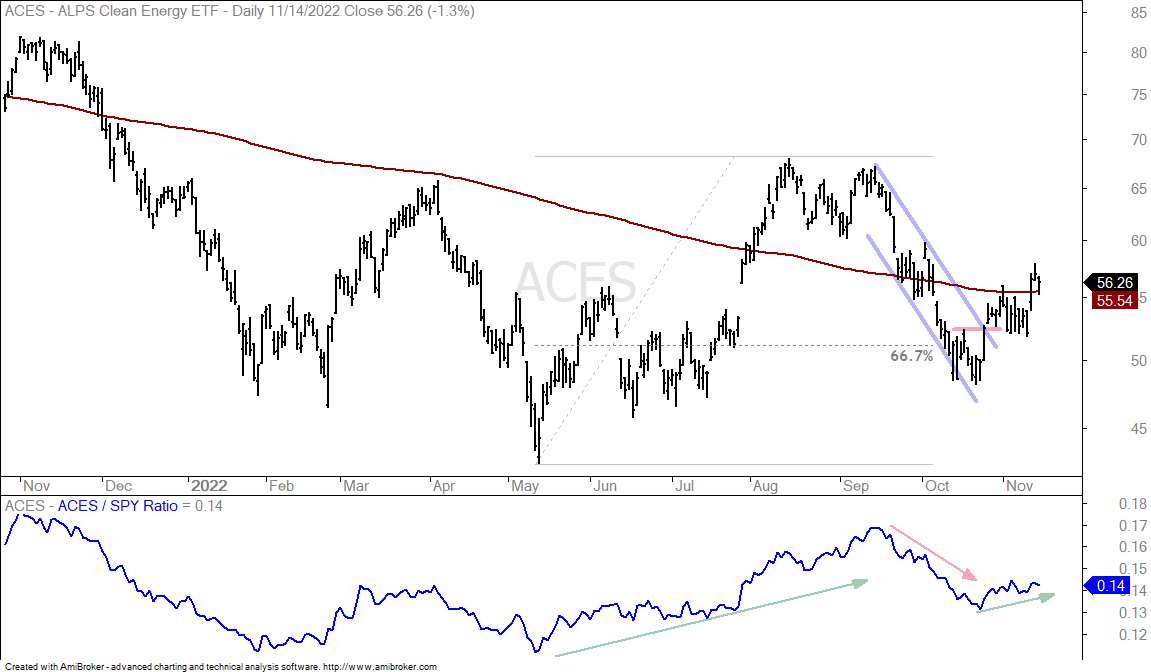
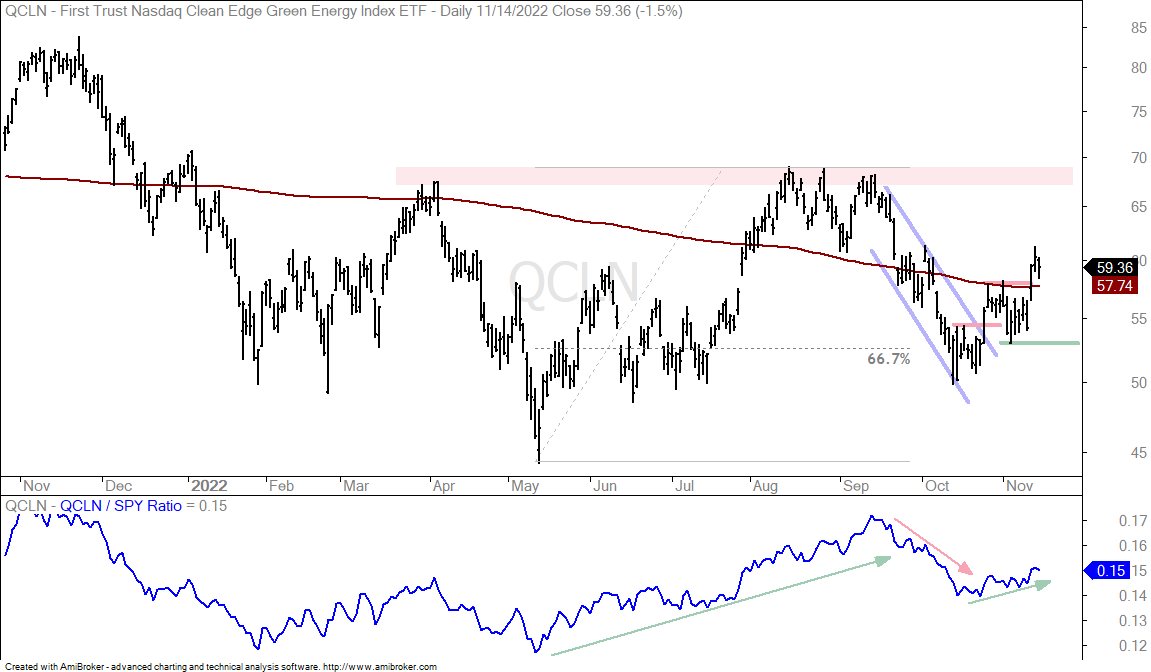
The clean energy ETFs were hit hard from mid September to mid October, but held their summer lows and turned up the last five weeks. The Solar Energy ETF (TAN) is leading the group with an 18.5% gain the last 23 days. The chart below shows TAN breaking the March highs with a surge in late July, retracing just over 2/3 of the May-August advance with a decline into October and breaking out of a falling channel in late October. This channel looks like a normal correction after a big advance and the breakout signals a continuation higher. The indicator window shows the TAN:SPY ratio with periods of outperformance (green arrow) and underperformance (red arrow). This ratio turned up the last five weeks and TAN is again outperforming. TAN is a bit extended short-term and could be vulnerable to a pullback or consolidation.
Previous Reports
- Thursday, November 10th (here [5])
- SPY with Short-term Support Break
- IWM Reversing at Falling 200-day
- Big Stocks Leading Nasdaq 100 Lower (QQQ)
- Broad Weakness within the Tech Sector (SOXX, IGN)
- Home Construction ETF Forms Bearish Triangle (ITB)
- The Bearish Alternative for the US Oil Fund (USO)
- Energy ETFs Leading, But Quite Extended (XLE, FCG, XOP)
- Breakouts in Copper and Copper Miners (CPER, COPX)
- Silver Leads Gold with Breakout (SLV, GLD)
- Platinum Leads Metals with Double Bottom Breakout (PLTM)
- Palladium ETF Firms within Short-term Downtrend (PALL)
- Previous Commentary and Video
You can learn more about my chart strategy in this article [2] covering the different timeframes, chart settings, StochClose, RSI and StochRSI.

